
Our Work
Steel
Steel is a fundamental building block of modern society used in consumer goods, buildings, and energy and transport infrastructure that support mature and emerging economies. However, most primary steel production still relies on coal or coke-based blast furnaces, making the steel sector the leading industrial contributor to greenhouse gas (GHG) emissions, accounting for about 8% of global CO2 emissions. For most applications, steel has no direct substitute, making realistic strategies reduce the industry’s emissions while maintaining production and material standards to meet demand all the more urgent.
Steel by the numbers
95%
Global primary steel production based on the highly carbon-intensive blast furnace route using coal.
7-9%
Global CO2 emissions from steel production.
2.6 gigatonnes
Estimated yearly global demand for steel by 2050.

Why address emissions from steel?
- Global demand for steel is increasing. As the leading industrial contributor to greenhouse gas emissions, decarbonizing the steel sector is critical.
- In addition to greenhouse gases, coke ovens and steel plants release a range of other pollutants with negative health and environmental impacts, including ground-level ozone, particulate matter, carbon monoxide, lead, sulfur dioxide, and nitrogen dioxide.
Solutions
Decarbonizing steel presents significant challenges. In the U.S. and in Europe, where the steel industry is mature, a key hurdle will be replacing emission-intensive blast furnaces with direct reduced iron (DRI) — where natural gas or hydrogen is used in place of coal — or other lower-carbon processes. Decarbonization pathways can vary in cost and feasibility depending on local clean energy availability, workforce impacts, and infrastructure development, making regionally tailored approaches essential to success.
With proper incentives and policy support, these decarbonization solutions could be transformative:
- Low-carbon hydrogen
- Carbon capture and storage
- Innovative steelmaking technologies, such as electrified reduction and smelting, electrowinning, laser smelting, and chemical reduction pathways

Our work
CATF is active on steel decarbonization in Europe and U.S., both regions with mature steel industries and the potential to be first movers in the steel decarbonization space.
Education and thought leadership
- Develop analytical frameworks that clarify technology pathways and interactions, tradeoffs and total system benefits for steel decarbonization, including co-pollutant reductions and innovation gains.
- Communicate the full value of clean industry to audiences ranging from local communities to policymakers.
Coalition building
- Engage policymakers, funders, industry, and civil society around sector-level and inter-sector solutions.
- Build regional coalitions around clean industry clusters to create local demand for decarbonization and reduce infrastructure costs through co-location.
Policy innovation
- Design policy approaches that unlock investment, infrastructure, and coordinated deployment.
- Develop demand-side and supply-side market mechanisms that create the market signals needed for bankable clean industrial projects.
Direct advocacy
- Advance regulatory and market reforms that enable steel decarbonization at scale.
- Collaborate with stakeholders across the iron and steel value chain to understand and remove barriers to decarbonization project deployment.





Forging Demand for Low-Carbon Steel in the Industrial Accelerator Act
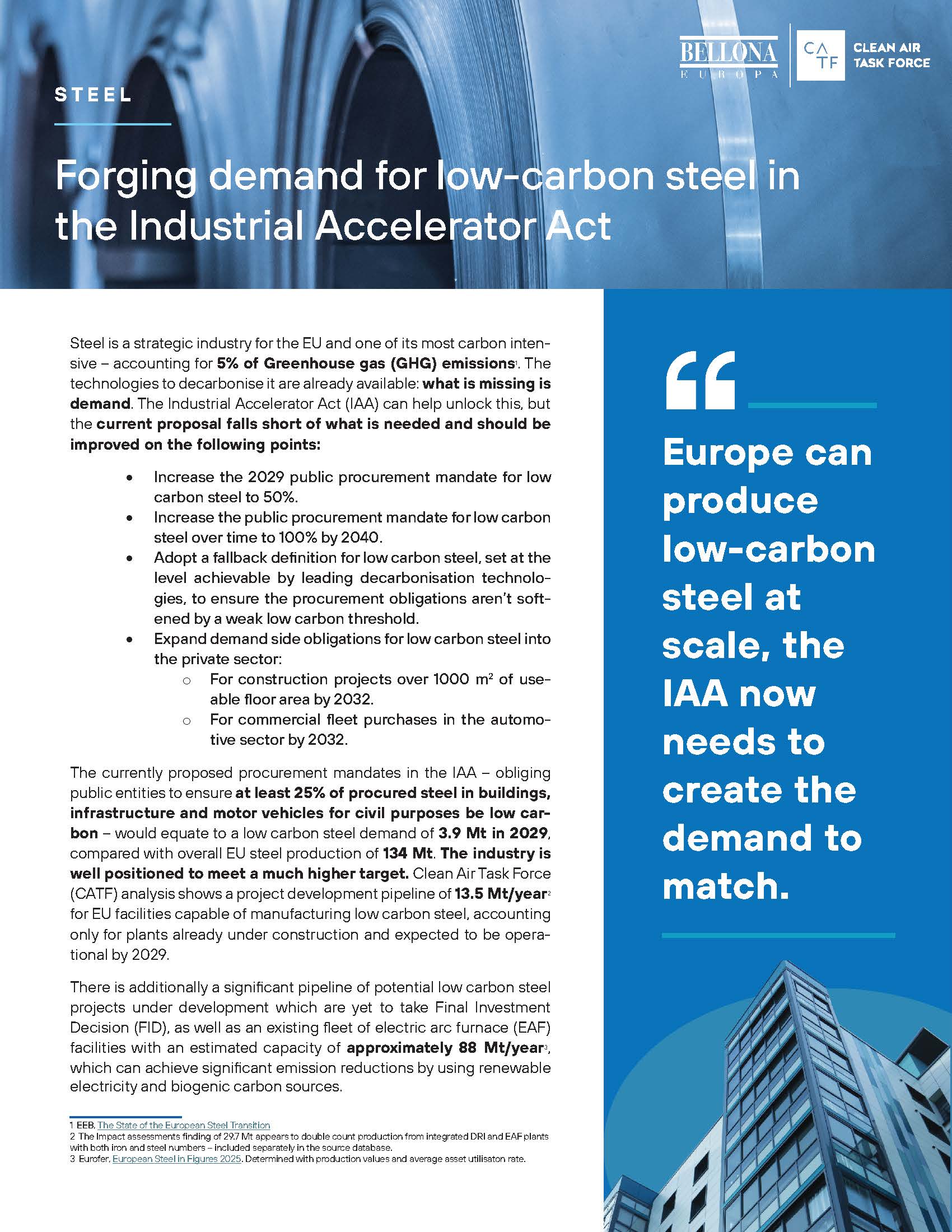
Steel is a strategic industry for the EU and one of its most carbon intensive – accounting for 5% of greenhouse gas emissions. The technologies to decarbonise it are already available: what is missing is demand. The Industrial Accelerator Act (IAA) can help unlock this, but the current proposal falls short of what is needed and should be improved on.
Strengthening Lead Markets in the Industrial Accelerator Act
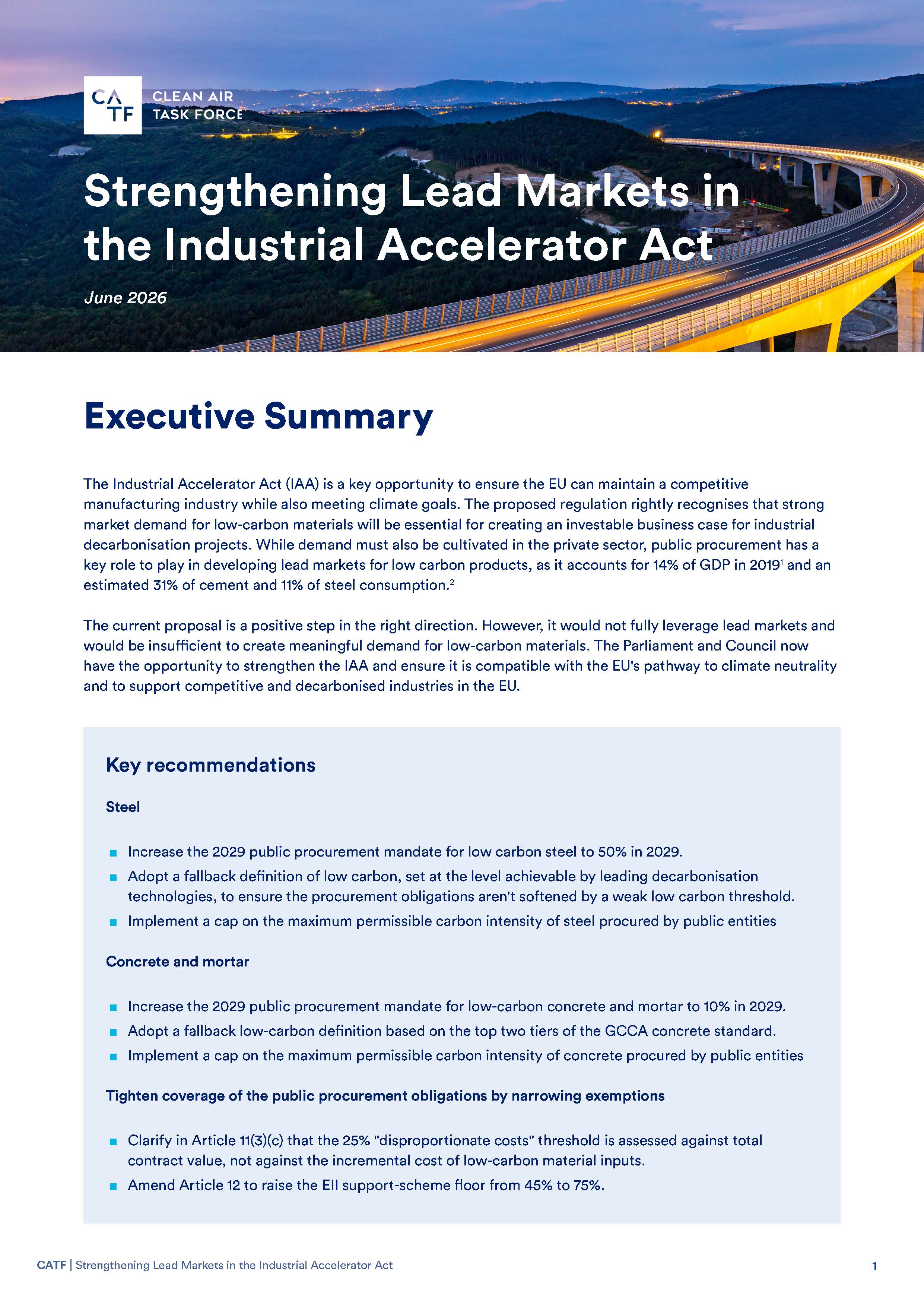
The Industrial Accelerator Act (IAA) is a key opportunity to ensure the EU can maintain a competitive manufacturing industry while also meeting climate goals. The proposed regulation rightly recognises that strong market demand for low-carbon materials will be essential for creating an investable business case for industrial decarbonisation projects.
Decarbonization Pathways and Policy Recommendations for the United States Steel Sector
Steel production is a significant greenhouse gas emitter, responsible for 2% of U.S. greenhouse gas emissions, and 8% of global GHG emissions. To meet climate change targets, the global steel industry must undergo significant decarbonization.
With decarbonization adding significant cost to the production process for a relatively low-cost, low-margin commodity material, some form of policy support will be necessary to provide additional incentives for decarbonization.
Related resources
Interactive Maps
Early-stage carbon capture project maps
CATF has built interactive maps that track carbon capture and storage projects that have been publicly announced in the U.S., Europe, and the Middle East and North Africa (MENA). Click on the colored circles on each map to learn about each project’s location, sector (industrial, power, or direct air capture), type of carbon dioxide storage (EOR or saline), storage capacity, and current status.
The map also shows the vast expanse of potential geologic saline storage formations around each country.

Stay in the know
Sign up to receive updates on the latest in industrial innovation
"*" indicates required fields
