
Critical Chemicals Alliance – Critical molecules and sites: CATF’s review
The Critical Chemicals Alliance (CCA) was established by the European Commission in late 2025 to address the growing challenges facing the EU chemicals sector. The Alliance has brought together the chemicals industry, trade and industry associations, investors, academia and civil society groups. CATF has been actively involved with three of the CCA’s four working groups – Critical Molecules and Critical Production Sites (WG1), Modernisation and Investments (WG3), and Lead Markets (WG4). The final deliverables from the working groups were produced in September 2026 and approved at a General Assembly that took place on 8th October 2026, with some dissenting opinions. In this commentary, CATF shares its assessment of the outcomes from Working Group 1.
CATF notes the ambition and challenge of identifying critical molecules and production sites in a sector as complex and interconnected as EU chemicals and recognises the contributions of all stakeholders involved, while also highlighting the limitations of the results. In this commentary, CATF shares its assessment of the outcomes from Working Group 1 and makes recommendations for the next steps for the CCA and the European Commission.
The methodology for critical molecules and production sites
Working Group 1 (WG1) of the Critical Chemicals Alliance (CCA) was tasked with developing a methodology to identify molecules and production sites that are critical to the functioning of Europe’s economy, strategic autonomy and industrial resilience. Critical molecules are set to benefit from enhanced monitoring under the Customs Surveillance System, and critical sites are to receive targeted support to modernise facilities at risk of closure and to enable their decarbonisation, in compliance with State aid rules, where applicable. A list used for monitoring can afford to be broad since monitoring is easily reversible and low-cost whereas a list that determines eligibility for financial support needs to be much more stringent.
The methodology sets out to identify critical molecules based on assessments of both the vulnerability of their production in the EU and how essential the molecule is to strategic sectors or wider value chains. The vulnerability assessment considered reliance on imports, logistics constraints, and exposure to competitive pressure.
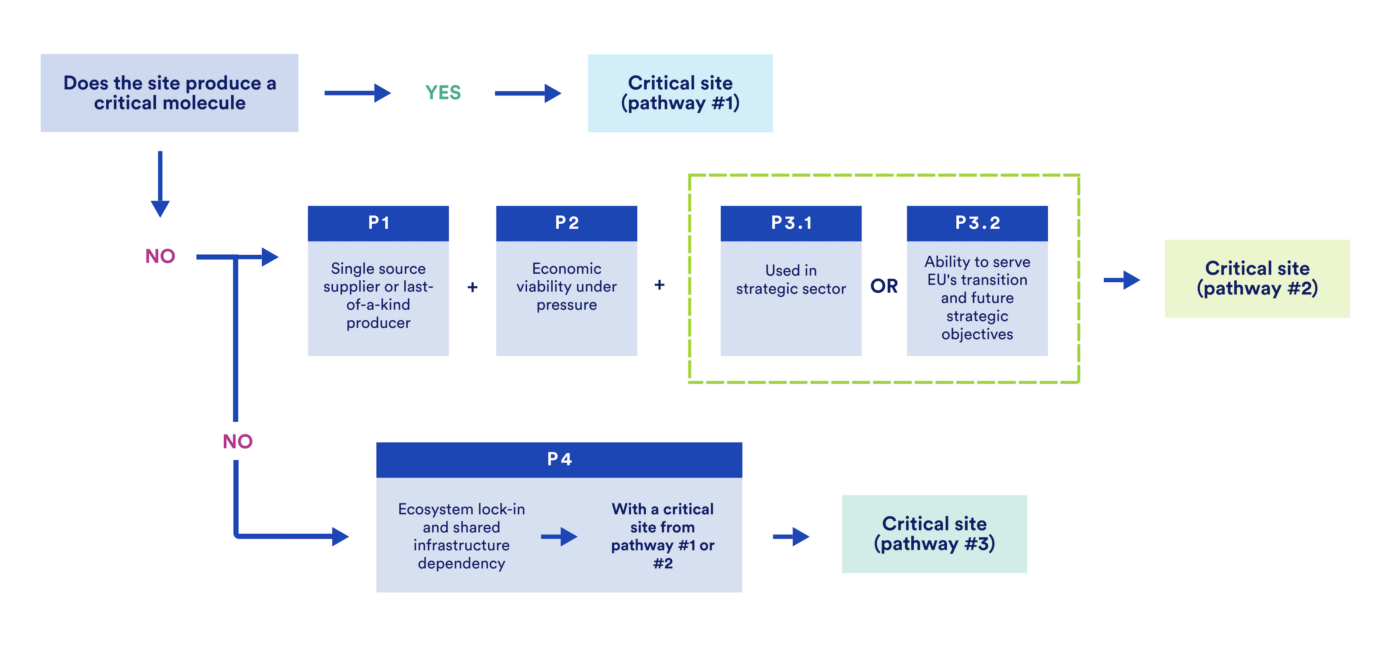
The working group sought to refine and simplify the original methodology relying on the expertise of its participants.1 However, the molecule methodology remains demanding to apply, requiring substantial collection and interpretation of trade, production, site, energy, carbon-cost, and value-chain data for each molecule. The site methodology, by contrast, was simplified substantially, and importantly allows a site whose main production is a critical molecule to qualify automatically as a critical site – a measure to which CATF objected. Other pathways for designation as a critical site are shown in Figure 1.
Figure 1. Pathways for determining a critical site, as identified by Working Group 1.
Critical molecules: a sound framework whose results need validation
WG1 has delivered an important first step: a common EU-wide methodology and an initial list of critical molecules on which the Commission can build, which is transparent and broadly endorsed by participants.
As with any rule-based methodology, some results depend heavily on the proxies chosen which could risk miscategorising molecules.
One potential pathway for miscategorisation relies on the inadequate selection of proxies for certain criteria such as relying on a molecule’s classification as a dangerous good under the ADR/RID dangerous-goods transport rules to assess the molecule’s logistical challenges.2 Methanol, for instance, falls under this classification due to its hazardous properties and associated safety and handling requirements, thereby contributing to its designation as a critical molecule. However, Europe already imports most of the methanol it consumes, demonstrating that its hazardous classification does not necessarily translate into significant logistical constraints or supply vulnerability.3
Another potential pathway for miscategorising molecules arises where molecules have been ommited from the assessment altogether. The Working Group is clear that the initial list of molecules tested is not comprehensive or exhaustive, as it is based on a calibration exercise covering 70 molecules – a sample the report notes was inherently biased toward molecules likely to pass. Nonetheless, several important candidates were not included in the initial testing universe and should be assessed as a priority: nitric acid, urea, MDI/TDI, carbon black, hydrogen peroxide, acrylonitrile and nitrocellulose.4
Another observation is the qualification of hexamethylenediamine (HMD) as critical, but not adipic acid, which raises a question of value-chain consistency. Adipic acid is the co-monomer with HMD in the production of nylon-6,6, an important engineering polymer used in automotive and other industrial applications. This does not necessarily mean adipic acid should be classified as critical, but it illustrates the need for value-chain consistency checks.
Finally, coverage is weakest for downstream and specialty chemicals, where CN8 trade codes5 often group chemically or commercially distinct products together and captive production is poorly captured by trade statistics. As the report itself acknowledges, this creates a bias toward commodity and platform chemicals.
These limitations reinforce the view of some members of the Working Group to treat the methodology as a screening tool rather than a decision-making mechanism. Consistent with WG1’s own recommendations, the second-stage validation should therefore include Commission-led implementation, expert review to identify outliers and inconsistencies, and case-by-case assessments, drawing on the knowledge of experts that cannot be simply codified or captured in a methodology.6
Critical sites – does automatic designation cast too wide a net?
At site level, the implications of the selection methodology become more significant: under Pathway 1, a site whose main production is a critical molecule automatically qualifies as a critical site. The molecule list already contains most of the building blocks of Europe’s energy-intensive chemical base, including ethylene, propylene, butadiene, benzene, toluene and xylenes (BTX), chlorine, caustic soda, ammonia, methanol and several major first-tier derivatives. As a result, most EU steam crackers, chlor-alkali plants and ammonia plants could qualify through Pathway 1, with the eligibility of interdependent sites (Pathway 3) extending the perimeter even further within integrated clusters.
This broad route for site criticality risks diluting the purpose of critical-site designation: identifying the relatively limited set of assets whose loss would have disproportionate and hard-to-reverse consequences. WG1 recognises this tension: of 70 members polled, 53% supported automatic designation and 39% opposed it, and the report calls for this feature to be reviewed after a few applications.7 CATF did not support including this measure and suggested further criteria that consider the number of remaining operating sites producing the critical molecule, the site’s contribution to overall EU production of the critical molecule in question and the downstream dependency on the site. It is difficult to justify, for instance, the labelling of all 30 EU ammonia production facilities as equally critical. Average plant utilisation is below 70%, while 26 out of 30 production sites individually account for less than 5% of EU ammonia production capacity. WG1 acknowledges that criticality should ultimately relate to the volume the EU needs to preserve, yet automatic site designation assigns critical status irrespective of an individual site’s contribution to that volume.
The open question of refineries
In a recent report on Europe’s petrochemical sector, CATF showed that in the EU over 20 refineries produce aromatics (BTX) and propylene; all of which are listed as critical molecules. Refineries are also an important source of recovered elemental sulphur through fuel desulphurisation, alongside sulphur recovered from natural-gas processing. Finally, refineries and steam crackers are co-located at 15 sites, illustrating how closely refining and petrochemical production are integrated in parts of the EU. Despite this, the framework does not clearly resolve how refinery-integrated chemical production should be treated.
While a refinery’s main products are fuels, WG1 defines critical sites as chemical plants, i.e., single production units. A refinery’s aromatics extraction unit or propylene splitter, whose main production is a critical molecule, could therefore qualify directly under Pathway 1, and other units could follow through the lock-in and interdependency pathway (Pathway 3). The framework should therefore state clearly where the assessment boundary lies.
What designation unlocks, and why prioritisation matters
The stakes are high, as WG1 recommends a package of measures for critical sites including energy cost relief, adjustments to ETS benchmarks, no further reduction of free ETS allowance allocation in 2026-2030, continued free allowances for all chemical sites after 2038, and CAPEX and OPEX support.8
Taken together with the relatively low bar for critical site status, annual updates and an eight-year minimum designation period, this package risks creating an expectation of durable support across a very broad share of Europe’s existing emissions-intensive asset base. Limited public funding spread too thin across many sites is unlikely to drive either modernisation or decarbonisation due to the capital intensity of decarbonisation projects; a sentiment echoed by some members of Working Group 1. Therefore, an additional prioritisation step is required to make limited funding more effective in transforming and supporting a limited number of truly critical sites. Ultimately, support for critical sites should be focused not only on criticality, but the potential of each site to decarbonise effectively. Moreover, support for the identified sites should be limited and proportional to the goal they aim to achieve. Some of the measures considered, such as continued free allowances in the ETS, would damage decarbonisation ambition unless they are associated with clear and time-bound commitments to decarbonise.
Recommendations
- Publish the rationale for inclusion for every molecule assessed, including those that did not qualify, and publish the criteria that drove the result with a short plain-language rationale. The expert consultation which WG1 already proposes to examine outliers should be used to validate each selection, especially where a single proxy such as logistics drives the outcome.
- Complete the assessment. Prioritise testing of nitric acid, urea, MDI/TDI, carbon black, hydrogen peroxide, acrylonitrile and nitrocellulose, and re-examine notable failed cases such as adipic acid.
- Define critical volumes before attaching support. As WG1 itself recommends, determine how much EU capacity is needed for each critical molecule and target support at maintaining that capability rather than automatically supporting every site producing it.
- Restore the distinction between monitoring and support. Use the molecule list broadly for monitoring and customs surveillance, but subject critical sites to a separate and more selective assessment of number of remaining sites, share of EU production, downstream dependency, closure risk and decarbonisation potential.
- Clarify how criticality applies to integrated assets and co-products. Define how the methodology applies to refinery-integrated chemical units and other integrated sites, and how co-produced molecules are treated.
- Clarify how criticality applies to overlapping EU frameworks such as the Critical Raw Materials Act, the proposed Critical Medicines Act and REACH restrictions.
- Tie site-specific support to decarbonisation. Make operating support, energy cost relief and ETS relief conditional on credible, time-bound decarbonization plans, while prioritising investment that materially transforms production through electrification, low-carbon hydrogen, carbon capture, or first-of-a-kind low-carbon production routes.
Footnotes
- Core members of Working Group 1 adopted the PWC/CEFIC study as the basis for its methodology. Two other methodologies, including one by Advancy on behalf of France Chimie and another by Chemelot, were reviewed by the core members but were eventually not adopted.
- ADR (Accord européen relatif au transport international des marchandises Dangereuses par Route) and RID (Règlement concernant le transport international ferroviaire de marchandises Dangereuses) establish requirements for the classification, handling and transport of dangerous goods. Both frameworks are harmonised with the United Nations Recommendations on the Transport of Dangerous Goods.
- Some WG1 members also noted that methanol and anhydrous ammonia may be false positives under this proxy because the UN classification can reflect toxicity and hazard more than the economic practicality of importing the product.
- These molecules warrant further assessment given their strategic importance to European industry and, in several cases, their exposure to high energy costs and/or international competition. Nitric acid and urea are key inputs to fertiliser production; MDI (methylene diphenyl diisocyanate) and TDI (toluene diisocyanate) are precursors for polyurethane production; carbon black is widely used in tyres and other rubber products; hydrogen peroxide is used in chemical processing, pulp and paper; acrylonitrile is an important precursor for synthetic fibres, plastics and resins; and nitrocellulose is used in coatings, inks and propellants.
- CN8 refers to the EU’s eight-digit Combined Nomenclature product classification used for customs and trade statistics.
- The number of false positives or outliers may ultimately be small, but this can only be determined in hindsight through expert review of the results. Second-stage validation should therefore be targeted at anomalous or uncertain cases, rather than requiring a full reassessment of every molecule.
- WG1 explicitly notes that critical status should not be treated as an automatic entitlement to support, which makes a separate prioritisation step especially important and necessary to define.
- France does not endorse OPEX support, while Spain, the Netherlands and IndustriAll Europe do not endorse the proposed ETS adjustments
Credits

