
Our Work
Fusion Energy
The potential for zero-carbon,
abundant energy
Fusion is an advanced energy source with the potential to produce abundant, zero-emissions power around the world. Paving the way for fusion commercialization could allow us to integrate this carbon-free, firm source into the energy mix, and transform how we power the global economy.

The latest on fusion energy








Related resources
Our vision
A world where fusion energy has a clear path to commercialization, enabling a transformed global energy system that dramatically reduces greenhouse gas emissions.
Clean Air Task Force plays the critical role of catalyst and coordinator to find existing gaps in the industrialization and regulatory process and to set up and lead strategies to fill those gaps.
We aim to create a network that facilitates international collaboration and early commercial connections to increase technology readiness and prepare the reference schemes and regulatory frameworks needed to commercialize fusion energy. We engage in policy advocacy and interface with public communications efforts to propose solutions, add new tools, and contribute to the development of a global fusion industry.

Fusion Energy Policy
- Support elected officials on policy formation
- Advise regulators
- Monitor alternate fusion approaches
- Describe new and existing rule sets for neutron management
- Inform national and regional fusion strategies
- Inform policies to align global safety and regulatory frameworks and accelerate commercial deployment
De-Risking Strategies
- Align global safety requirements
- Create materials catalogue to identify common challenges
- Provide generic techno-economic cost analysis
- Create tools for risk assessment
- Identify and mitigate the uncertainties in the deployment of fusion
Supply Chain Development
- Produce universal catalogue of material needs
- Maintain technology-agnostic view on workforce needs
- Evaluate technology enablers such as AI, HPC
- Codes and standards development
- Identify priority materials for supply chain security
- Workforce development
- Inform reference tools to be able to integrate fusion into the net-zero energy mix
Awareness
- Increase fusion’s visibility in the energy sector
- Articulate fusion’s role in the marketplace
- Support national, regional, and international fusion commercialization efforts
- Demonstrate progress and set expectations for fusion expansion
- Position fusion as “clean tech” and as part of the net-zero solution
What we’re working on
CATF acts as an honest broker in supporting and assessing the commercial deployment of fusion energy as an affordable, clean energy source — convening world-class experts, regulators, economists, and industry stakeholders across four international working groups.
Fusion energy policy
CATF is working to establish the regulatory and market conditions needed to enable commercial deployment of fusion energy in the electricity sector. This includes shaping policies on non-proliferation and export controls, advancing coal-to-fusion repowering as a pathway to accelerate deployment while supporting host communities, and strengthening critical mineral supply chains for the sector. CATF is also engaging internationally to align safety standards, regulatory approaches, and investment priorities across North America, the UK, and Europe. Together, these efforts aim to remove key barriers and supporting the global scale-up of fusion energy.
De-risking strategies
We develop guidance and tools to reduce uncertainty around first-of-a–kind fusion deployment. This includes helping developers and regulators navigate fragmented safety and regulatory frameworks that can hinder investment and technology transfer. CATF is also working across jurisdictions to align approaches and integrate emerging tools, including AI, to streamline compliance and lower risk. Together, these efforts aim to improve the overall investment and deployment outlook for fusion energy.
Supply chain development
We’re building the tools and frameworks needed to integrate fusion into the global energy economy. This includes advancing fuel supply chains, such as fusion-grade lithium and Li-6 production, while addressing export control considerations. CATF is also developing codes and standards to provide regulatory clarity and support confident plant design and licensing, alongside feasibility analyses that strengthen the economic case for fusion. In parallel, the organization is supporting workforce development to ensure the talent and institutional capacity needed for long-term industry growth.
Advocacy and awareness
CATF is working to position fusion as a credible component of the global clean energy mix. This incudes building a strong evidence base through independent analysis that informs policymakers, investors, and the public. CATF also convenes industry, government, and civil society to elevate fusion’s profile and support its inclusion in national and international energy planning.
Commercialization tools and databases
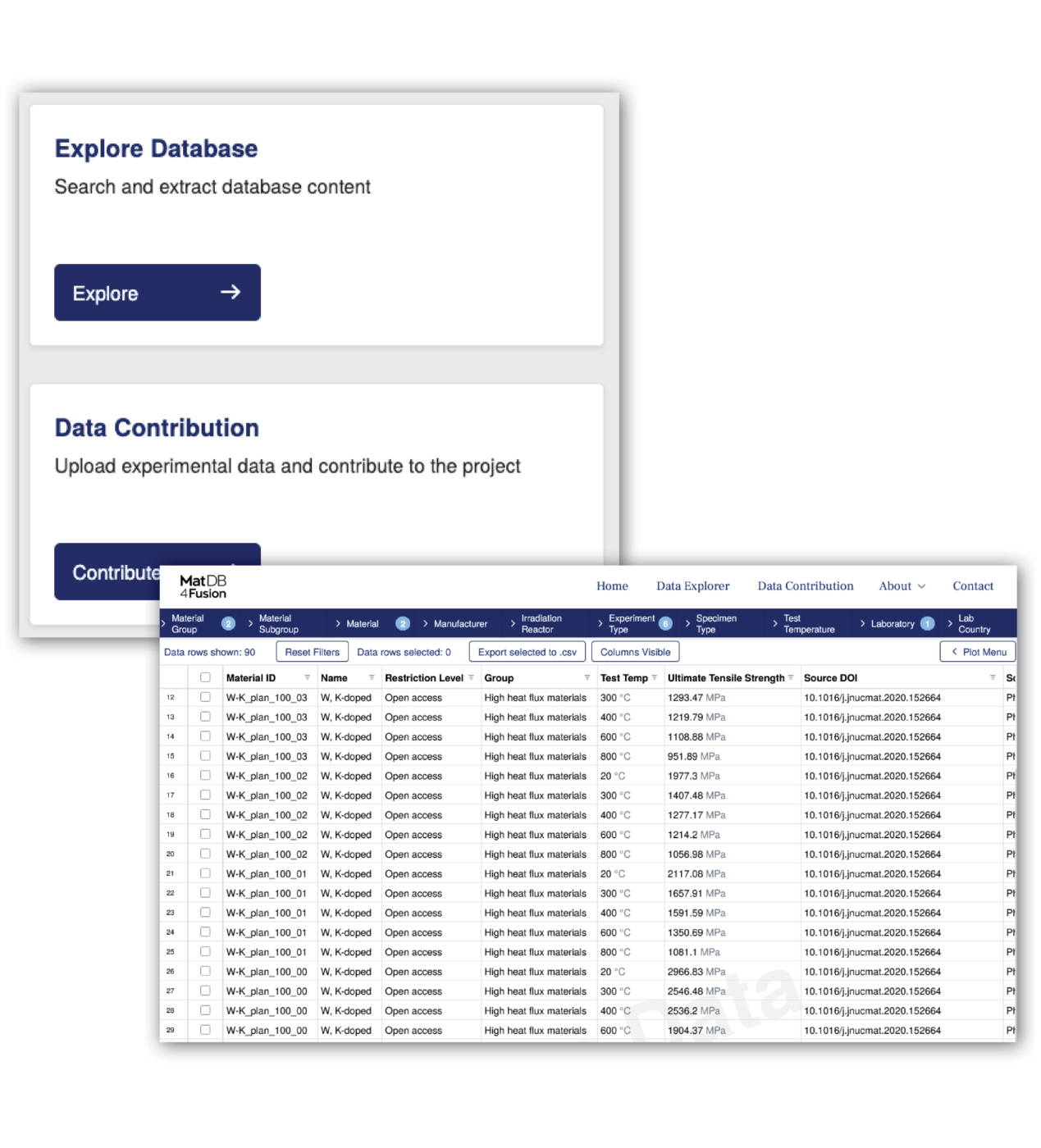
CATF is developing analytical resources to support investment and decision-making for fusion deployment. This includes the Fusion Cost Model, which provides a structured framework to evaluate plant economics and identify key cost reduction pathways, offering a common reference point for developers, investors, and policymakers. CATF is also advancing MatDB4Fusion, an AI-assisted international materials database that improves access to reliable data and addresses critical gaps. Together, these tools aim to address technical and economic uncertainty in the industry to help accelerate commercialization.
MATDB4Fusion
Accelerating fusion materials research through global collaboration
Commercial fusion power is within reach – but it hinges on access to robust, validated data on materials that can withstand fusion’s extreme environments.
That’s why Clean Air Task Force initiated an international working group and collaborated with the Organization for Economic Cooperation and Development’s – Nuclear Energy Agency (OECD-NEA), to launch MatDB4Fusion: a next-generation, community-driven materials database designed to support the development and deployment of fusion energy.
MatDB4Fusion will grow and evolve through collaboration, with contributions and insights from researchers, laboratories, and institutions worldwide.
Fusion Cost Model
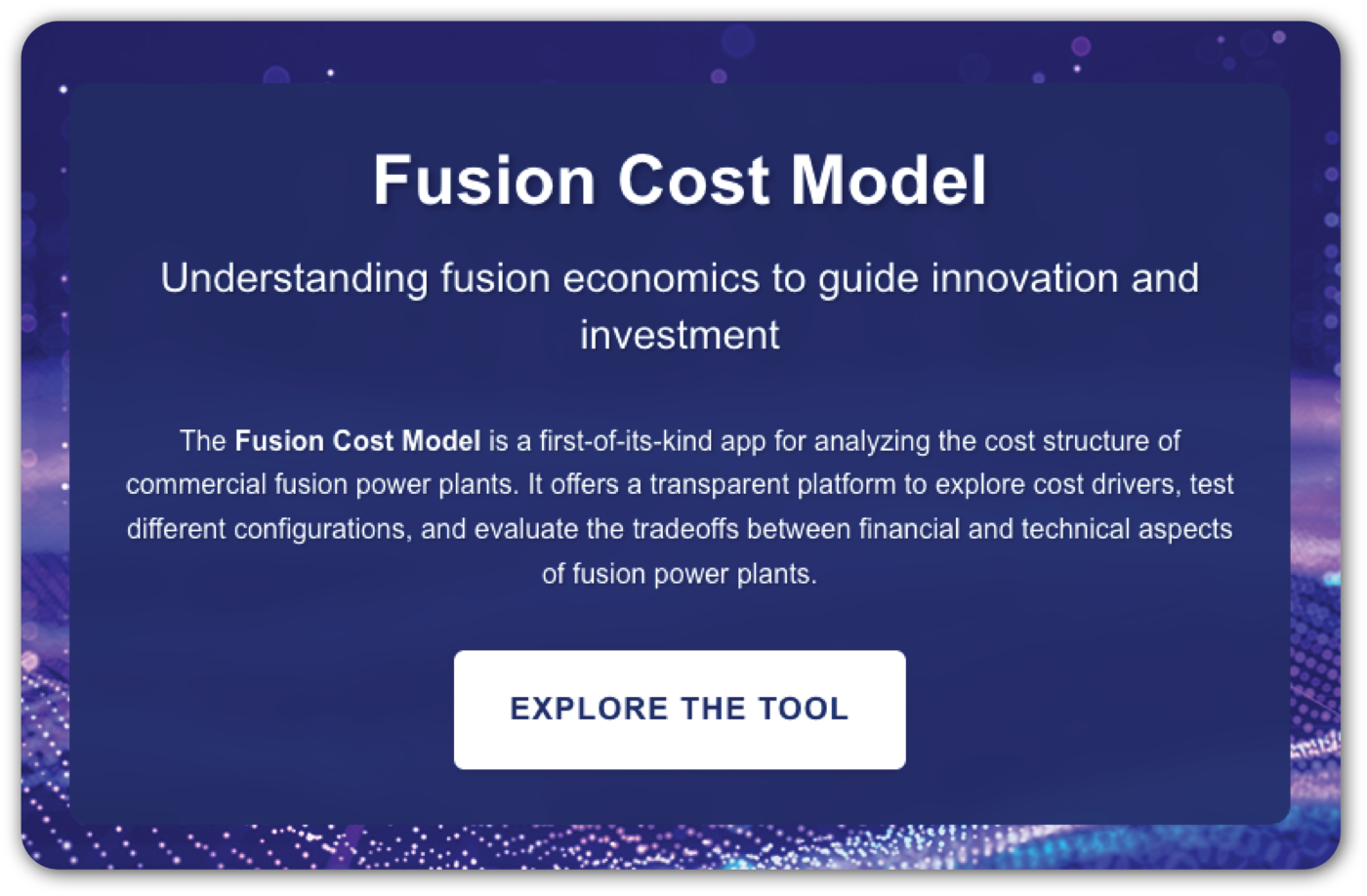
Cost model for fusion power plants
Commercial fusion energy is moving closer to reality – but credible, transparent cost insights are essential to guide research priorities, policy decisions, and investment strategies.
To meet this need, Clean Air Task Force developed the Fusion Cost Model, informed by more than a decade of collaboration with fusion developers, industry leaders, and international institutions. The model gives users a clear and as complete as possible view of the cost categories present in a fusion power plant, helps identify key cost drivers shaping different fusion power plant designs, and enables consistent, apples-to-apples economic analysis across approaches.
How does fusion energy work?
Fusion energy is a natural phenomenon, the very process that powers the Sun and helps make life on the Earth possible. In a fusion reaction, two light nuclei merge to form a single heavier nucleus when the right temperature, density, and time length conditions are met. The process releases energy because the total mass of the resulting single nucleus is less than the mass of the two original nuclei. The leftover mass becomes energy following the famous Einstein equation (E=mc2).
Fusion energy has the potential to provide:
- Always available, firm power with non-high-level radioactive waste or greenhouse gas emissions.
- High energy outputs with a very small land footprint, and no meltdown risk, reducing siting barriers.
- Accessibility worldwide, as it does not rely on regional natural resources.
- Potential for highly competitive power, producing more energy per gram of fuel than any other generating process.
But challenges remain:
- Technology Advancement: We do not currently have the technology commercialized to tap into this promising energy source. To make fusion a reality, we must advance a diversity of fusion technologies and develop and test fusion plants in real conditions.
- Regulatory Certainty: We need clear, specific, and proportionate regulations that provide a reference framework for developers.
- Industry and Market Cultivation: We must establish a global fusion industry with a global market. The fusion industry is flourishing as new companies and start-ups are being created worldwide, and international collaborations and contracts are evolving quickly.
Meet the experts
Meet our staff working on fusion energy.


Fusion energy FAQs
What is fusion energy?
Nuclear fusion occurs when one or more lighter atomic nuclei combine to form a heavier nucleus, while releasing energy. This reaction happens in nature: it is the process that powers stars like the Sun, and because of fusion’s net energy generation, life on the Earth is possible.
What are fusion energy’s benefits?
Fusion energy provides distinct advantages as a net-zero, firm energy source:
- Zero Carbon Emissions: Unlike fossil fuels, fusion energy emits no greenhouse gases during the fusion process. By transitioning to fusion power, we can significantly reduce our carbon footprint, preserve natural resources, and foster a cleaner environment for future generations.
- Abundant Fuel Supply: Fusion fuel sources, such as deuterium and tritium, can be extracted from seawater and are virtually inexhaustible. With an ample supply of fuel, fusion energy offers long-term energy security and relief from concerns over resource scarcity.
- Safety and Waste Reduction: Fusion is self-limiting, making it inherently safe. Moreover, fusion machines are being tailored to not generate high level radioactive waste, making fusion a responsible and sustainable energy option.
- Minimal Land Requirements: Fusion offers higher energy output per land used with no significant space requirements for fuel or waste.
- Less Transmission Expansion: Fusion’s smaller footprint increases the suitability of locating plants near demand centers, thus reducing the expansion of long-distance transmission systems.
What are the different approaches to tapping into fusion energy?
There are many different approaches to harnessing the power of fusion energy – and CATF encourages advancement of all approaches that offer promise. Here are some of the most prominent approaches:
- Magnetic Confinement Fusion (MCF): The most prominent fusion research approach, MCF involves using powerful magnetic fields to confine and heat the plasma to the extreme temperatures required for fusion. Projects such as ITER and SPARC (a compact fusion machine being developed by MIT and Commonwealth Fusion Systems) aim to achieve sustained fusion reactions and pave the way for commercial-scale fusion power plants.
- Magnetized Target Fusion (MTF): Developed in the 1970’s by the U.S. Naval Reactors program, MTF relies on an imploding cylindrical metal liner that compresses a preheated and magnetized plasma configuration until thermonuclear conditions are achieved.
- Inertial Confinement Fusion (ICF): In ICF, high-energy lasers or particle beams compress and heat small fuel pellets to induce fusion. This approach, exemplified by the National Ignition Facility (NIF) in the United States, seeks to replicate the conditions found in the core of stars. While ICF faces technical challenges, progress is being made in achieving ignition and sustained fusion reactions.
- Field Reverse Configuration: Field reversed configurations, as well as related field-reversed mirrors, offer compact toroids with little or no toroidal magnetic field. This approach is characterized by high beta plasmas and their macroscopic stability.
- Other Fusion Categories: Magnetic or electric pinches, inertial electrostatic confinement, muon-catalyzed fusion and other forms of low-power fusion also exist, often at earlier stages of development when compared to more familiar categories.
What is the difference between nuclear fusion and nuclear fission?
Fusion and fission are different ways to convert energy into something useful, like heat or electricity. Both have the power to generate zero-carbon energy.
Energy is defined as the ability to do work. The categories of potential energy include kinetic, electrical, magnetic, nuclear, and gravitational. For each category, scientists have formulas to describe them. Fusion and fission both convert energy from atoms, but in opposite ways.
Fusion brings small nuclei so close that together that they fuse. Nuclei must be near enough that they can feel each other’s nuclear force. For fusion to occur, reacting nuclei must be very close to each other, within 10-10– 10-15 (a thousand trillionth) meter of one another. This is the same process that powers stars. The stars exploit their own gravity to create plasma conditions in their central regions where net fusion energy is generated. On Earth, fusion energy machines rely on other categories of energy to create similar conditions.
Fission breaks atoms apart, splitting up big nuclei into smaller ones. A neutron hits a larger atom, forcing it to split into two smaller atoms—also known as fission products. Additional neutrons are also released that can initiate a chain reaction. Energy is released when each atom splits.
Does nuclear fusion produce waste?
Fusion does produce waste. However, efforts are underway to minimize, circularize, or eliminate waste from the fusion energy cycle as much as possible. Most of the concepts being developed include materials affected by tritium. Tritium is a low beta energy emitter and low risk when outside the human body. As an isotope of hydrogen, it is highly mobile and can displace hydrogen in a range of organic compounds that can be inhaled or ingested (see Boyer, 2009). Tritium occurs naturally in the environment in very low concentrations and it was widely dispersed into the atmosphere during weapons testing in the 1950’s and 1960’s. Accordingly, tritium release limits to the environment are stringent. As it is short-lived, tritiated waste will be 99% decayed within 82 years.
Also, reduced activation materials will result in low-level radioactive waste after 100 years of operation shutdown. Fusion–tailored Reduced Activation Ferritic Martensitic steels like EUROFER97 and F82H have been produced with this objective.
Is nuclear fusion safe?
Yes, fusion energy can be safely commercialized. Fusion is self-limiting, meaning the machine generating it turns off as soon as it is not in control – making it inherently safe. This characteristic results from the dependable physics of magnetically confined plasma. Additionally, fusion energy machines create their fuel as they operate, so unlike fossil and fission plants, no large stockpile of fuel exists on site. They are designed in a way that does not produce highly radioactive, long-lived nuclear waste.
