
Our Work
Cement
Cement forms the foundation for our buildings, industry, transport, and energy infrastructure, making it one of the most widely used materials globally. However, the cement manufacturing process is responsible for a substantial share of greenhouse gas emissions – nearly 8% globally – much of which are process emissions that cannot be addressed through electrification or fuel switching alone. Less-polluting processes and alternative materials are available, but deploying these at scale requires coordinated policy, finance, and innovation.
Cement by the numbers
8%
Total global CO2 emissions from cement manufacturing.
23%
Projected global demand growth for cement by 2050.
60%
Of emissions from cement manufacturing are process-related.

Why address emissions from cement?
- Global demand for cement is projected to grow by up to 23% in 2050. New cement production should be built using the most efficient, low-polluting technologies.
- Cement is one of the largest industrial CO2 emitters, accounting for nearly 8% of total global emissions and 20% of industrial emissions.
- While cement production is technically difficult to decarbonize, there are solutions that we can deploy to address the emissions while minimizing impact on the supply chain for the industries, sectors, and economies that rely on it.
- In addition to greenhouse gas emissions, cement plants release a range of other pollutants with negative health and environmental impacts, including criteria air pollutants, including ground-level ozone, particulate matter, carbon monoxide, lead, sulfur dioxide, and nitrogen dioxide.
Solutions
Solutions exist to decarbonize the cement industry, but will require synchronized financial, policy, market, and regulatory support alongside continued innovation in cement production technologies. Examples of decarbonization solutions include:
- Plant upgrades to improve energy efficiency
- Alternative feedstocks and production processes
- Clinker substitution and supplementary cementitious materials (SCMs), alternative binder chemistries, and blended cements
- Carbon capture, utilization, and storage
- Alternative fuels
- Electrification with clean firm power
These solutions could be accelerated by various adoption strategies, including policies and programs that support the entire cement production value chain from RD&D to full market penetration for decarbonized cement. However, not all these solutions will have equal impacts on emissions, and some will leave substantial emissions behind, making the use of multiple solutions critical.
Our work
CATF is active on cement decarbonization in the U.S. and Europe, two regions that have mature cement industries and the potential to be first-movers in cement decarbonization.
Education and thought leadership
- Develop analytical frameworks that clarify technology pathways and interactions, costs, tradeoffs, and total system benefits for cement decarbonization, including co-pollutant reductions and innovation gains.
- Communicate the full value of low-carbon industry to audiences ranging from local communities to policymakers.
Coalition building
- Engage policymakers, funders, industry, and civil society around sector-level and inter-sector solutions.
- Build regional coalitions around clean industry clusters to create local demand for decarbonization and reduce infrastructure costs through co-location.
Policy innovation
- Design policy approaches that unlock investment, infrastructure, and coordinated deployment.
- Develop demand-side and supply-side market mechanisms that create the market signals needed for bankable clean industrial projects.
Direct advocacy
- Advance regulatory and market reforms that enable cement decarbonization at scale.
- Collaborate with stakeholders across the cement and concrete value chain to understand and remove barriers to decarbonization project deployment.



Related resources
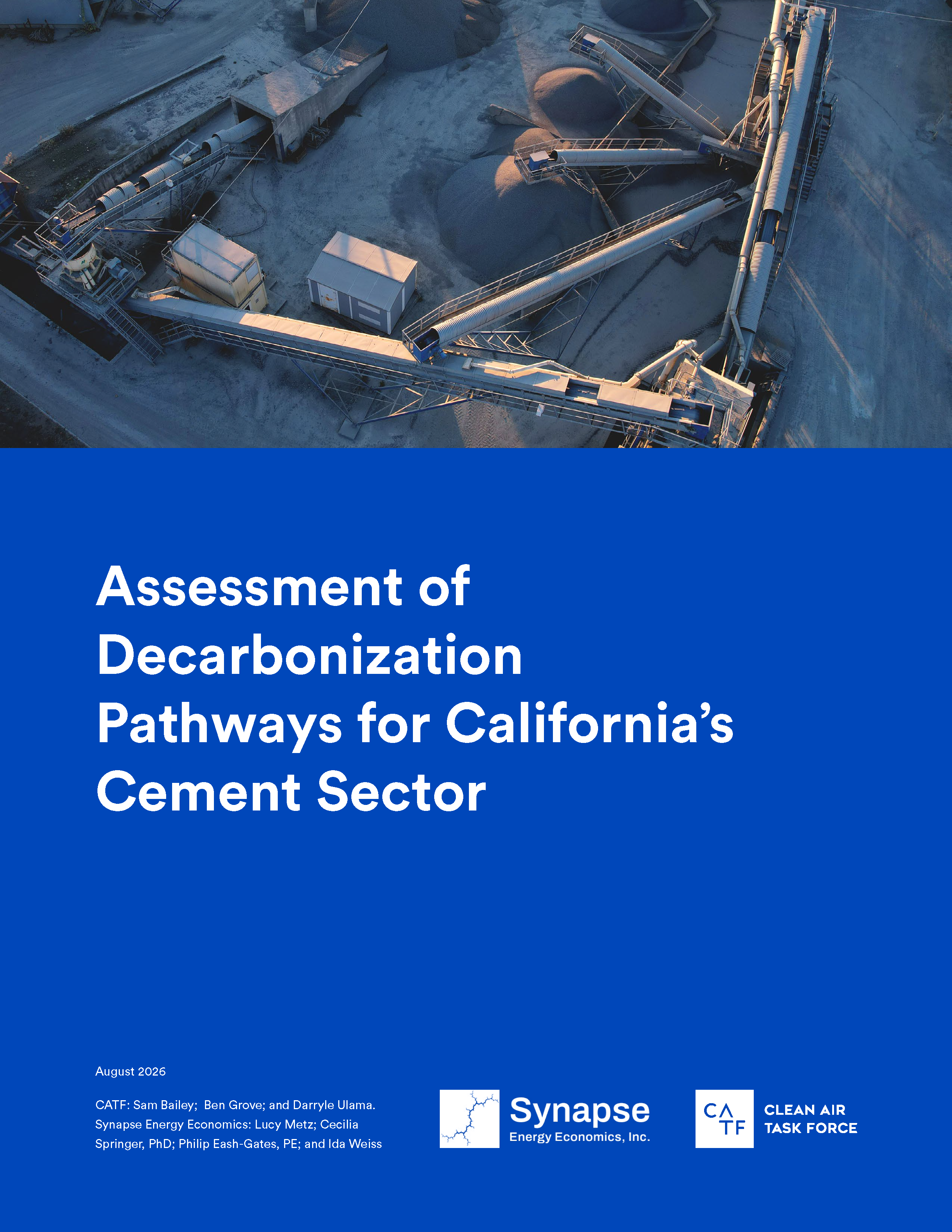
Assessment of Decarbonization Pathways for California’s Cement Sector
This report examines four decarbonization pathways for California cement plants.
Recasting the Future: Policy Approaches to Drive Cement Decarbonization
This report presents key technological pathways, adoption strategies, and policy recommendations for transitioning to a low-carbon cement industry.

The Role for Carbon Capture and Storage in Decarbonising Europe’s Cement Sector
This brief explores the role for carbon capture and storage in decarbonising Europe’s cement sector.
Interactive Maps
Early-stage carbon capture project maps
CATF has built interactive maps that track carbon capture and storage projects that have been publicly announced in the U.S., Europe, and the Middle East and North Africa (MENA). Click on the colored circles on each map to learn about each project’s location, sector (industrial, power, or direct air capture), type of carbon dioxide storage (EOR or saline), storage capacity, and current status.
The map also shows the vast expanse of potential geologic saline storage formations around each country.

Stay in the know
Sign up to receive updates on the latest in industrial innovation
"*" indicates required fields
