
Planning for yesterday: Why EU 2040 modelling needs updating
1. Executive summary
Modelling frameworks shape what governments perceive as feasible, so the limits of any reference model matter for policy design. Research on EU model adoption finds heavy concentration around a small number of modelling frameworks, so their quality and assumptions matter and must be open to challenge.1
Planning for the next decade of EU climate and energy policy has begun, but the EU’s strategy risks being informed by outdated information. The upcoming revision of the EU Governance Regulation will set the framework to plan, report, and monitor progress to reach the 2040 climate target. While dedicated impact assessments for the post 2030 framework are being developed, the basis for the EU legal structure on energy governance up to 2040 is provided by a European Commission’s impact assessment of 2023, accompanying the 2040 climate target communication.2 However, this modelling3 is an incomplete reference. The Commission’s 2040 modelling is out of date, and its methods inaccurately constrain the expansion of new nuclear power despite independent modelling suggesting significant value to achieve climate targets. To properly inform conclusions about the energy system’s decarbonisation trajectory over the next decade, it would benefit from significant updates reflecting recent policy developments at the EU and national level. Using it as a reference without accounting for these developments risks building the post-2030 framework and targets on assumptions that predate recent policy changes.
The Commission should recognise the gaps and limits of previous modelling when designing the Governance Regulation and the post 2030 package, and should consider adjusting the modelling in its next iterations. These should better reflect technology options, enhance modelling methods, and stress-test modelled pathways with scenarios. Key considerations to better formulate EU’s 2040 climate targets include updated forecasts of Member State nuclear policy, changed Emission Trading System (ETS) expectations, reduced hydrogen offtake, stronger alignment with electrification ambition, existing grid connection and permitting bottlenecks, and a deeper assessment of supply chain and volatility risks.
Future modelling for the post-2030 framework should consider various plausible futures that can inform policymakers about what is ambitious and achievable. It should stress-test pathways against headwinds; cover more weather years including recent heat and drought extremes; let renewables, nuclear, and emerging clean firm generation options compete on economics; and publish its full assumptions. Simply increasing the share of renewable energy in final energy consumption or changing the target architecture, without assessing changed policies and enabling conditions, will not produce a framework fit for the decade ahead. A future-proof post-2030 framework must keep climate 2040 targets but strengthen them by better reflecting technology options, system realities, and making them resilient across multiple future scenarios.
2. The EU Governance Regulation and the Post-2030 Energy Union Package
2.1. Current framework
To oversee the EU reaching its climate and energy targets, the Regulation on the Governance of the Energy Union4 sets common rules for planning, reporting, and monitoring, providing a framework for the climate and energy objectives established across EU legislations. The current framework tracks progress towards 2030 EU-wide energy and climate objectives on the path to EU climate neutrality by 2050. It also allows the European Commission to monitor and ensure EU compliance with international commitments under the Paris Agreement, based on Member States’ reporting. Included in the framework is a binding renewable energy target of at least 42.5% of total EU energy consumption by 2030 (aiming for 45%), as set by the EU Renewable Energy Directive (REDIII)5. The Governance Regulation also supports progress towards an energy efficiency target (at least 11.7% reduction in final energy consumption by 2030), a greenhouse gas (GHG) emissions target (at least 55% net reduction by 2030 vs. 1990, with a new 90% target for 2040), and the EU’s climate neutrality objective (net-zero GHG emissions by 2050), all defined and operationalised in their corresponding legislative texts. As such, the Governance Regulation needs to be understood as a key component of the broader complex architecture of EU climate and energy laws, and its update as part of the upcoming revision of the Union’s energy and climate laws.
As part of the Governance Regulation, each Member State must submit an integrated ten-year National Energy and Climate Plan (NECP) covering national objectives for each of the five dimensions of the Energy Union, along with corresponding policies and measures to meet those objectives. The plans report national contributions and the policies and measures to reach them, including nationally set targets. They also provide an overview of the investments needed to achieve climate target objectives as well as the planned policies and measures across the five dimensions.
Alongside NECPs, Member States also produce national long-term strategies (LTS) looking out decades further until 2050, and they must submit biennial progress reports (NECPRs) on implementation.
The Commission is expected to put forth a proposal for a revised Governance Regulation by early 2027. The ambition is to update the governance framework in light of the new legally binding EU climate target for 2040, as well as simplify, strengthen, and modernise national energy and climate planning for the post-2030 period.6 Other aspirations of the post-2030 Energy Union package include establishing further links with EU budget vehicles and NECPs as well as the July 2026 Electrification Action Plan, energy security and crisis preparedness, and the European Grid Package.7
2.2. New targets are informed by existing and upcoming EU modelling
Whether a binding renewables target is kept, complemented, or replaced by a technology-neutral clean energy target in the broader revamping of EU energy policy is a central open question. The renewable energy target and energy efficiency framework are also planned to be overhauled in the beginning of 2027. The Energy Council discussion of June 2026 highlighted however that instead of just renewing target numbers, the target architecture could pivot towards new metrics, emphasising the need for a broader “clean energy target”. A new target architecture could build around a binding electrification target complemented by an energy efficiency factor,8 potentially with renewable energy targets and “low-carbon flexibilities”.9 Given the Commission’s previous modelling, reported drafts for the post- 2030 framework, and electrification goals, the 2040 benchmarks would likely include a renewable target of 65-75%,10 an electrification target of 46% of final energy consumption, and targets to replace 70% of gas demand with electricity and cut oil consumption by 40%. They could also include targets for storage capacity, waste heat recovery, and a district heating. Any proposal would still need to undergo political discussion and negotiations with the Council and the European Parliament. Whatever architecture emerges must cut emissions in line with climate targets while delivering resilience, strategic autonomy and affordability.
3. Findings and Shortcomings of the previous EU 2040 Climate Target Impact Assessment
3.1. Results from EU modelling of the 2040 climate target impact assessment
While dedicated impact assessments for the post-2030 Energy Union framework are being developed, a key analytical foundation for the EU legal structure on energy governance up to 2040 is provided by the European Commission’s impact assessment accompanying the 2040 climate target communication.11 The model was performed in early 202312 and it has not been updated since.13 The current 2040 power system vision is summarised below:
Power sector
- Renewables: The model finds that renewables should supply 81–87% of electricity in 2040 and almost 90% in 2050 (currently 46%).14 This requires installed renewable capacity to grow 4–5 times between 2020 and 2040 and to exceed 3 TW by 2050.
- Storage and electrolysers: Pumped hydroelectric energy storage grows from 50 GW (2020) to 75 GW (2040). Batteries grow from 100 GW (2030) to 135–200 GW (2040), mainly for daily and weekly balancing. Electrolysers grow from 30 GW (2030) to 185–300 GW (2040).
- Nuclear: Nuclear fission generation falls from 730 TWh (2021) to about 495 TWh (2040), a 30% drop. Its share falls from 25% today15 to 10–11%. Capacity falls from about 110 GW (2015) to 95 GW (2030) and 70 GW (2040).
- Fossil generation: Its share falls from 36% (2021) to 3–8% (2040), against 29% today.16 In the last decade before 2050, gas plants with Carbon Capture and Storage (CCS) produce most gas-fired power, while plants without CCS serve only as peakers.
Final energy consumption (FEC)
- Level: FEC falls to 765 Mtoe in 2030, in line with the Energy Efficiency Directive target. It then falls further to 604–622 Mtoe in 2040.
- Sector reductions vs. 2021 (2040): transport –59%, residential –45%, services and industry –30%, agriculture –25%.
- Electrification: The share of electricity in FEC rises from 23% (2015-2025) to above 45% (2040), about 280–290 Mtoe.
- Renewables: Their share in gross FEC rises from 42.5% (2030, in line with the Renewable Energy Directive target) to 65–75% (2040). Across all sectors, RFNBOs account for approximately 5–10% of total FEC in 2040. The fossil share falls from above 60% (2015) to 23–30% (2040).
3.2. What is missing in the EU model’s power sector assumptions
Modelling frameworks influence what policymakers perceive as feasible and how energy systems develop.17 Frameworks differ in how they represent the socioeconomic system and in their assumptions about an uncertain future. A 2026 study in Energy Research & Social Science, which analysed the energy models that EU Member States reported using for policymaking, found that few models used in academic research had been adopted for policymaking, and that most models used for policymaking had not been published in the scientific literature.18 This means models should be sufficiently documented and versioned to allow scrutiny by civil society. All model code and libraries used to develop the scenarios should be published using an open-source licence.
While the full documentation of the EU 2040 modelling is not available, some gaps in the modelling methods and assumptions can be identified based on the publicly available documentation. Even the lower end of the scenarios (65–70% renewables in FEC) exceeds the current trend. Renewables’ share in total energy consumption has doubled since the first binding target was adopted in 2009.19 Renewables reached 26.2% of EU final energy consumption in 2025, up one percentage point (pp) from 2024.20 Between 2023 and 2024 it managed 0.7 pp. Reaching the 2030 target of 42.5% would require adding around 3 pp per year from 2025 to 2030.21 The European Court of Auditors (ECA) found that while the 2020 targets were met, the Commission did not sufficiently assess the impact of the 2009 financial crisis and COVID-19 pandemic on that result before setting the 2030 trajectory.22
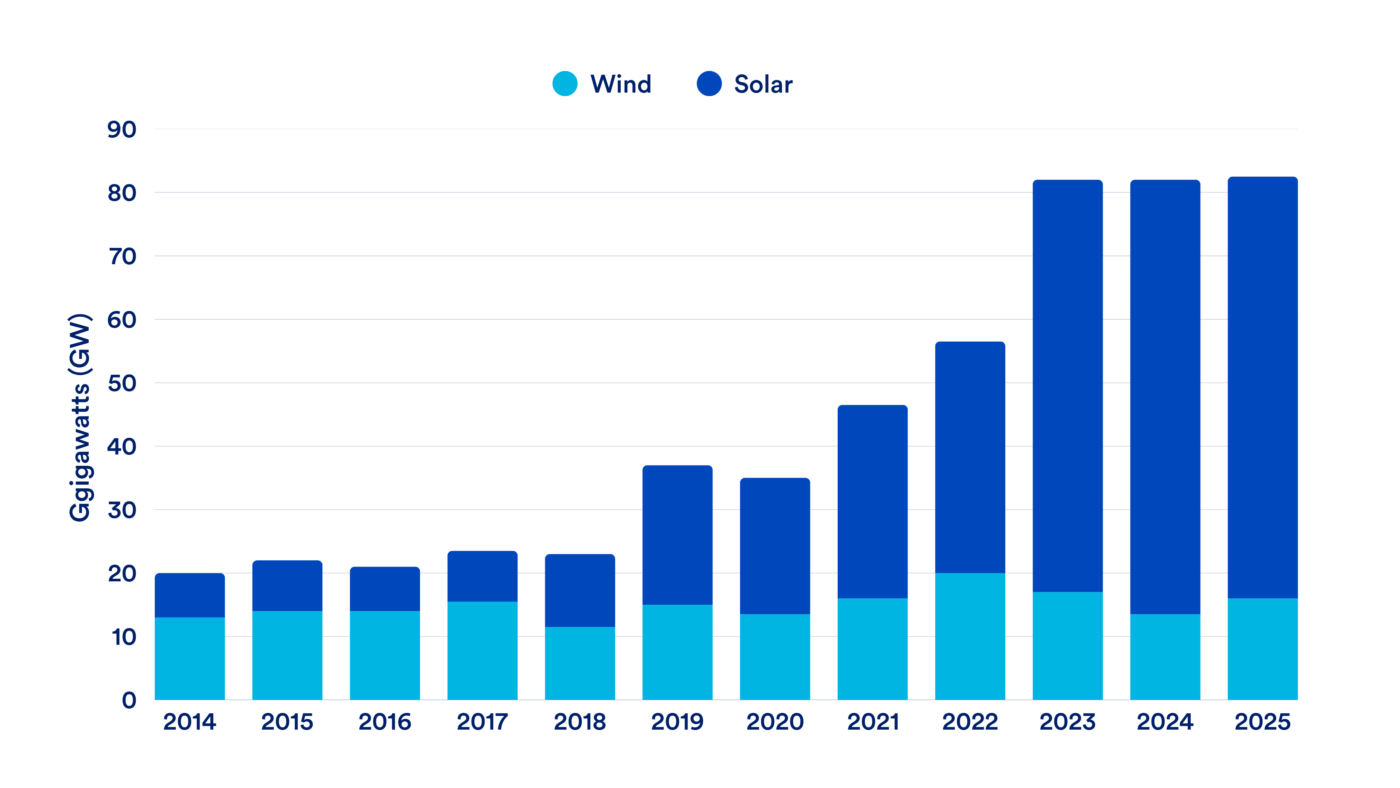
Undoubtedly, the Renewable Energy Directive targets have given Member States direction, attracted investment, and set a shared objective towards a cleaner energy system. However, progress could slow as grid connection and permitting queues,23 siting constraints, and slow system integration persist. Other risks include a potentially weaker carbon price signal, slower hydrogen and CCS scale-up, and more frequent weather extremes.
Figure 1: Buildout slowing from historically-strong growth. Annual capacity addition of renewable energy, Europe (2014 – 2025).
Source: Energy Transition Monitor 2026
The Commission’s 2040 impact assessment uses economic modelling to analyse the evolution of sectoral emissions and the contribution of technologies that are necessary to meet different 2040 target levels and climate neutrality by 2050. Based on the available insights, it evaluates the amount of renewables and energy storage needed to achieve the 2040 climate target of a 90% GHG emissions reduction and net-zero emissions by 2050 at least cost. The impact assessment uses economic modelling to analyse the evolution of sectoral emissions and the contribution of technologies that are necessary to meet different 2040 target levels and climate neutrality by 2050. The amount of renewable capacity deemed necessary to decarbonise, is heavily influenced by the model’s fixed assumptions for other technologies. One key conclusion is that the previous impact assessment for the 2040 climate target proposal, and the models it used,24 not truly assess the significant role of clean firm generation can play in achieving EU climate targets. Clean firm generation is a distinct class of dispatchable, low-emission electricity generation sources that do not rely on the weather.25 By not representing these technologies, the models, fail to accurately reflect Member State ambitions to develop clean firm generation alongside solar, wind and storage. Independent power system studies consistently show that this strategy can lower the costs of decarbonisation, reduce the amount of infrastructure necessary to achieve targets, and to reduce supply chain and delivery risks compared to variants that exclude these options.26, 27, 28 Notably, the EU 2040 model does not economically optimise nuclear power deployment or retirement. Instead, the installed nuclear capacity in future years is treated as an exogenous assumption. This assumption is informed by NECPs submitted in 2019, with modifications based on updated NECPs submitted by Member States up to March 2023. Driven solely by modelling assumptions (not model optimisation, as done for other technologies), the assumptions state that nuclear power generation decreases.
Modelling guidance for least-cost effective power sector decarbonisation: For future energy models, the EU could enhance modelling methods by considering including assumptions on land-use constraints, higher spatial granularity, and realistic sector coupling. Most models used currently treat the EU as national nodes, which hides local scarcity events and internal transmission needs. Few also represent the price-stabilising value that especially clean firm generation capacity provides, understating its true system value.
- Enhance modelling methods:
- Use a wider weather-year coverage that include recent heat records that impacted large shares of European electricity generation. Test system adequacy against recent heat and drought records, and apply climate-adjusted availability to nuclear, thermal and hydro plants. Multi-year analyses, up to 30+ historical weather years and including recent trends, can identify the value of certain power sector technologies also during unfavourable drought years.29
- Land-use constraints are poorly accounted for (if at all) in most studies, and incorporating spatial constraints can significantly alters the optimal power generation technologies portfolio. Incorporating spatial constrains gives a more realistic scale of variable renewable energy (VRE) deployment potential and considers conditions or areas where strategic (military, political, environmental) interests oppose buildout.
- Future EU modelling studies should incorporate higher spatial granularity. Low spatial resolution in models (e.g., by using a single national node) smooths out local scarcity events, masks congestion, and hides internal transmission needs. This not only captures the potential of generation to dampen local price spikes and support load centres but also exposes complementary value in providing flexibility nearer to consumers and easing constraints on lower-voltage networks.
- Model various integration scenarios. Implicit assumptions of reliable imports via strong interconnections drive a lower role for local power generation, yet this may not hold during geopolitically stressed periods or continent-wide VRE scarcity events. Scenario design should also be mindful of the extent to which they include assumptions for sector coupling – integrating heat, hydrogen, and transport including advanced interconnection into their electricity modelling. Sector coupling may implicitly assume a lower role for power generation technologies.
- Price volatility outcomes should be increasingly scrutinised in modelling studies to inform policymakers about technology choices and system planning. When volatility is considered, the stabilising effect of power system portfolios and their potential contribution for market resilience becomes visible. Alongside market design choices, the system value of clean power generation technologies which dampen scarcity-driven price spikes may be identified as contributing to a more predictable market capable of sustaining decarbonisation investments.
- Stress test modelled pathways with scenarios: Stress-test the 2040 benchmarks under difference plausible future scenarios: slower grid and permitting progress, a weaker ETS price trajectory, and extreme-weather years.
Reflect full scope of technology options: Allow the model to retire and deploy new nuclear power freely based on economics in Member States where this is legally permitted, rather than prescribing a fixed trajectory that is prone to being outdated. Explore the role of additional emerging climate technologies in enabling a cost-efficient, system-oriented, and environmentally friendly energy transition. Represent emerging clean firm options, such as superhot rock geothermal and advanced nuclear, with up-to-date cost trajectories. Consider social, supply chain, and land use trade-offs of technologies for a sustainable system transformation.
3.3. Relevant changes in EU and Member State policies not reflected in previous modelling
Policy changes at the EU and national levels have already rendered the model’s basis. The Commission proposals from July 2026 on the EU ETS and the Electrification Action Plan[30] introduce new assumptions that the EU model hasn’t tested yet together with Renewable and energy efficiency targets.
The indicative electrification target of 46% by 2040, while considered unrealistic by some31 given the current stagnant 23% electrification rate,32 would need to work alongside these other climate governance elements. The proposal to revise the EU ETS Directive, which sets the framework for Phase 5 (2031–2040) is currently under negotiation. The Commission’s impact assessment identifies a preferred policy option, that combines a revised cap with changes to the Market Stability Reserve, free allocation and the scope of the EU ETS. Under this option, cumulative EU ETS emissions over 2026-2040 would reach 10,598 Mt, compared with 9,687 Mt under current legislation. This represents 911 Mt more emissions, or 9.4% above the baseline.33
The effects of this reform may alter the trajectory of reducing emissions considered in the 2040 climate target impact assessment, which means that identifying pathways towards 90% emission reduction by 2040 and post-2030 framework target architecture need to be based on an updated assessment. A credible post 2030-framework that keeps the EU 2040 climate target in place cannot be built until these variables, which have significant GHG emissions implications, are agreed.
In addition, significant policy changes have occurred at the Member State level since the modelling was done in 2023, especially regarding technology openness, that are meaningful and impact the modelling results. For example, many of the model’s fixed inputs are based on member states’ 2019 National Energy and Climate Plans, with data additions reflecting developments up to early 2023.34,35 Many of these inputs are today out of date, as the section below on nuclear policy developments illustrates, and constrain the model in assessing the least-cost, lowest-risk pathway to the EU’s targets. As such, the current governance and target revision should serve as motivation to re-establish a more updated and accurate analytical foundation for the post-2030 framework, ensure that various EU targets and delivery policies are consistent with each other, and to better reflect updates to Member State policy.
The gaps in the modelling can be visible across different technologies, such as nuclear, geothermal, or CCS.
Nuclear
The 2040 impact assessment fixed nuclear capacity using 2019 NECPs updated to March 2023, which implies a fall to 70 GW by 2040.36Member State decisions since then point to more nuclear than assumed.
- Existing plants kept running. France repealed its 50% generation-share target and 63.2 GW cap in 2023, postponed closure of 14 reactors, and now expects only two to four closures by 2028.37 This marked a pivot in strategy. In addition, several operators have either already obtained licences or announced plans for further lifetime extensions of nuclear plants. In February 2026, France announced ambitious new nuclear generation buildout plans revealed, including six new reactors before 2035, including Small Modular Reactors (SMRs).38 Spain extended the nuclear power plant Almaraz to 2030, Hungary extended its nuclear reactor Paks I to 70 years, and Belgium repealed its 2003 phase-out law in favour of long-term extensions.39
- New build. In February 2026, France announced ambitious new nuclear generation buildout plans revealed, including six new reactors before 2035, including Small Modular Reactors (SMRs).40 Poland targets 6–9 GW, backed by a ~€42bn state-aid package. Romania expects 1.4 GW from Cernavodă 3 and 4, and the Doicești SMR received a conditional investment decision in February 2026. Estonia plans a 600 MW SMR plant, with a first unit possible by 2035.41 Italy’s Senate approved enabling legislation in September 2026, with first reactors expected in 2033–34. Hungary began construction of Paks II in February 2026, and Bulgaria is advancing Kozloduy 7 and 8.42 In Slovenia, the indicative timeline for the JEK2 project next to Krško concluded in a final investment decision by 2029, construction is expected from 2033 and commercial operation in 2041.
- Enabling laws. Finland and Estonia have adopted or proposed new nuclear legislation, and Croatia aims for nuclear generation to make up 30% of its energy mix by 2040.43
Geothermal
The Commission’s 2040 modelling does also not adequately account for the potential contribution of geothermal to clean electricity and heat generation. With a strategy and robust funding, next-generation geothermal technologies could likely complement traditional generation close to 2040.44 By omitting emerging clean firm technologies from its scenario set entirely, rather than testing their cost and deployment trajectories, the EU’s 2040 modelling understates the range of cost-effective, low-carbon pathways available to Member States. Certain pre-commercial geothermal technologies,, whose costs and timelines are uncertain, should be tested as sensitivities across a range of costs and deployment dates, as the model already does for other emerging options such as CCS and e-fuels.
Hydropower
Furthermore, the 2040 impact assessment gives no indication that the availability of thermal and hydropower plants is adjusted for heat and water stress. The slight decline in the share of renewable energy generation in 2025 compared to 2024 (46% and 47%, respectively) was driven by a significant decline in hydropower generation which dropped by 50 TWh (-13%).45 At global level, van Vliet et al. project reductions in usable capacity for 61–74% of hydropower plants and 81–86% of thermoelectric plants in 2040–2069.46 Increased droughts and heatwaves affecting nuclear power might also require adapting models to new extremes. Updated 2040 modelling would therefore benefit from test system adequacy against recent heat and drought records rather than historical averages, apply climate-adjusted availability to nuclear, thermal, and hydropower plants and represent the adaptation options that reduce these losses.
Carbon capture and storage
The Commission expects that gas plants equipped with CCS generate the majority of the gas-fired electricity 2040- 2050, while the ones without CCS equipment are only used as peakers. Prior to 2040, only a limited use of CCS for power generation is projected in the considered scenarios of the Commission. In 2030, there is only a small amount of CCS-equipped installed capacity which increases to 10-20 GW in 2040. This will depend on, first, CCS being available and affordable at scale, and second, the carbon price trajectory currently under negotiation and other policies strong enough to incentivise its application.
Hydrogen
The deployment of renewable hydrogen47 has also so far not been achieved at the rate nor scale envisaged by the EU. The REDIII renewable hydrogen deployment mandates across industry, maritime, aviation and other transportation would require an estimated 2.1Mt of renewable hydrogen annually by 2030, while EU production capacity in 2025 was approximately 0.09-0.14Mt.48 The 2040 model still builds on the ambitious 2030 hydrogen targets.
Several national decisions taken since the modelling was locked point to longer-lived coal and a larger role for gas in the systems where coal still dominates.49 Combined with the weaker carbon-price trajectory implied by the proposed ETS revision, this risks higher power-sector emissions through the 2030s than the previous EU modelled pathway assumes.
The new 2040 benchmarks for a 90% GHG emission reduction should therefore be stress-tested against less favourable conditions, which could materialise in modelling scenarios that reflect lower-than-desired technology deployment rates limits. Not only would this better inform policymakers on the impacts of current barriers and the need to address them, it would also identify complementary solutions to manage these risks. Ultimately, both the electrification and renewable targets will depend critically on accelerated infrastructure and clean generation permitting, coordinated planning and community buy-in. These pressures compound when deployment leans on a narrow technology set: supply-chain and permitting shocks to any single technology propagate directly into system cost and delivery risk.
Key Takeaways for EU policymakers:
- A future-proof post-2030 framework must keep 2040 targets but enhance them to better reflect technology options, system realities, and be resilient across multiple future scenarios. The revised framework should anchor ambition in emission outcomes and build resilience into the target architecture itself. It should require policies such as the ETS, the Electrification Action Plan and the Renewable Energy Directive to be assessed for coherence with those outcomes. And it should keep all climate solutions ambitiously supported, including variable renewables, storage, clean firm generation, carbon capture and energy efficiency, so that shortfalls in one area can be offset by progress in another.
- EU’s 2040 modelling methods inaccurately constrain the expansion of new nuclear power despite independent modelling suggesting significant value. The modelling fixes the amount of new nuclear to outdated plans, which do not anticipate new nuclear to be developed. All scenarios modelled for the 2040 climate target, use this same exogenous nuclear trajectory. In contrast, industry and academic modelling of power system decarbonisation consistently show a role for new nuclear in reducing system costs, price volatility, and reducing the overall infrastructure buildout needed to achieve climate targets.
- EU’s 2040 modelling is out of date. The Commission’s 2040 modelling is anchored in 2019 NECPs with additions only to early 202350, before several notable energy policy developments occurred at both the EU and Member State level, and do not consider current demand forecasts, clean energy deployment speed limits, and supply-chain realities. Targets for the post 2030-framework built on an outdated baseline could lock in a decade of misdirected investment.
- Update 2040 EU modelling for the post-2030 framework to better reflect technology options, enhance modelling methods, and stress test modelled pathways with scenarios. Updated modelling should stress-test the 2040 benchmarks against less favourable conditions, widen weather-year and spatial coverage, and let nuclear and emerging clean firm options compete on economics.
- Publish the full input assumptions and scenario data of past and future energy modelling. The limited transparency of the model makes it difficult to evaluate, how storage and infrastructure needs and constrains are considered in generation technology assumptions.
Footnotes
2. European Commission, SWD(2024) 63 final, Impact assessment accompanying the 2040 climate target.
3. The European Commission’s 2040 impact assessment used PRIMES/PRIMES-TREMOVE as its core energy model, linked with GAINS, GLOBIOM/G4M, CAPRI and POLES-JRC, and cross-checked against POTEnCIA, AMADEUS-METIS, EU-TIMES and POLES-Enerdata (SWD(2024) 63 final, Part 2, Annex 6).
4. Regulation (EU) 2018/1999 of the European Parliament and of the Council of 11 December 2018 on the Governance of the Energy Union and Climate Action.
5. Directive (EU) 2023/2413 of the European Parliament and of the Council of 18 October 2023 amending Directive (EU) 2018/2001, Regulation (EU) 2018/1999 and Directive 98/70/EC as regards the promotion of energy from renewable sources, and repealing Council Directive (EU) 2015/652.
6. A proposal on the use of international credits as part of the 90% target is expected to be proposed in Q4 2026.
7. EPRS briefing PE 796.987 (October 2026); Commission, 2024 Governance Regulation report; WKO summary of the 2024 review; Commission follow-up to the EP grids resolution; EP Legislative Observatory summary; Carbon Gap tracker.
8. The displacement of fossil fuels also pushes down the primary energy factor (PEF), which reflects the higher efficiency of electricity in final uses. The PEF is defined through the Energy Efficiency Directive and is set to be revised by the end of 2026.
9. Contexte, “Nuclear energy should count towards the EU’s 2040 renewables target, Germany says”.
12. The models used can be found in Annex 6 (“Analytical methods”) of SWD(2024) 63, Part 2 of 5.
13. Status October 2026, the electrification target set out in the Electrification Action Plan has still an indicative character.
14. European Commission, Market Observatory for Energy, Quarterly Report on European Electricity Markets, Volume 18, issue 4 2026.
15. European Commission, Market Observatory for Energy, Quarterly Report on European Electricity Markets, Volume 18, issue 4 2026.
16. European Commission, Market Observatory for Energy, Quarterly Report on European Electricity Markets, Volume 18, issue 4 2026.
17. Gusheva, E., Goyal, N., Lilliestam, J. & Pfenninger-Lee, S. (2026), “Does science matter for policymaking? Explaining energy model adoption in the European Union”, Energy Research & Social Science
18. Gusheva, E., Goyal, N., Lilliestam, J. & Pfenninger-Lee, S. (2026), “Does science matter for policymaking? Explaining energy model adoption in the European Union”, Energy Research & Social Science
19. Directive 2009/28/EC (Renewable Energy Directive), consolidated version of 5 October 2015.
20. Eurostat, news item of 18 December 2025 (Eurostat 2025).
21. Eurostat, news item of 18 December 2025 (Eurostat 2025).
22. European Court of Auditors, Special Report 18/2023, paras 81–85 and 94–95
23. 375 GW of renewables and 455 GW of battery storage are now stuck waiting for grid access, driven by the late implementation of the Renewable Energy Directive provisions and a buildup of speculative project applications, reports the ETC Energy Transition Monitor 2026.
24. PRIMES was the core energy model. Several other models were run alongside it for comparison, with cut-off dates between 2021 and May 2023. See Annex 6 of SWD(2024) 63 final PART 2/5 of the impact assessment of Securing our future Europe’s 2040 climate target and path to climate neutrality by 2050 building a sustainable, just and prosperous society
25. This group includes nuclear fission, geothermal energy, combustion or gasification of sustainably sourced biomass, low-carbon synthetic fuels (such as low-carbon hydrogen), gas generation with high levels of carbon capture and upstream methane mitigation, hydropower, and eventually fusion.
26. QC and CATF, Power system Expansion Poland, 2023
27. QC for CATF, Power System Expansion Germany, 2025
28. Quantified Carbon (2025), Clean Firm Power in Europe’s Energy Transition, reviewing sixteen modelling studies; .QC and CATF, Power system Expansion Poland, 2023, QC for CATF, Power System Expansion Germany, 2025
29. Quantified Carbon (2025), Clean Firm Power in Europe’s Energy Transition, reviewing sixteen modelling studies; van Zuijlen et al. (2019), Applied Energy 253, 113587.
31. https://mliebreich.substack.com/p/eu-proposes-unachievable-electrification
32. IEA – impetus for EU electrification. The electrification rate corresponds to the electricity share of final energy consumption.
33. The comparison excludes waste, landfills and extra-EU aviation to ensure consistent sectoral coverage and reflects the preferred option as a whole, rather than changes to the cap alone. The impact assessment does not directly model the reduction factors ultimately proposed, so its findings illustrate the potential scale of the changes rather than the precise impact of the legislative proposal.
34. The modelling for 2040 scenarios was conducted using PRIMES amongst other models, and is presented as a multi-sector optimisation charting least-cost paths to stated policy goals. However, several important potential outputs of the model are fixed assumptions and inputs, which limits the model’s ability to freely optimise future energy pathways.
35.All scenarios assessed aim at meeting climate neutrality by 2050. Three scenarios share the same key assumptions (S1, S2, S3) and allow to compare three levels of GHG emissions in 2040. The analysis is complemented by a variant, “LIFE”, which illustrates the additional impact of different assumptions on circular economy, mobility and the food system.
- S1 aims at reaching net GHG emission reductions of close to 78.5% in 2040 compared to 1990, to be aligned with a “linear” trajectory between 2030 and 2050, and climate neutrality in 2050.
- S2 aims at reaching net GHG emission reductions of at least 85% in 2040 compared to 1990 and climate neutrality in 2050.
- S3 aims at reaching net GHG emission reductions of at least 90% in 2040 compared to 1990 and climate neutrality in 2050.
The LIFE scenario aims at reaching net GHG emission reductions of at least 90% in 2040 compared to 1990 and climate neutrality in 2050.
S2 builds on S1 and generates a faster decarbonisation of the energy system until 2040. It projects by 2040 a higher deployment of novel technologies such as carbon capture and e-fuels than S1. The S3 scenario assumes large and fast uptake of all mitigation options, including development of novel technologies, already in the 2031-2040 decade. By 2040, S3 leads to a fully decarbonised power system and industrial sector and a high share of e-fuels in all sectors. This is supported by wide deployment of carbon capture, covering all industrial process emissions by 2040, and industrial carbon removals, compensating for the residual in the international maritime and aviation sectors covered by the ETS and delivering carbon to produce e-fuels. The key principle for the energy and industrial sectors in LIFE is a more efficient use of materials across the whole EU value chain. Supported by a larger deployment of smart energy management systems, consumers in residential and service buildings also optimise their energy consumption via setting heating and how water temperature set points that are lower in winter and higher in summer.
36. Commission, SWD(2024) 63
37. RFI, France: green light for ten-year extension of part of the nuclear fleet, 3 July 2025.
38. Le Monde, “France bets on nuclear in new plan to cut fossil fuel imports”, 12 February 2026 (Le Monde 2026).
39. Hungary: Paks I lifetime extension to 70 years; Paks II construction started in February 2026 and is now under review.
Spain: In August 2026, Spaindecided to extend the operation of the Almaraz nuclear power plant until 2030, postponing its planned closure by three years. The decision follows a favourable opinion issued by the Nuclear Safety Council, confirming that the plant meets all nuclear safety requirements to continue operating until 2030.
Belgium: Belgium has reversed its 2003 nuclear phase-out law and pivoted towards long-term extensions of their existing fleet of 3 reactors. They are also looking into new reactor development, and a potential nationalisation of its nuclear sector.
40. Le Monde (2026), “France bets on nuclear in new plan to cut fossil fuel imports”.
41. Enerdata, “Estonia launches planning process for 600 MW SMR nuclear power plant”. Estonia changed its nuclear legislation, establishing a phased licensing system for the construction of a plant, and the nuclear regulator will begin operations on 1 January 2027. Fermi Energia expects to submit its construction permit application for a 600 MW plant using two GE Hitachi BWRX-300 small modular reactors in 2029, with construction targeted to begin in 2031. The first of the two units could start operating in 2035.
42. Bulgarian PM discusses Units 7 and 8 with Westinghouse (BTA), Bulgaria planning to move Kozloduy project to EPC stage in 2027 (NucNet), Bulgarian minister wants fixed price for Kozloduy 7 and 8 (World Nuclear News). The developer plans to move the project into the engineering, procurement and construction phase in 2027.
43. Finland’s government submitted a draft new Nuclear Energy Act to parliament to replace the 1987 act, with more flexible approval and licensing processes and entry into force expected on 1 January 2027. Finland plans a new nuclear energy act (oEnergetice), Finland looks to reform nuclear energy legislation (World Nuclear News) Croatia adopted a new law in May 2026 that recognizes nuclear power as a formal component of its future energy mix. Aiming for nuclear to make up m30% of its energy mix by 2040.
44. Clean Air Task Force, “Superhot rock geothermal in the EU”.
46. van Vliet, M.T.H., Wiberg, D., Leduc, S. & Riahi, K. (2016). Power-generation system vulnerability and adaptation to changes in climate and water resources. Nature Climate Change 6, 375–380.
47. Note: CATF, “Hydrogen in the power sector” (on the low priority of hydrogen for power generation).
48. CATF analysis based upon Clean Energy Technology Observatory: Water Electrolysis and Hydrogen in the European Union
49. Commission Decision C(2025) 5575 of 11 August 2025; see Dentons (2025), Notification of prolongation mechanism for coal fired power plants in Poland’s Capacity Market. PSE estimate, as reported by Forum Energii (2024), Support mechanism for new capacity after 2030 – for whom and why? Bulgarian National Radio (29 May 2026); Enerdata (2026), Bulgaria allows Maritza Iztok coal complex to operate until 2038. OMV Petrom (2026), Neptun Deep.
50. PRIMES is calibrated on the 2023 edition of the Eurostat complete energy balances. Macro and national inputs were frozen around March–May 2023. Complementary model cut-off dates vary between 2021 and May 2023. See Annex 6 of SWD(2024) 63 final PART 2/5 of the impact assessment of Securing our future Europe’s 2040 climate target and path to climate neutrality by 2050 building a sustainable, just and prosperous society
Credits
Author
- Lea Romm – Associate, Europe Policy, Electricity, CATF
Acknowledgements
- Kasparas Spokas – Director, Electricity Program, CATF
- Wilson Ricks – Program Manager, Electricity Program, CATF
- Alessia Virone – Acting Director, Europe, CATF
- Alejandra Muñoz Castañer – Senior Government Affairs Manager, Europe

