EU Emissions Trading System: Tightening conditionality on free allowances for heavy industry

Conditionality on free allocation is one of the most significant reforms in the EU Emissions Trading System (ETS) proposal. Free allocation is worth tens of billions of euros a year. As the proposal extends free allocation that was otherwise due to be phased out, strong conditionality will be essential to ensure that these allowances are accompanied by meaningful investment in decarbonisation. Conditioning free allocation on credible and verifiable decarbonisation measures could therefore turn the ETS’s largest form of industrial support into an incentive for the necessary investments the transition requires.
This builds on an existing principle. The 2023 review already linked free allocation to the implementation of certain recommendations from energy audits or energy-management systems and, separately, required the 20% least-efficient installations under each product benchmark to establish and implement climate-neutrality plans. However, so far, conditionality attached to free allocation has provided only a very limited incentive for industrial decarbonisation.
The proposal makes free allocation more generous than what was planned under the current ETS. It slows the phase-out of free allocation into the 2040s and, for sectors covered by the CBAM, reintroduces 15% of the allocation that would otherwise have been removed, delaying the full phase-out from 2034 to 2038. A more generous allocation risks weakening the carbon price signal and, consequently, the incentive to decarbonise. With more support available for longer, the robustness of these conditions matters all the more, since it is those conditions that determine whether this continued free allocation translates into real investment and emissions reductions.
Yet conditionality alone will not deliver the investment required where decarbonisation projects still lack a business case, and complementary funding through instruments such as the Industrial Decarbonisation Bank (IDB) and dedicated Member State support will therefore remain essential.
Much will depend on the detailed design of the conditional allocation. The challenge will be to balance robust protection against carbon leakage with clear and ambitious incentives for industrial innovation and decarbonisation. Article 10a(3b) requires operators of installations applying for free allocation to invest in the EU an amount equivalent to at least the economic value of 100% of their free allocation over each five-year allocation period from 2031, with the first plan due by 30 September 2029.
Under Article 10a(3c), the free allocation of allowances is made in two parts. The first, covering 80% of an installation’s allocation for the period, is released in annual instalments once the operator has an approved Invest in EU decarbonisation plan. The remaining 20% is withheld until the end of the period, and released only once the required investment has been implemented and a “significant emissions reduction” has been verified at the installation. As verification can take up to two years after the period ends, the withheld 20% for the first period could be released as late as 2037. Where a project is already supported by the Industrial Decarbonisation Bank, the Investment Booster or the Innovation Fund, the installation is exempt from preparing a separate plan, and the release of its withheld allocation is tied instead to the supported project reaching its own milestone, the disbursement of Innovation Fund support or the start of construction for a project under the Investment Booster or IDB. This avoids duplicating the assessment of an investment already approved for EU support. The same rationale should apply to projects that have already undergone an equivalent quality, investment or decarbonisation assessment under a Union programme or national instrument, including those awarded a Competitiveness Seal. Requiring a further equivalent assessment would add administrative burden without strengthening the incentive to deliver decarbonisation investments.
Figure 1. Conditions for receiving free allocation under the European Commission proposal
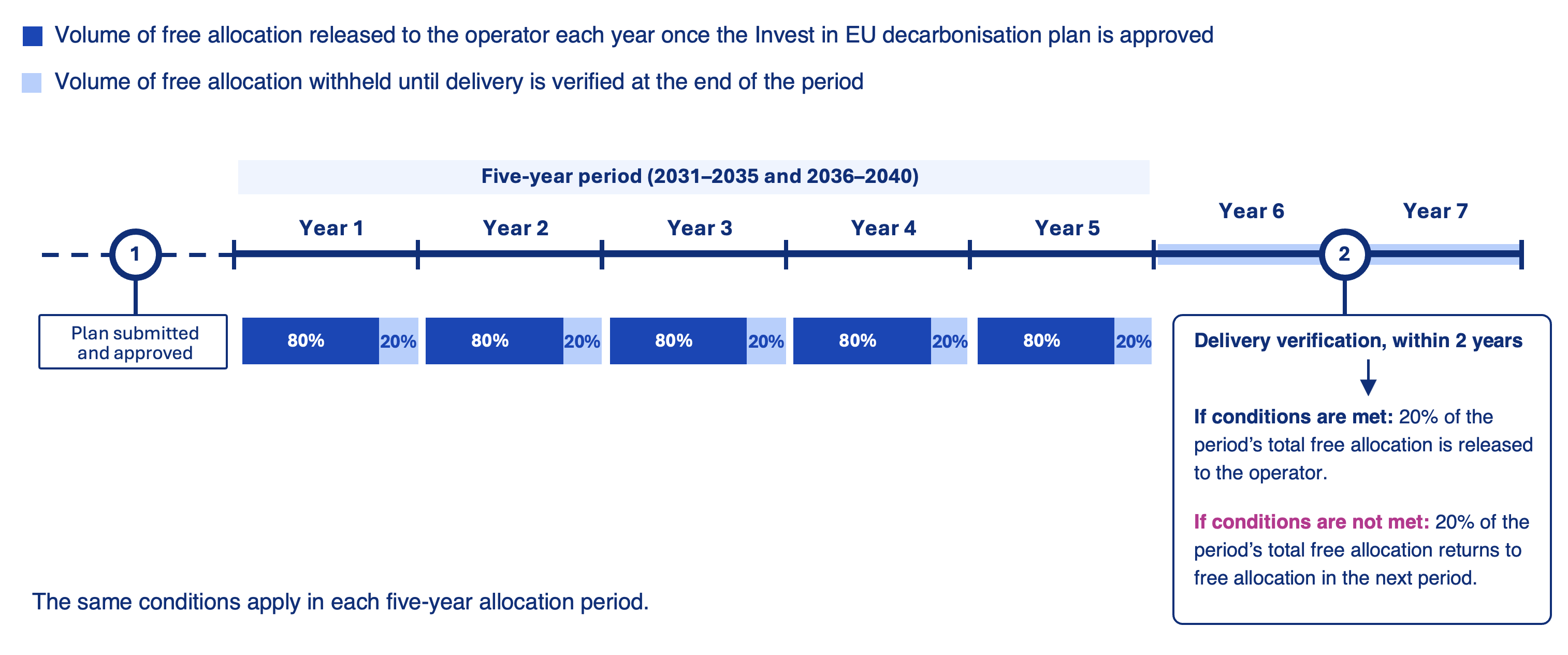
The effect, however, is that only the withheld 20% is directly contingent on verified delivery of the investment. The first 80% of free allowances is released against the plan alone. Once it is granted, there is no equivalent mechanism to reclaim it if the investment is not made, except where the operator relocates outside the Union. The larger part of the allocation is therefore not conditioned on verified delivery, and the main consequence of not investing is the loss of the final 20%, which is not established until the end of the period. Because most of it has already been received, that 20% may provide too limited an incentive to ensure that the required investment is delivered. There is therefore a significant risk that most of the free allocation is disbursed without securing the investment it is meant to support.
At the same time, withholding part of the allocation increases an operator’s exposure to carbon costs during the period, potentially requiring it to purchase additional allowances or draw on existing holdings while financing its decarbonisation investment. Strengthening conditionality therefore requires balancing stronger incentives for investment delivery with the financial pressures facing operators undertaking capital-intensive projects.
Introducing an intermediate assessment of investment progress would strengthen the link between free allocation and decarbonisation by making part of the allocation conditional on demonstrable steps towards implementation, rather than relying solely on plan approval and final verification.
The risk that free allocation is disbursed without securing investment is compounded by what becomes of the allocation the conditionality holds back, since allowances that are never released – whether because no plan is approved or because the conditions are not met – are not withdrawn but returned to the free allocation envelope in the following period.
The Commission’s Impact Assessment had considered a different approach, in which the conditional share of free allocation would rise each year, from 20% in 2031 to 100% in 2035, while the remaining share would be unconditional. The conditional share would be released only once the operator had taken a binding financing decision for an investment of equivalent value, with implementation verified at the end of the period.
The effectiveness of the investment obligation will also depend on which costs qualify as decarbonisation expenditure. Industrial decarbonisation pathways differ in their balance between upfront capital expenditure (CAPEX) and ongoing operating expenditure (OPEX). For technologies such as carbon capture and storage or processes relying on lower-carbon energy inputs, operating costs can represent a substantial share of the expenditure required to achieve emissions reductions. Although recital 46 already recognises both CAPEX and OPEX, their eligibility is not explicitly established in the operative provisions. This risks disadvantaging decarbonisation pathways with higher operating costs, making it important to recognise both categories while ensuring that eligible expenditure is directly linked to decarbonisation rather than ordinary business operations.
The proposal also allows operators to meet the investment obligation jointly rather than individually. Under Article 10a(3d), several installations may form a pool through a joint decarbonisation investment agreement, under which one or more of them invest on behalf of the others, provided that the combined investment corresponds to at least the economic value of 100% of the free allocation granted to all installations in the pool over the five-year period. This is a sensible flexibility, since installations differ in their access to the infrastructure decarbonisation depends on, including CO2 transport and storage, electricity grids and hydrogen, and it allows investment to be directed to where it can deliver the greatest decarbonisation benefit.
Several conditions that will determine how pooling works in practice are left to delegated acts under Article 10a(3e). The proposal envisages a higher level of emissions reduction from the installation that invests on behalf of the pool but does not say how much higher, and it defers the distribution of liability between pool members, should the pool fall short of its obligation, to those acts. The agreement must also be concluded before any installation in the pool applies for free allocation, and no further member can join until the following five-year period, when a new agreement, plan and investment obligation apply.
Policy recommendations:
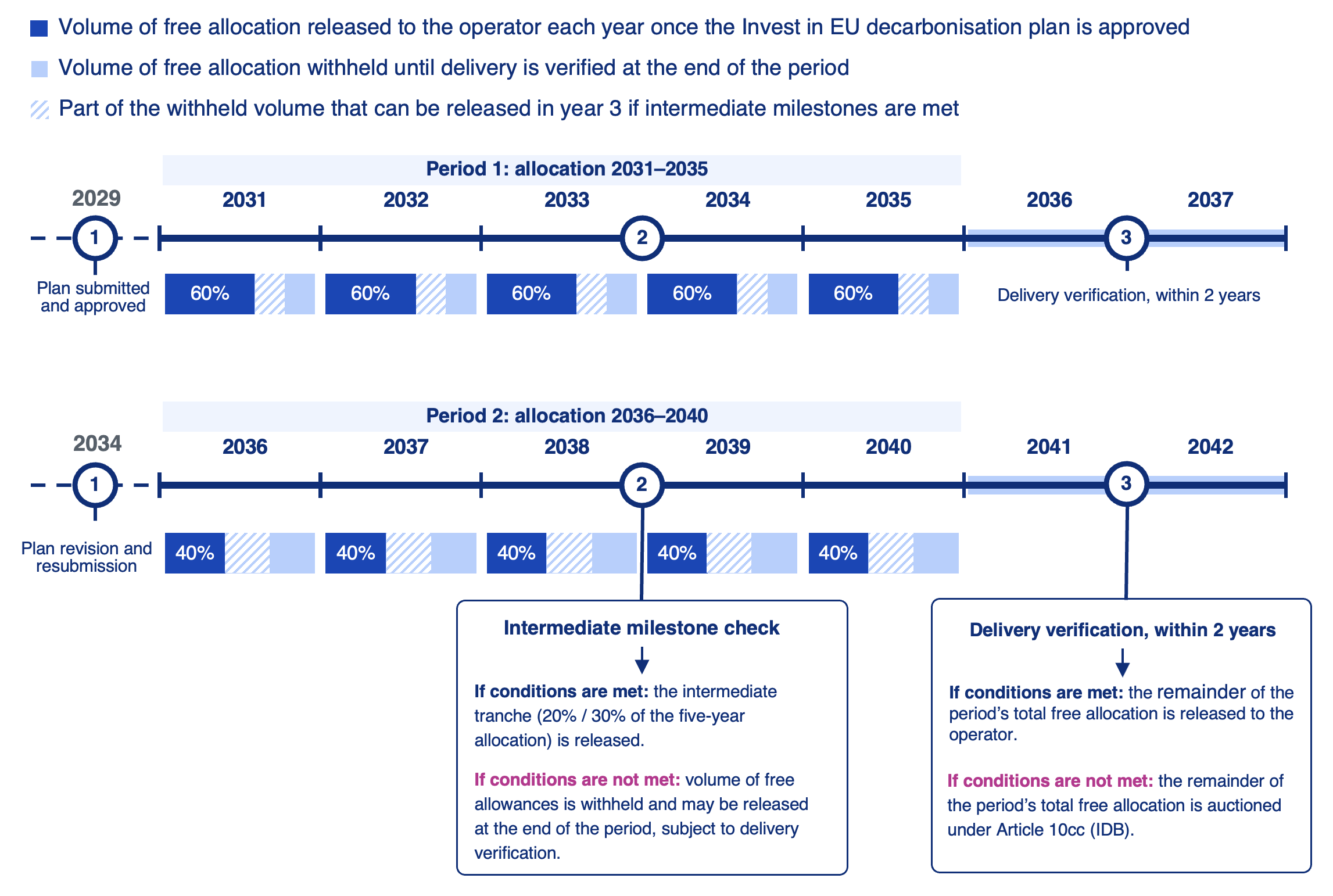
- Strengthen conditionality by progressively increasing the share of free allocation subject to investment progress and delivery requirements. For 2031–2035, 60% should be released following approval of the Invest in EU decarbonisation plan, 20% at an intermediate stage, and the remaining 20% following verified investment implementation and significant emissions reductions. For 2036–2040, these shares should change to 40%, 30% and 30%, respectively.
- Introduce a milestone-based intermediate tranche. Release 20% of free allocation for 2031–2035, increasing to 30% for 2036–2040, in the third year of each period only where the operator demonstrates substantial progress against agreed milestones and indicators, including completed feasibility studies as a minimum. Where progress is insufficient, the tranche should remain withheld but may be released at the end of the period if the required progress is subsequently demonstrated.
- Allowances withheld because no plan is approved or the conditions are not met should be auctioned, rather than returned to free allocation in the following period. The proceeds should be directed to the IDB.
- Clarify that the definitions of “significant emissions reductions” by delegated act will include sector-specific thresholds linked to available near-zero options for each sector.
- Extend recognition of previous project assessments beyond the IDB, the Investment Booster and the Innovation Fund. Projects that have undergone an assessment under a Union programme or national instrument applying equivalent or more stringent quality, investment or decarbonisation criteria, including those awarded a Competitiveness Seal, should be deemed to fulfil the corresponding Invest in EU decarbonisation plan requirements to the extent covered by that assessment.
- Explicitly recognise both CAPEX and OPEX as eligible decarbonisation investment in the operative provisions. Article 10a(3b) should specify that both CAPEX and OPEX may qualify where directly attributable to the implementation, operation or maintenance of decarbonisation measures contributing to significant emissions reductions. The delegated act under Article 10a(3e) should establish detailed eligibility criteria, distinguishing eligible OPEX from ordinary operating costs.
Figure 2. Conditions for receiving free allocation under CATF’s proposal