

Digging deeper: $20 million to kickstart next-generation geothermal in California


California’s 2026 budget included $20 million for geothermal exploration, mapping, characterization, and development. The funding is designed to overcome early-stage exploration risk, which is a major barrier to project deployment in the state. The program’s cost share model will ensure every state dollar is matched by non-state funding, bringing the total potential investment to $40 million. If implemented successfully, this program could help derisk the subsurface in high-potential geologic regions, which could crowd in large amounts of private investment and launch next-generation geothermal projects throughout the state to provide the clean firm energy that California needs.
Why geothermal matters for California
Geothermal energy is a clean firm energy source, providing zero-carbon, always available electricity. California is a global leader in conventional geothermal, which produces power from existing pockets of hot water in the Earth’s subsurface. But in recent years, the geothermal map has expanded dramatically with the advent of next-generation geothermal: power that can be created anywhere the Earth’s subsurface is warm, without looking for pockets of hot water. CATF’s modeling indicates that just 1% of the highest-temperature geothermal resources available in California at currently accessible depths (superhot rock geothermal) could produce 35 gigawatts of power, translating to nearly 300,000 gigawatt-hours of power annually – about the same amount the entire state consumed in 2023.
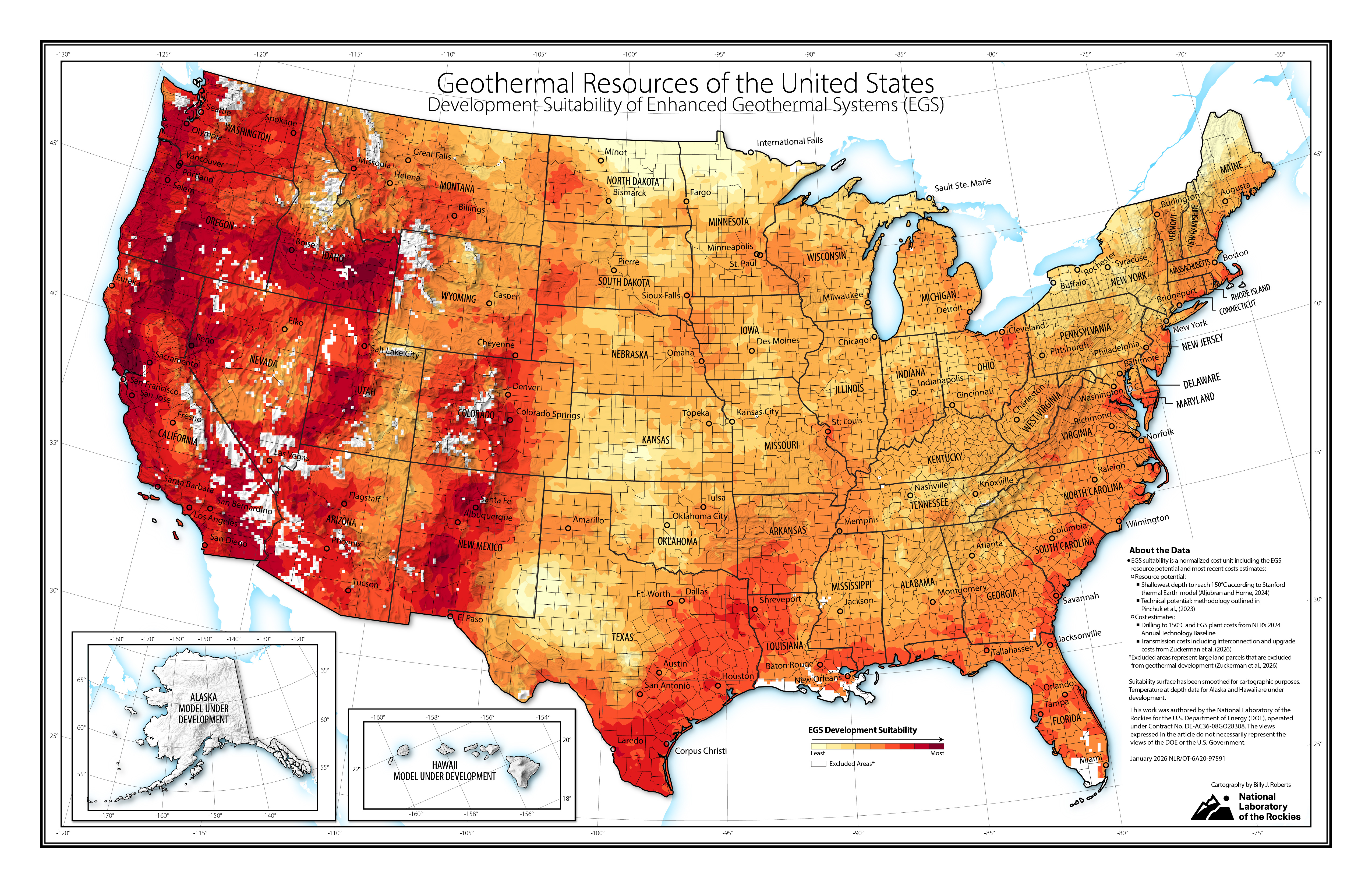
Geothermal can provide enormous benefits to California.
- The availability of clean firm resources like next-generation geothermal can reduce annual electricity supply costs by $10-44 billion by 2045.
- Clean firm energy reduces the amount of new generating capacity necessary to achieve California’s clean energy targets. It also provides flexibility for the required pace of renewables deployment while helping address land-use constraints through its smaller surface footprint.
- As California advances its clean energy goals, next-generation geothermal can provide an onramp for experienced oil and gas workers to bring their expertise to the state’s clean firm power sector – supporting good-paying jobs in communities with a legacy of energy development.
Public investment in appraisal can unlock geothermal development
Next-generation geothermal projects are planned or underway in Utah, Nevada, Oregon, New Mexico, and Texas, but relatively few projects have been announced in California despite the state’s rich subsurface heat endowment. High upfront costs and insufficient understanding of large portions of California’s geology remain significant barriers to development.
Appraisal – drilling the first full-scale wells on a site and creating connectivity between them – are critical to understanding subsurface conditions and assessing whether a project is viable, but they are expensive, costing as much as $20 million (or more) depending on well depth and geology. Because appraisal drilling has high costs and involves significant uncertainty about resource viability, it can be difficult to attract private financing for this phase. These risks recur in each new geologic region, with the first appraisal wells holding the highest risk. Information gained through appraisal wells will reduce uncertainty for subsequent projects, especially if data is shared publicly. By sharing the upfront costs of appraisal and making subsurface data publicly available, state funding can help reduce risks for early developers and unlock geothermal development across California.
Maximizing the impact of California’s geothermal funding
The $20 million in state funding can help kickstart a next-generation geothermal industry in the state and crowd in additional private capital if implemented successfully. Key features of an effective design for the program include:
- Catalyze the development of new projects. The highest-impact use of these funds is to launch projects which would not have otherwise occurred, rather than simply supporting projects already moving forward. The state should prioritize applicants who illustrate that state funding would be catalytic for their proposed project.
- Fund next-generation geothermal projects. California is home to many conventional geothermal projects, including the world’s largest producing geothermal field, and it is a mature technology that has existed for decades. Next-generation geothermal has much larger potential in California but faces greater early-stage technical and financial risks as an emerging energy source. Limiting the state funding to next-generation geothermal can help address these risks and catalyze the development of a new industry in the state.
- Focus funding on appraisal drilling (i.e., drilling the first full-scale wells and creating connectivity between them). Appraisal drilling is the riskiest stage of geothermal development, and private capital is generally unwilling to fund it.
- Prioritize meaningful eligible award amounts calibrated to the high cost of exploratory drilling. The total program size is $20 million with a statutorily-mandated 50% cost share. The maximum eligible award amount should be large enough to meaningfully reduce financial risk and attract developer participation. For example, funding two projects at $10 million each would cover approximately half the cost of a typical appraisal well (though costs vary by location and project details), while reducing exploration risk in multiple locations and generating subsurface data that could support future development.
- Spread funding across companies. To ensure that multiple companies can contribute to California’s geothermal future, limit this funding to only one award per company.
- Fund projects in at least two distinct geological regions of the state, including at least one project in a new region. California has a long history of conventional geothermal development, concentrated near four locations: the Geysers, Salton Sea, Mammoth, and Coso. For next-generation geothermal to fulfill its full potential, more projects will need to be sited in more regions of the state, beyond those four locations. The first project in any new region is riskier than later projects, so private financiers are often unwilling to support those projects. Funding at least one project in a new geologic region – one without a history of geothermal development – will help derisk that location.
- Provide funding certainty. Developing the first next-generation geothermal project in a region is seen as risky by investors. State funding can play a unique role in absorbing this early-stage technical risk, enabling the activities necessary to crowd in private investment and generating information to determine project viability. California should ensure that eligible drilling and stimulation costs will be reimbursed provided the funded activities are completed in accordance with the grant requirements, regardless of whether the wells ultimately achieve connectivity or sufficient flow rates. Certainty about reimbursement is necessary for developers to be able to find private financing for projects in this program.
- Have a line of sight to full-scale development. When determining which applications to fund, the state should prioritize applicants who seem likely to be able to turn successful appraisal drilling into a full-scale project. The most important consideration is whether applicants have a technology and approach that is economically viable and could produce power at competitive prices. The state should also consider transmission access (e.g., availability of nearby interconnection capacity) and permitting (e.g., applicants with a history of successful development, line of sight on permits, and/or strong relationships with communities and key stakeholders near the project site). Integrating these factors into application decisions will help ensure that the program results in commercial-scale geothermal development.
If it is designed thoughtfully, California’s $20 million geothermal demonstration financing program can be a crucial step towards a future of abundant clean firm energy produced in California, for Californians.

