
Landfill methane is misunderstood. Three myths are undermining effective mitigation efforts.

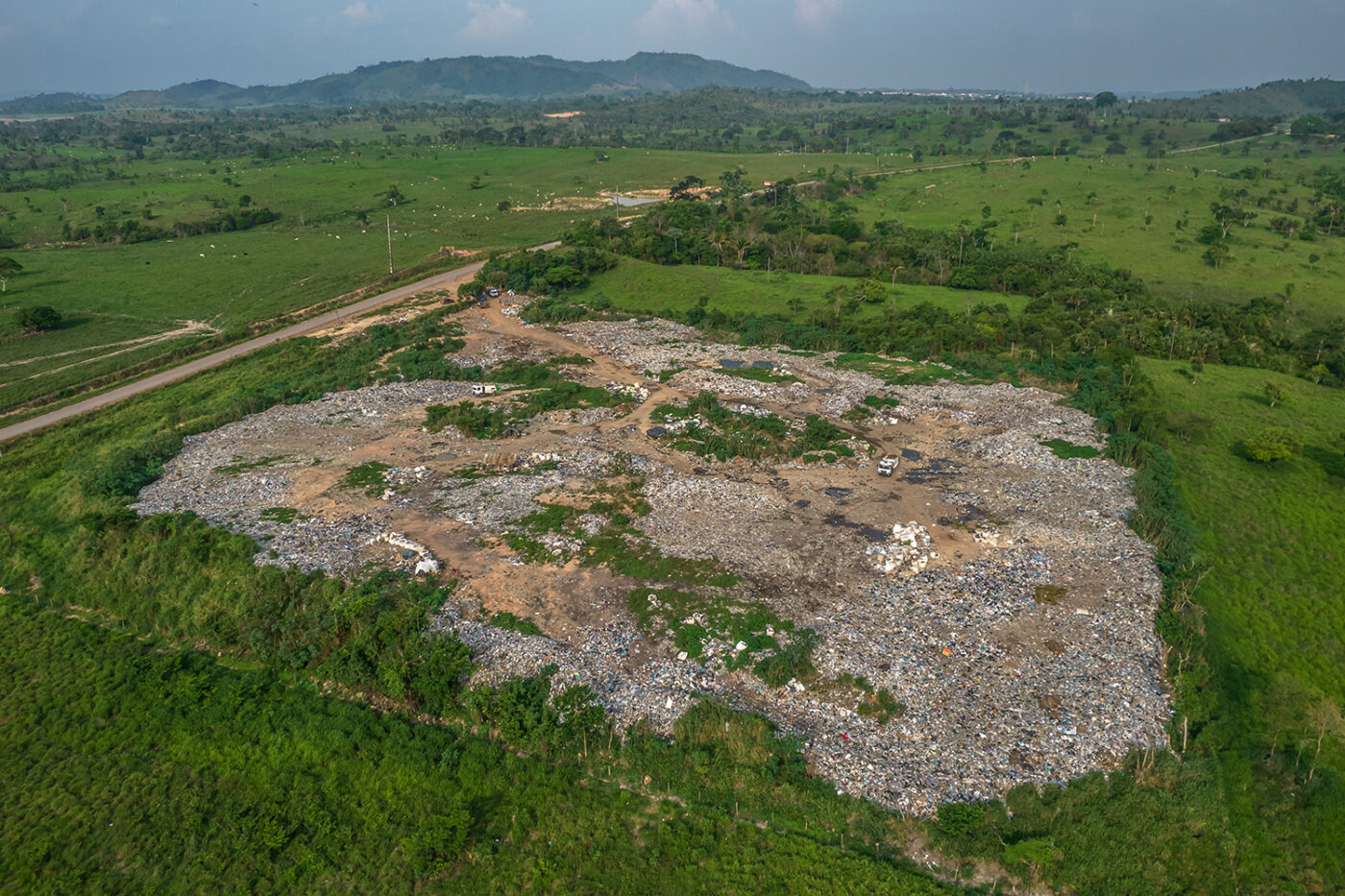
Solid waste disposal sites remain one of the largest sources of global waste methane emissions. Methane is generated when organic waste—such as food and yard waste—decomposes in low- or zero-oxygen (anaerobic) conditions at landfills and dumpsites. These emissions are expected to grow as waste volumes increase rapidly, particularly in low- and middle-income countries where waste management systems are often underdeveloped. Many countries continue to rely on open dumping as a primary method of waste disposal, exacerbating methane emissions while also creating environmental and public health risks. This policy brief examines three common myths about methane mitigation at solid waste disposal sites. It contrasts these myths with current evidence, global trends, and country experiences.
Myth: Installing gas capture systems at landfills is enough to curb methane emissions.
A common perception is that landfill gas capture systems are a straightforward, easy to implement, engineering-based methane mitigation solution that does not require fundamental changes in how waste is generated or separated. By contrast, alternative solutions like organic waste diversion are often viewed as complex and costly. They require behavioral change, new collection systems, and coordination across multiple actors and levels of government. Furthermore, gas capture systems generate measurable outputs (e.g., volume of gas collected, flared, or converted to energy), and often generate revenue through electricity or gas sales, making them a visible and politically attractive solution.
Fact: Gas capture systems cannot capture all methane emissions from landfills.
Landfill gas capture systems, while essential, cannot capture all methane generated by a disposal site. When well-operated and maintained, landfill gas capture systems can achieve as much as 90% methane recovery; but in most cases, the default methane recovery is about 50%. Poorly performing gas capture systems can even create pathways that allow methane to migrate and escape more easily, increasing the risk of large-scale emissions (i.e., super-emitter events).
The efficiency of gas capture systems is impacted by several technical and operational factors.
- Gas capture systems require consistent and precise operation to function effectively yet monitoring and maintenance practices are often not stringent enough to sustain optimal performance.
- Not all gas capture systems are optimally designed in the first place. Poor system design, including inadequate well spacing, incomplete coverage, and improper installation, can leave portions of the landfill unmanaged, allowing methane to accumulate and escape.
- System failures, such as leaks in pipes or wellheads or malfunctioning flares, can reduce system efficiency.
- Gas capture systems cannot be implemented in active landfill areas where waste is still being deposited. In these zones, anaerobic conditions can develop rapidly, allowing methane to form and escape into the atmosphere in the absence of adequate surface cover.
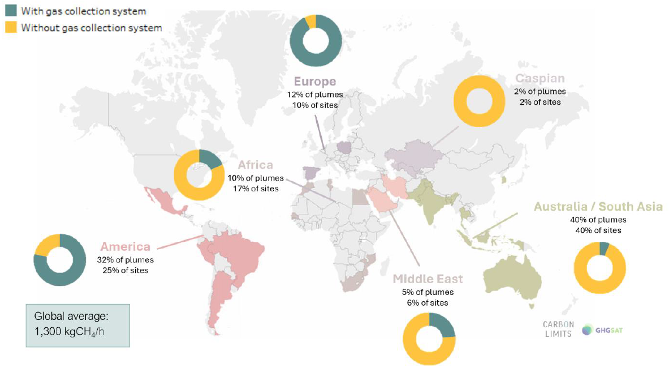
Satellite observations have detected methane plumes at sites with gas systems in place. A Carbon Limits study of satellite-detected methane super-emitting plumes in 2021-2022, identified more than 800 emission points originating from 89 landfills and dumpsites within a subset of countries (see Figure 1). Notably, over 30% of these emissions came from just 28 sites that appeared to have gas capture systems installed. These sites exhibited even higher average emission rates than those without such gas capture systems. These findings show that gas capture systems, without proper operations and maintenance, do not eliminate methane emissions.
Figure 1: Summary of landfill sites observed via satellite detections. Countries are colored based on their associated region. Countries in light grey were not covered by the study.
Organic waste diversion plays a critical role in methane mitigation. As the primary driver of methane generation at landfills and dumpsites, organic waste should be diverted to prevent methane from being generated in the first place. While landfill gas capture systems attempt to collect methane that has already been generated, organic waste diversion avoids future emissions by reducing the volume of degradable material entering landfills. By addressing emissions at their source, diversion provides a durable mitigation strategy that not only prevents methane generation but also reduces odors and pests, minimizes leachate, and conserves landfill space.
Myth: Gas capture is the only mitigation solution at a landfill.
Landfill gas capture systems are often treated as the default solution to controlling methane emissions at landfills because they are well-established and proven at many landfills across the globe. Many policymakers and landfill operators have exposure to gas capture systems due to their long history of use and standardized design approaches. By contrast, alternative strategies, implementing biosystems or improving landfill operations, are less widely understood and, as such, often overlooked.
Fact: Methane mitigation at landfills is not limited to gas capture.
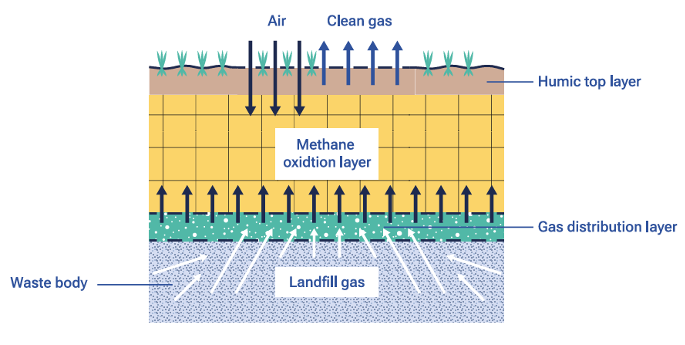
An alternative or complementary approach to the installation of a landfill gas capture system is the application of a microbial methane oxidation system. This system consists of several engineered layers that work together to ensure that the methane generated by the waste body is oxidized (i.e., converted into carbon dioxide and water). As illustrated in Figure 2, methane generated in the waste body rises upwards and first enters a gas distribution layer, which spreads the gas evenly across the landfill. The methane then passes into the methane oxidation layer—typically made of compost or amended soil—where methanotrophic (methane-consuming) bacteria convert methane into carbon dioxide and water. A top layer with vegetation allows oxygen to flow downward into the methane oxidation layer, creating the conditions needed for methanotrophs to oxidize methane.
Figure 2: Methane oxidation cover
Biocovers are a type of microbial methane oxidation system. They are typically applied across the entire landfill surface to intercept methane as it moves upward from the waste body. A study by the Climate and Clean Air Coalition found that biocovers are most effective at landfills where methane generation rates are low (e.g., old, closed, or unmanaged landfills) and landfill gas capture infrastructure is not feasible. Biofilters and biowindows are other types of microbial methane oxidation systems that build on the same concept but are designed for more targeted emissions reduction applications. Biowindows, for example, are methane oxidation layers typically applied to a small section of a landfill to enhance methane oxidation in targeted areas with higher emissions. Similarly, biofilters are methane oxidation layers applied to a specific gas vent or collection point.
Another approach to reducing methane at landfills is improving landfill operations. Key measures include minimizing the size of active working faces—the areas where waste is actively deposited and a major source of methane emissions—and strengthening daily, intermediate, and final cover practices to limit the release of landfill gas into the atmosphere. Improving moisture and leachate management can also influence how quickly organic waste decomposes and how methane moves through the landfill. In addition, surface emissions monitoring is critical to identify super-emitters so that operators can take targeted corrective actions.
Myth: Flaring landfill gas eliminates methane.
Flaring is widely promoted as a highly effective methane control technology. Under ideal conditions, flares are typically expected to destroy over 98% of methane. This assumption has led to a simplified narrative that once landfill gas is captured and sent to a flare, methane emissions are essentially eliminated. In many cases, flare systems are designed and permitted based on these high-performance assumptions, reinforcing the perception that flaring is a near-perfect solution.
Fact: Flaring does not fully eliminate methane emissions.
Flaring can significantly reduce methane emissions but does not eliminate them completely. Flares do not always achieve complete combustion. Methane destruction depends on maintaining stable combustion conditions, including sufficient temperature, proper mixing with air, and consistent gas flow. In practice, these conditions are not always met. External factors such as wind, precipitation, and fluctuating gas quality can disrupt combustion, allowing some methane to pass through the flare unburned.
Furthermore, not all types of flares perform equally well. There are important differences between flare designs. Open (candlestick) flares, for example, are simpler and less expensive, but expose the flame directly to the environment, making them more sensitive to wind and temperature changes. As a result, these flares have lower and more variable methane destruction efficiencies. Enclosed flares, which use a combustion chamber to better control temperature and airflow, allowing more efficient and consistent methane destruction, often exceeding 98% under proper operations. However, these systems are more costly and require more advanced operation and maintenance.
Most importantly, flares only destroy methane that is actually collected. Landfill gas collection systems are inherently imperfect. Even well-designed and well-operated systems typically collect only a portion of methane generated in the waste body. Studies have shown that gas collection efficiencies can vary widely, often ranging from about 50% to 95% depending on landfill design, age, and operational practices. This means that a significant share of methane can bypass a gas collection system entirely and escape directly into the atmosphere without ever reaching the flare.
The Path Forward
Reducing methane emissions from solid waste disposal sites requires an integrated, system-wide approach. Governments should prioritize organic waste diversion to prevent methane generation at the source, alongside strengthening landfill gas capture systems through improved design, monitoring, and maintenance to maximize capture efficiency. Implementing alternative solutions, such as biocovers, can reduce methane at landfills where gas capture systems are not feasible. At the same time, improving landfill operational practices, including minimizing the active working face, enhancing cover systems, managing moisture and leachate, and conducting routine surface emissions monitoring, can significantly reduce emissions while reducing odors, controlling pests, and improving public health.
This policy brief is part of the Waste Methane MythBusters Series, a set of policy briefs designed to address common misconceptions on methane mitigation in the waste sector. Read other briefs in the series below:

