

Waste methane is rising fast. Three myths are holding policy action back.

Methane emissions from the waste sector have historically occupied a blind spot in climate policy despite its significant and growing impact on climate change. While over 150 countries now include or acknowledge the waste sector in their national climate plans, only a small number have methane-specific targets, dedicated financing, or enforceable implementation strategies to reduce emissions at scale. Methane is generated gradually over many years at landfills and dumpsites, meaning that policy decisions deferred this decade effectively lock in emissions well into the 2040s and 2050s. This policy brief challenges three common myths that continue to shape waste policymaking and governance—and, in doing so, slow progress on methane mitigation.
Myth: Methane emissions from the waste sector are a minor issue compared to energy and agriculture.
This perception persists in part because the waste sector accounts for roughly 20% of global anthropogenic methane emissions, less than energy or agriculture, reinforcing the view that waste is not a priority sector for mitigation. Furthermore, because methane from landfills and dumpsites is released gradually, the benefits of reducing it take longer to show, weakening the political will for early action. In many low- and middle-income countries, this is compounded by limited public budgets and immediate pressures to prioritize other areas such as energy and food security.
Fact: Methane emissions from the waste sector are rising rapidly and are projected to grow sharply this decade.
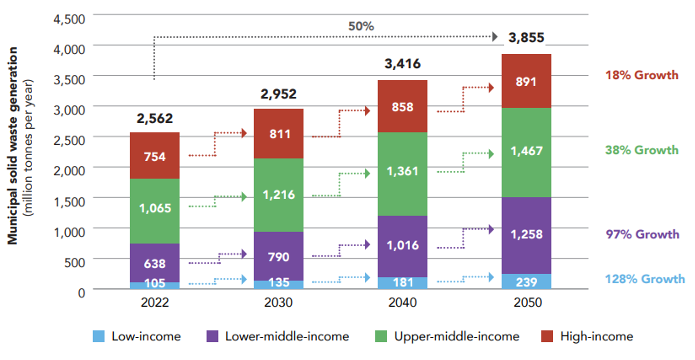
Current trends show that global methane emissions from the waste sector are increasing rapidly with population and economic growth. In 2022, greenhouse gas emissions from solid waste management were estimated at approximately 1.28 billion metric tons of carbon dioxide equivalent (CO2e), with methane accounting for 90% of the total. Looking ahead, global waste generation is projected to grow from 2.56 billion tonnes in 2022 to 3.86 billion metric tons by 2050—a 50% increase (see Figure 1). Much of the growth in waste generation will take place in low- and lower-middle-income countries, placing increasing strain on solid waste management systems. Where systems fail to keep pace, large amounts of organic waste will accumulate in landfills and dumpsites, generating methane.
In this decade alone, if no additional actions are taken, methane emissions from the waste sector are expected to increase by roughly 10 million metric tons (Mt)/year, roughly equal to increases in the agriculture sector (11 MT/year) and outpacing projected changes in the fossil fuels sector (approximate decrease of 4 Mt/year). By 2050, increases in waste sector emissions (40 MT/year), greatly exceed those in the fossil fuel (11 MT/year), and agriculture sectors (25 MT/year).
Figure 1: Projected waste generation by income group
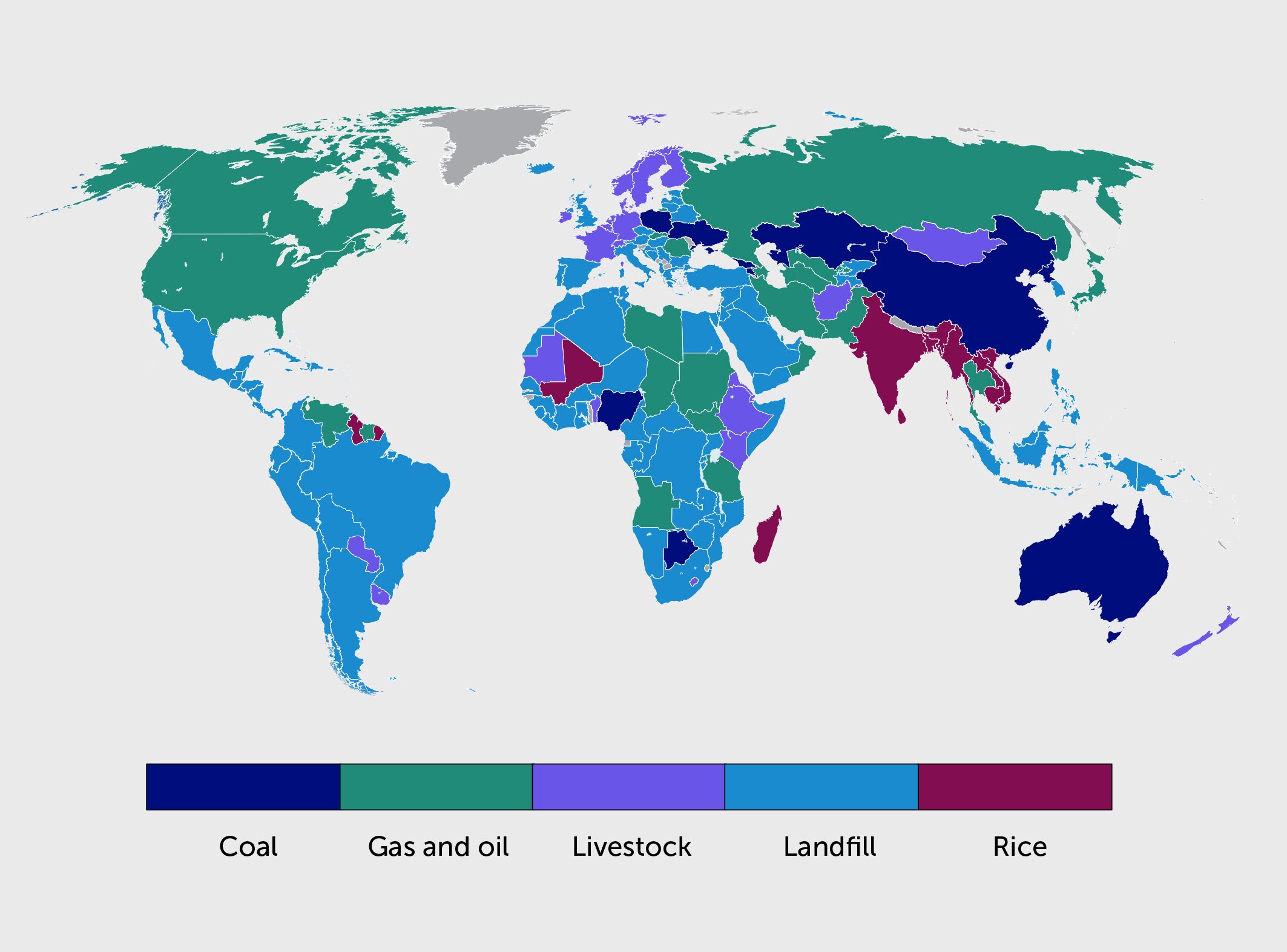
While waste accounts for roughly 20% of global methane emissions, its share is far higher in many countries, especially where organic waste makes up most of what’s discarded or waste disposal systems are underdeveloped. As shown in Figure 2, landfills have the largest methane mitigation potential in many countries in the Middle East, Southern Africa, and South America. These regions are also where waste generation is growing fastest and where basic waste management infrastructure is often weakest.
Figure 2: Methane mitigation potential by sector
Solutions to reduce methane emissions from the waste sector already exist, yet they remain unimplemented in many countries. Studies show that up to 80% of emissions could be reduced using existing technologies such as composting, anaerobic digestion, and landfill gas capture. Beyond climate benefits, these solutions improve local air quality, reduce pests, and prevent public health risks. When these co-benefits are considered, around 60% of measures deliver results with low or even negative costs. Waste infrastructure built today will shape methane emissions for decades, so implementing these solutions now is critical to avoid complex and costly retrofits in the future.
Myth: National governments play a limited role in waste methane mitigation.
Waste collection and disposal services are typically delivered by cities and local authorities. Waste is often framed as a sanitation or service delivery issue rather than a climate issue, leaving it outside of national climate and energy strategies. As a result, national governments limit their role to setting broad solid waste management strategies, leaving implementation, financing, and enforcement to municipalities with widely varying capacity and resources.
Fact: National policies that set consistent standards, mobilize financing, and ensure enforcement across jurisdictions are essential for durable waste methane reductions.
Cities play a critical role in reducing methane from the waste sector, and in many cases are already driving progress. Some municipal governments have piloted organic waste diversion, improved collection systems, and invested in landfill gas controls, demonstrating what is possible even without national government intervention. However, municipal action alone is not sufficient to deliver sustained methane reductions. Cities operate under widely varying rules, funding constraints, and limited technical capacity, leading to fragmented coverage or poorly executed programs or projects. National policies are needed to enable city-level approaches to be scaled and sustained.
India’s experience illustrates how national policy can unlock and scale city-level actions. Before the adoption of the 2016 Solid Waste Management Rule, waste management in India was highly fragmented. Many municipalities lacked technical capacity, resources, and incentives to invest in source separation, organic waste treatment, and improved landfill design and operations, leading to heavy reliance on open dumping and burning of waste. The 2016 rules established a national framework that clarified rules and responsibilities across levels of government, required source segregation of waste, set minimum standards for the treatment and disposal of waste, and created the basis for monitoring and enforcement. This rule was accompanied by training programs, technical assistance, grant-based financing, and other incentives to support municipalities with implementation.
Myth: Legislative and regulatory approaches are sufficient to achieve significant methane emissions reduction from the waste sector.
National regulations are often prioritized because they have defined obligations and legal enforceability, giving policymakers greater confidence that actions will occur. By contrast, public education is sometimes perceived as less predictable and harder to measure because these programs rely on voluntary behavior change, which can take time and vary widely across households and communities. Incentive programs require careful design to ensure they are large enough to influence behavior, equitably distributed, and fiscally sustainable. As a result, these measures are frequently treated as optional add-ons rather than core components of waste methane mitigation strategies, especially in resource-constrained countries.
Fact: Public education and incentives are essential complements to regulations.
Reducing methane emissions from the waste sector depends heavily on everyday behavior that regulation alone cannot control. Policies such as source separation requirements, food waste reduction targets, or landfill diversion mandates ultimately rely on households, businesses, and institutions to change how they generate, separate, and manage waste. Without public buy-in and participation, even well-designed regulations are at risk for low compliance and limited impact.
Evidence shows that public education can deliver meaningful methane reductions by shaping these daily decisions. In the United Kingdom, the Love Food Hate Waste campaign focused on household behaviors such as meal planning, food storage, understanding date labels, and using leftovers. Between 2007 and 2018, household food waste fell by roughly 26%, demonstrating how sustained public engagement can reduce organic waste at the source and prevent methane emissions before they occur.
South Korea’s food waste recycling program initially faced strong public pushback when households were required to pay additional fees for food waste disposal. Rather than rolling back the policy, authorities expanded public education and outreach to explain the rationale, benefits, and operation of the system. These efforts helped increase acceptance and compliance, allowing the program to reduce food waste and the associated methane emissions.
The path forward
Misconceptions about waste methane have pushed the sector down the political agenda at precisely the moment when early action matters most. The evidence is clear: methane emissions from solid waste are rapidly growing, and reductions are essential to keep climate goals within reach. National governments need to elevate the waste sector as a priority by setting methane-specific targets and allocating dedicated funding streams for abatement projects to avoid long-term infrastructure and emissions lock-in. They should develop national solid waste management frameworks that set consistent standards, mobilize financing, and ensure consistent implementation across cities. Integrating public engagement and incentives alongside regulations is critical to strengthen compliance and deliver durable methane reductions.
This policy brief is part of the Waste Methane MythBusters Series, a set of policy briefs designed to address common misconceptions on methane mitigation in the waste sector. Read other briefs in the series below:

