
NEPA By the Numbers: What Triggers NEPA Reviews?

Key Findings
- Federal funding is the dominant NEPA trigger for decarbonization-related reviews—9,210 of 20,725 reviews (44.4%). The Department of Energy’s (DOE) grant and loan portfolio generates more decarbonization-related NEPA reviews than any other federal nexus in the dataset.
- But funding-triggered reviews are almost entirely categorically excluded— 99% of reviews for decarbonization technologies are completed through categorical exclusions (CEs). Removing federal funding as a trigger for NEPA would therefore mostly eliminate determinations that already conclude in days or weeks, and consequently would not significantly speed those reviews.
- The triggers that result in more substantial reviews are federal land- and permit-related, not funding-related. Reviews triggered by federal land access or federal permits generate proportionally far more environmental assessments (EAs) and environmental impact statements (EISs).
- There are clear patterns in review triggers. Reviews in the dataset for transmission projects are most commonly triggered by the federal power marketing administrations, which build, own, and operate transmission lines; certain technologies (carbon capture, hydrokinetic, energy storage) are the most funding-driven; and solar and onshore wind are mostly funding-triggered, with Bureau of Land Management (BLM) land access the clear second trigger.
Introduction
The National Environmental Policy Act (NEPA) is a foundational environmental law that has, for more than fifty years, ensured that federal agencies consider the environmental impacts of a proposed major federal action. NEPA requires federal agencies to consider the reasonably foreseeable environmental impacts of their activities, integrate those considerations into agency decision making, and enhance public transparency in the decision-making process.
A NEPA review is required when agencies undertake “major Federal actions significantly affecting the quality of the human environment.”1 Common triggers include federal grants and loans, the issuance of permits (e.g., environmental permits and the rights of way on federal lands), and actions taken by a federal agency itself (e.g., to upgrade a federal building).
The scope of what actions should trigger a NEPA review has been the subject of debate and legislation. In the Fiscal Responsibility Act of 2023 (FRA), a major federal action was defined as “an action that the agency carrying out such action determines is subject to substantial Federal control and responsibility.”2 The FRA definition also listed certain activities that do not qualify as a major federal action, including when the federal government provides funds but does not control project outcomes, provides general revenue sharing funds, and provides loans or loan guarantees without “sufficient control and responsibility over the subsequent use of such financial assistance or the effect of the action.”3
More recent proposals suggest narrowing the scope of the actions that would trigger a NEPA review still further, including to:
- Set a dollar threshold over which funding would trigger a NEPA review (proposal from the CEQ guidance template)4
- Exempt the provision of federal funding (including through grants, loans, and loan guarantees) from a NEPA review entirely (proposal from the SPEED Act of 2025 and Problem Solvers Caucus,5 which was later included in the Bipartisan American Affordability and Jobs Act of 2026)
- Exempt projects from a NEPA review if they are also reviewed under “functionally equivalent” federal, state, or Tribal statutes (Problem Solvers Caucus, also included in the Bipartisan American Affordability and Jobs Act of 2026)
However, there exists no research to date on how often various NEPA triggers apply across federal actions, making it unclear if proposed reforms would have any beneficial impact. Research on NEPA has historically been hindered by federal data management practices: NEPA documents are scattered across numerous agency databases, often in machine-unreadable formats that lack basic metadata and other identifiers, and some documents (e.g., categorical exclusion determinations) are not always published as a matter of routine.
The National Environmental Policy Act Text Corpus (NEPATEC) 2.0 dataset, developed as part of the Pacific Northwest National Laboratory’s (PNNL) PermitAI project, is a substantial step toward remedying this situation. The NEPATEC 2.0 dataset contains more than 120,000 NEPA documents from 60,000 reviews prepared by more than 60 different agencies. Nearly 21,000 of these reviews involve decarbonization technologies and nearly 11,000 involve fossil fuel technologies, which are the primary focus of our research. Most records in the NEPATEC 2.0 dataset span the period from 2000 through 2025, with a handful of records from as early as the 1980s. Reviews involving decarbonization technologies mostly span from 2010 through 2025, with a handful of projects recording dates from earlier in the 2000s.
This analysis, part of an ongoing series, uses the NEPATEC 2.0 dataset as a basis for analyzing which NEPA triggers apply to a suite of 20,725 decarbonization-related environmental reviews, thereby adding data-driven evidence to this policy conversation.
Methodology
Scope and trigger definitions
The analysis covers all 20,725 decarbonization projects in NEPATEC 2.0. Each is assigned one primary trigger — the federal nexus that brought it under NEPA:
| Trigger | Federal Nexus |
|---|---|
| Funding | Federal grant, loan guarantee, or financial assistance (e.g., DOE loan programs, Inflation Reduction Act (IRA) grants, Rural Energy for America program) |
| Land | A right-of-way, special use permit, or lease on federal land (often from BLM or the Forest Service) |
| PMA/TVA | A federal power marketing administration (PMA6) or the Tennessee Valley Authority (TVA) acting as project proponent |
| Direct Action | The federal agency itself takes action — building or operating its own facilities (e.g., national laboratories) |
| Permit | A federal license or permit from a regulatory body (e.g., FERC license, Clean Water Act Section 404 permit) |
| Program | A programmatic review, land-use plan, or rulemaking umbrella covers the action |
| Property Transaction | A land exchange, disposal, or conveyance of federal property |
Classification approach and caveats
Triggers were classified by a five-tier pipeline that starts with deterministic agency-to-trigger mappings and hand-labeled examples, then escalates through regex extraction on titles, document text, and purpose-and-need sections, and finally to machine-learning classification for genuinely ambiguous cases. The pipeline resolved 20,642 of 20,725 projects (99.6%); the remaining 0.4% are confirmed NEPA actions whose trigger could not be reliably identified from available text. Several caveats apply:
- Triggers are assigned by priority rules when multiple nexuses exist, so secondary triggers (e.g., a funded project on federal land) are not counted here
- Unknowns concentrate among EAs and EISs, whose longer documents are harder to classify conservatively
- NEPATEC 2.0 contains substantially complete EA and CE data from only BLM and DOE, so these results may not be able to be fully extrapolated to all federal agencies
- The scope of this fact sheet is limited to decarbonization-related reviews7
Results
Funding is the most common review trigger
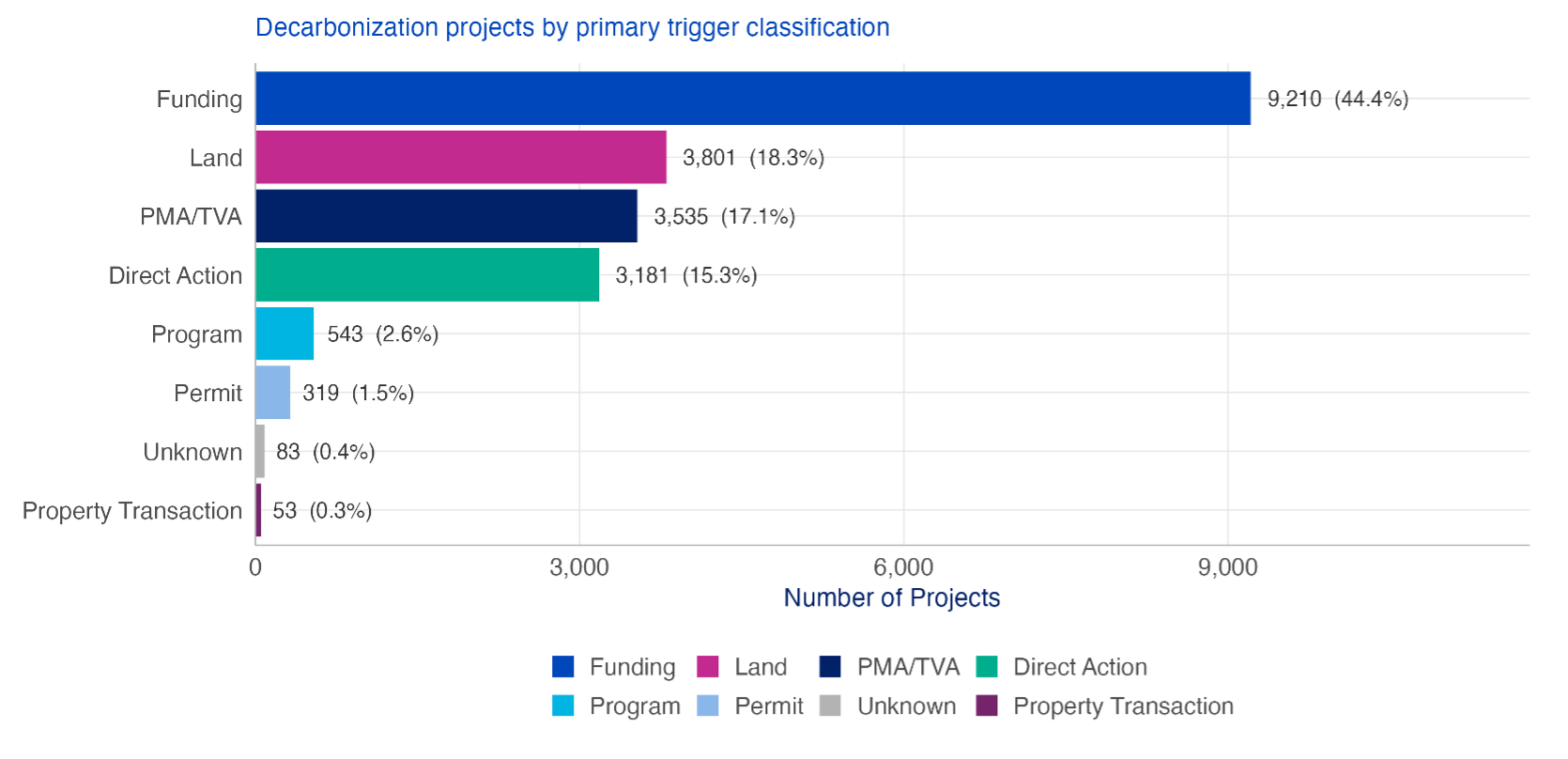
Federal agency funding is the most common trigger, responsible for at least two in five of all decarbonization NEPA reviews (44.4%)(Figure 1). Land access is the second most common NEPA trigger (18.3%), followed by the power marketing administrations and TVA (17.1%) and direct federal action (15.3%), the latter dominated by DOE’s own facilities and laboratories.
Figure 1: Federal Funding Triggers 44% of All Decarbonization NEPA Reviews – More Than Any Other Federal Nexus
Funding-triggered reviews are almost entirely categorically excluded
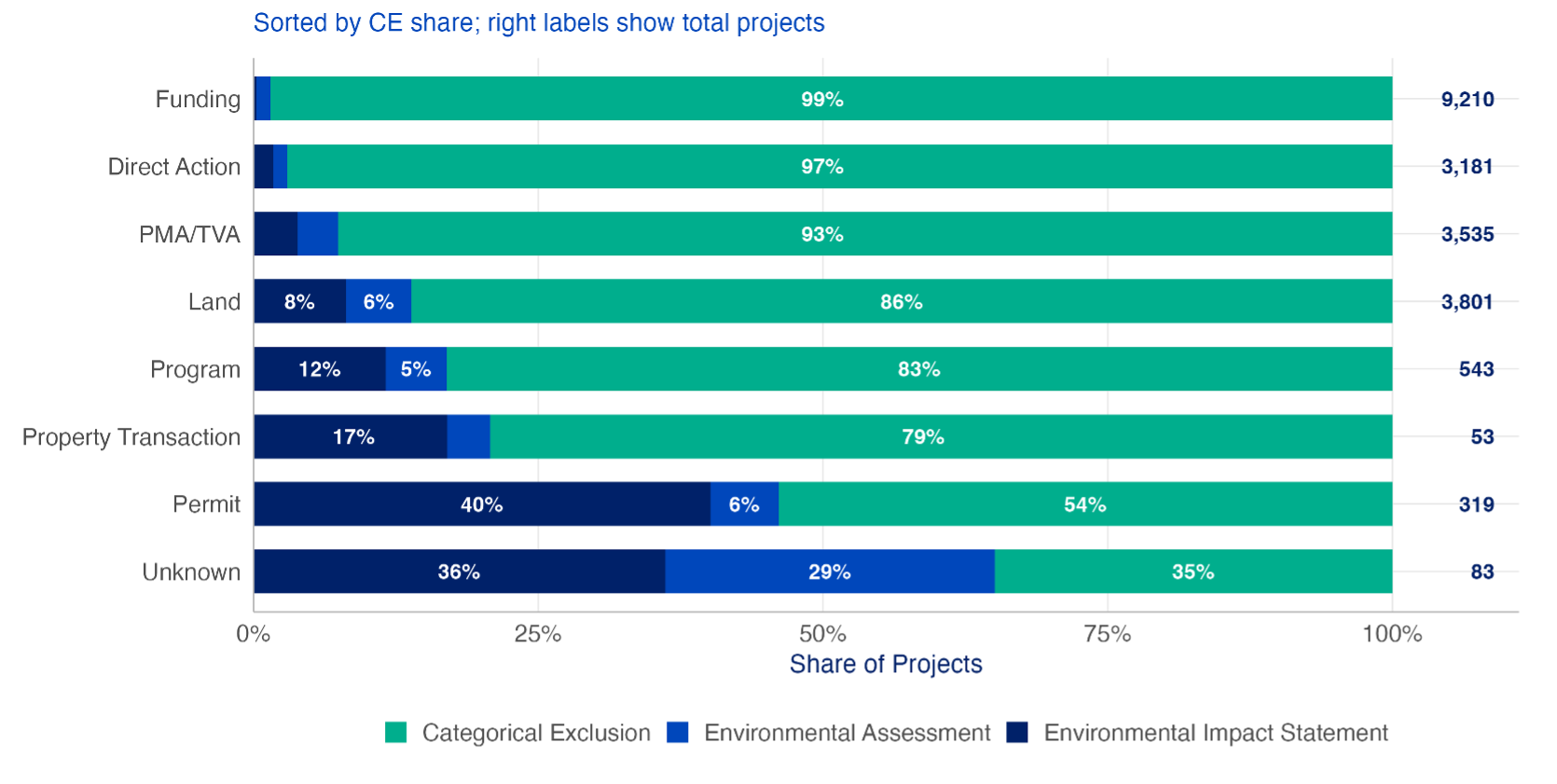
Projects that are triggered by federal funding are almost always categorically excluded. Of the 9,210 reviews in the dataset that exist because of a federal grant or loan, 99% were categorically excluded. Of the remaining 1%, 116 escalated to an EA and just 22 to a full EIS (Figure 2).
Figure 2: Funding-Triggered Reviews Are Almost Entirely Categorically Excluded (99%)
NEPA triggers are unevenly distributed across NEPA review processes
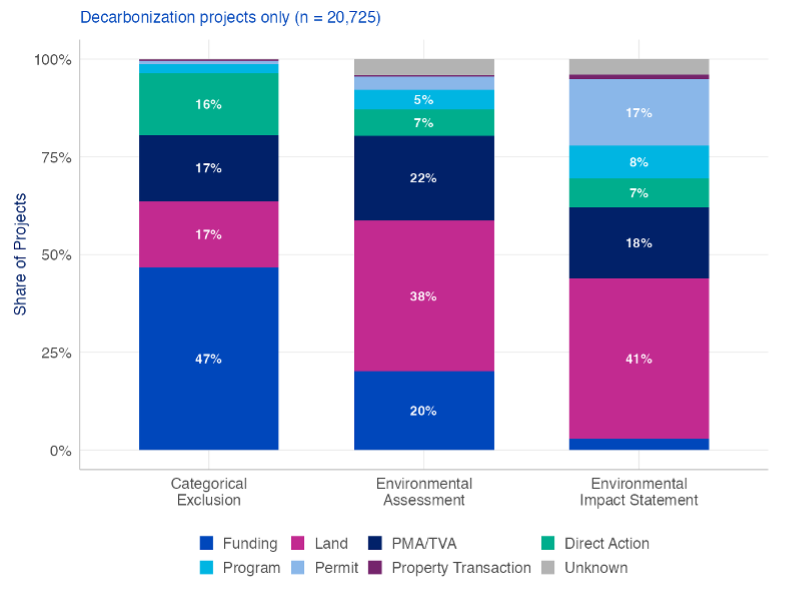
NEPA triggers are unevenly distributed across CEs, EAs, and EISs (Figure 3). Most CEs are triggered by funding — DOE’s energy grant and loan programs generate a high volume of low-complexity actions. EAs show the most balanced mix. EISs skew toward land, PMA/TVA, and permits: the larger, more contested projects tend to be sited on public land, federally built, or federally licensed.
Land- and permit-triggered projects require more substantial reviews more often — 14% and 46%, respectively, are EAs or EISs. Projects that require a permit are the most striking: two in five permit-triggered reviews (40%) are full EISs, by far the highest EIS rate of any trigger. And in absolute terms, federal land access produced 308 EISs — more than any other nexus — even though the land class is less than half the size of the funding class. The gradient is consistent: the further a federal hook moves from writing a check toward authorizing ground disturbance or licensing a facility, the more intensive the review it generates.
Figure 3: NEPA Trigger Type by Review Process
Department jurisdiction shapes the trigger mix
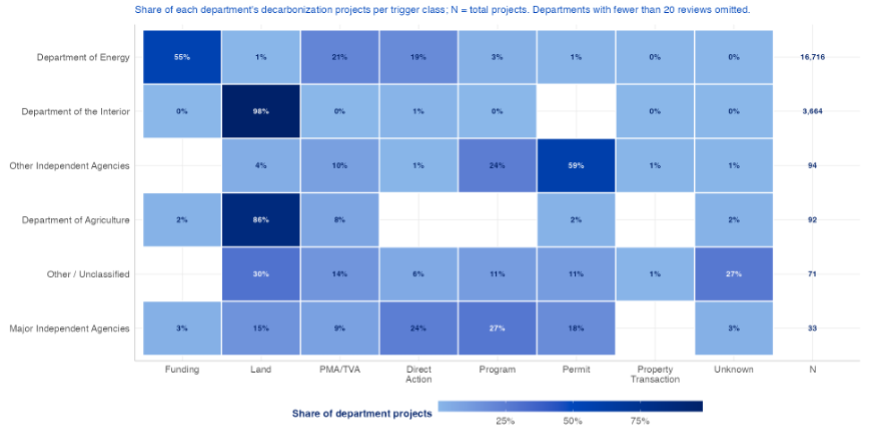
Department patterns follow jurisdiction (Figure 4): DOE projects are largely funding-triggered (with sizable PMA and direct-action shares from the power administrations and national laboratories housed within DOE); Interior (primarily BLM) skews toward land; Agriculture (Forest Service) mirrors Interior at smaller scale (though Forest Service coverage in the dataset is scarcer than for BLM and DOE).
Figure 4: NEPA Trigger Distribution by Federal Department
Technology mirrors the same nexus logic
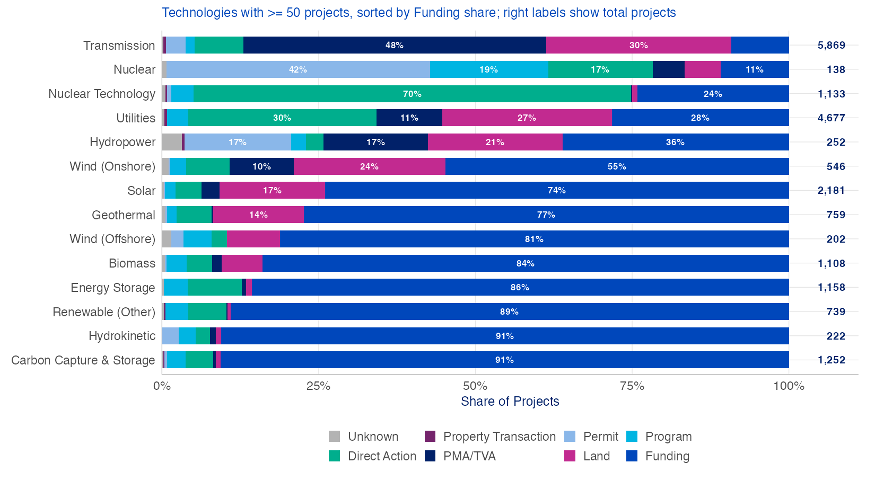
Technology patterns reflect the same nexus logic (Figure 5). The most funding-driven technologies are carbon capture (91%) and hydrokinetic (91%), with the other renewables catch-all category (89%) and energy storage (86%) just behind. Carbon capture and hydrokinetic technologies enter the NEPA process almost exclusively through DOE’s grant programs, because they have to date rarely been sited on federal land or required a federal license. Solar and onshore wind are also mostly funding-triggered (74% and 55%), but land (BLM rights-of-way) is a substantial second nexus (17% and 24%). Transmission is the mirror image — the lowest funding share of any technology (9%) and the highest PMA/TVA share (48%), because those agencies build and maintain federally-owned and operated lines. Hydropower and nuclear stand out for their permit shares (17% and 42%), driven by FERC licensing of non-federal dams for the former and Nuclear Regulatory Commission licensing for the latter.
Figure 5: Primary NEPA Trigger by Energy Technology
Few documents disclose a funding amount, and those that do skew small
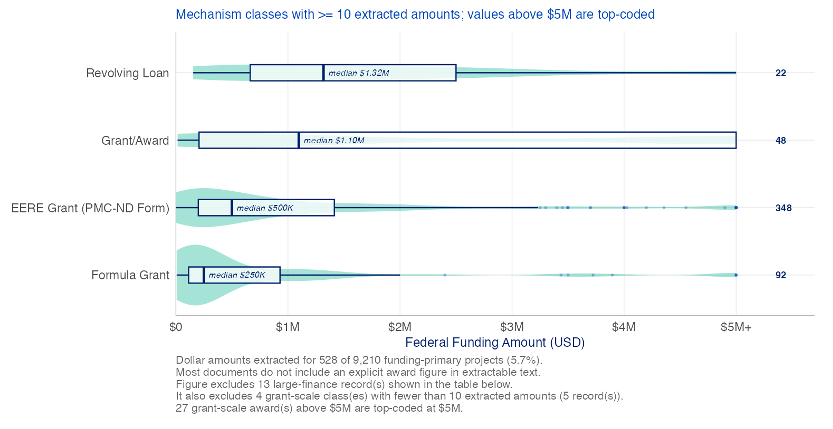
For funding-triggered projects, we also extracted the dollar amounts where documents state them, though most NEPA documents do not report an award figure and therefore it is difficult to draw strong conclusions. The distribution in Figure 6 therefore describes typical award sizes among reviews that disclose them (5% of reviews), not the full portfolio. With that caution, the extracted amounts show most disclosed grant-scale awards falling in the tens of thousands to low millions of dollars, with loan guarantees and cooperative agreements reaching far higher.
Figure 6: Common Grant-Scale Federal Funding Amounts
Conclusion
More than two in five decarbonization NEPA reviews (44.4%) are triggered by federal funding — and those reviews are almost entirely categorically excluded (99%).
In most cases, the federal funding trigger does not add significant time to project reviews. The reviews that are most robust tend to be EAs and EISs for projects on federal land, federally built transmission, and federally licensed facilities.
Two caveats bound these conclusions. The trigger classes that generate the heaviest reviews are also the smallest — only 319 decarbonization reviews are permit-triggered, and 53 are property transactions — so process shares for the rare classes rest on far fewer projects than the funding figures and should be read with corresponding caution. And because each project is assigned a single primary trigger, projects with several federal hooks — a funded project on federal land, a licensed dam that also received a grant — are counted once, understating how often the heavyweight nexuses are in play. Both limitations trace to the same root: nothing in the NEPA process requires an agency to clearly record why NEPA applied. Building trigger identification into NEPA metadata — a structured field naming the federal nexus, or all of them when several apply, captured at the time of review — would replace after-the-fact classification like ours with an authoritative record, just as the CEQ NEPA and Permitting Data and Technology Standard would do for timelines.
Data: NEPATEC 2.0, 20,725 decarbonization projects. Methods and full results: Phase 2 Deliverable 1.
Appendix: Definitions
- Categorical Exclusion (CE): The lowest and least complicated level of NEPA review, used for categories of agency actions with a record demonstrating that the category does not normally significantly affect the environment; takes days or weeks for agencies to complete.
- Environmental Assessment (EA): The middle level of NEPA review, used for agency actions that do not have a reasonably foreseeable significant effect on the quality of the human environment, or if the significance of such effect is unknown; agencies have a statutory limit of one year to complete.
- Environmental Impact Statement (EIS): The highest and most complicated level of NEPA review, used for agency actions that have a reasonably foreseeable significant effect on the quality of the human environment; agencies have a statutory limit of two years to complete an EIS, or three for agency actions of extraordinary complexity.
Footnotes
- 42 U.S. Code § 4332c
- 42 U.S. Code § 4336e
- 42 U.S. Code § 4332e
- Council on Environmental Quality. Appendix 1 – Agency NEPA Procedures Template. Executive Office of the President. https://nepa.gov/sites/default/files/documents/Appendix%201%20-%20Agency%20NEPA%20Procedures%20Template_0.pdf
- Problem Solvers Caucus. Permitting Reform Framework. https://problemsolverscaucus.house.gov/sites/evo-subsites/problemsolverscaucus.house.gov/files/evo-media-document/problem-solvers-caucus-permitting-reform-framework.pdf
- Bonneville Power Administration, Western Area Power Administration, Southeastern Power Administration, and Southwestern Power Administration, all part of the Department of Energy.
- Full details can be found at Zapatka, K. (2026, August 21). NEPA Decarbonization Technology Analysis: Deliverable 1. https://www.kaseyzapatka.com/nepa/phase2/reports/deliverable01.html.
Credits
Data management, analysis, and visualization: Kasey Zapatka, PhD
Clean Air Task Force project team: Kelsey Landau, Nicole Pavia, Natalie Manitius, Alan Mitchell, and Frank Sturges
Project advisor: Keith J. Benes, Adjunct Professor and Senior Researcher, University of Nebraska-Lincoln College of Law
GitHub: https://github.com/kaseyzapatka/nepa/blob/main/phase2/architecture/deliverables/deliverable01.md
Browse environmental reviews for energy technologies with the NEPA Document Explorer: https://huggingface.co/spaces/kaseyzapatka/nepa-document-explorer

