
NEPA By the Numbers: How Long Do Reviews Actually Take?
Key Findings
- NEPA review timelines range from days to decades, with more intensive reviews taking longer to complete. Decarbonization and fossil energy projects generally have similar review timelines. The median categorical exclusion (CE) is completed in 20 days, the median environmental assessment (EA) in 117 days (~4 months), and the median environmental impact statement (EIS) in 1,021 days (~2.8 years).
- EIS timelines have the most noticeable outliers with the longest reviews. A notable outlier with one of the longest verified timelines is the SunZia Southwest Transmission (14.6 years).
- Comparing timeline data against Council on Environmental Quality (CEQ) rule changes does not point to a clear association, but review times have increased over time. Median durations moved little across the 1978, 2020, and 2022–24 rule regimes, and no rule change lines up with a break in the year-by-year trend — so far, procedural changes have mattered less for review speed than other factors.
- Gaps in federal data collection limit analysis of NEPA reviews. No federal data source systematically records when NEPA reviews start and end. Agency adoption of the CEQ NEPA and Permitting Data and Technology Standard would make timeline analysis substantially more complete.
Introduction
For more than fifty years, the National Environmental Policy Act (NEPA) has ensured that federal agencies assess the environmental impacts of a proposed major federal action. This foundational environmental law requires federal agencies to consider the reasonably foreseeable impacts of their activities on the human environment, integrate those considerations into agency decision making, and enhance public transparency in the decision-making process.
Perhaps no topic has dominated discussions and policy debates over NEPA more in recent years than the time it takes for agencies to complete reviews. The Fiscal Responsibility Act of 2023 (FRA) mandated that environmental assessments (EA) be completed in one year and environmental impacts statements (EIS) in two years (with an extension to three years for projects of “extraordinary complexity”).1 More recent legislative proposals have sought to tighten timelines further.
However, the lack of comprehensive data on NEPA review timelines means the evidence record is dominated by anecdotes, hindering informed policy discussions. Where comprehensive data exists, it is limited to EISs, which comprise a small portion of federal actions subject to NEPA. Efforts to consolidate data and fill these knowledge gaps have been challenging. NEPA documents are scattered across numerous agency databases, often in machine-unreadable formats that lack basic metadata and other identifiers.
The National Environmental Policy Act Text Corpus (NEPATEC) 2.0 dataset, developed as part of the Pacific Northwest National Laboratory’s (PNNL) PermitAI project, is a substantial step toward remedying this situation. The NEPATEC 2.0 dataset contains more than 120,000 NEPA documents from 60,000 reviews prepared by more than 60 different agencies. Our research focuses on energy technologies, and nearly 21,000 reviews in the dataset involve decarbonization technologies and nearly 11,000 involve fossil fuel technologies. Most records in the NEPATEC 2.0 dataset span the period from 2000 through 2025, with a handful of records from as early as the 1980s. Reviews involving decarbonization technologies mostly span from 2010 through 2025, with a subset of projects recording dates from earlier in the 2000s.
This analysis, part of a series of analyses using the NEPATEC 2.0 database, builds on previous research on NEPA timelines2 and adds fresh evidence to the conversation. We expand on our previous work3 by improving timeline extraction data methodology and expanding the scope to include all reviews in the NEPATEC 2.0 database (~60,000).
Methodology
Scope
The timeline analysis covers the full NEPATEC 2.0 database, which includes publicly available data on environmental reviews. Although EIS data came from more than 70 lead agencies, CE and EA data come almost entirely from the Department of Energy (DOE) and the Bureau of Land Management (BLM) and therefore largely reflect those two agencies’ practices. This research program classified project technologies for comparison: roughly one-third of reviews are decarbonization-related, with fossil energy comprising another 17% and non-energy federal actions making up the rest.4
How dates were extracted
No federal data source systematically records NEPA start and end dates, so this data was recovered from the documents themselves. For each project we identified two milestones: the initiation (application received, Notice of Intent to Prepare an EIS [NOI], or scoping start) and the decision (signature, Record of Decision [ROD], or Finding of No Significant Impact [FONSI]). A machine-learning pipeline extracted every candidate date from every document, classified its role, ranked candidates, anchored on authoritative BLM or DOE register5 dates where available (~37,000 project-matched official dates), and sent only the hardest cases to a large language model for adjudication. A project’s timeline was deemed complete when both dates were found at usable precision (day or month) and in the right order (initiation before decision); date pairs that are out of order or dated only to a year cannot support a duration and are not counted as complete.6
Data completeness
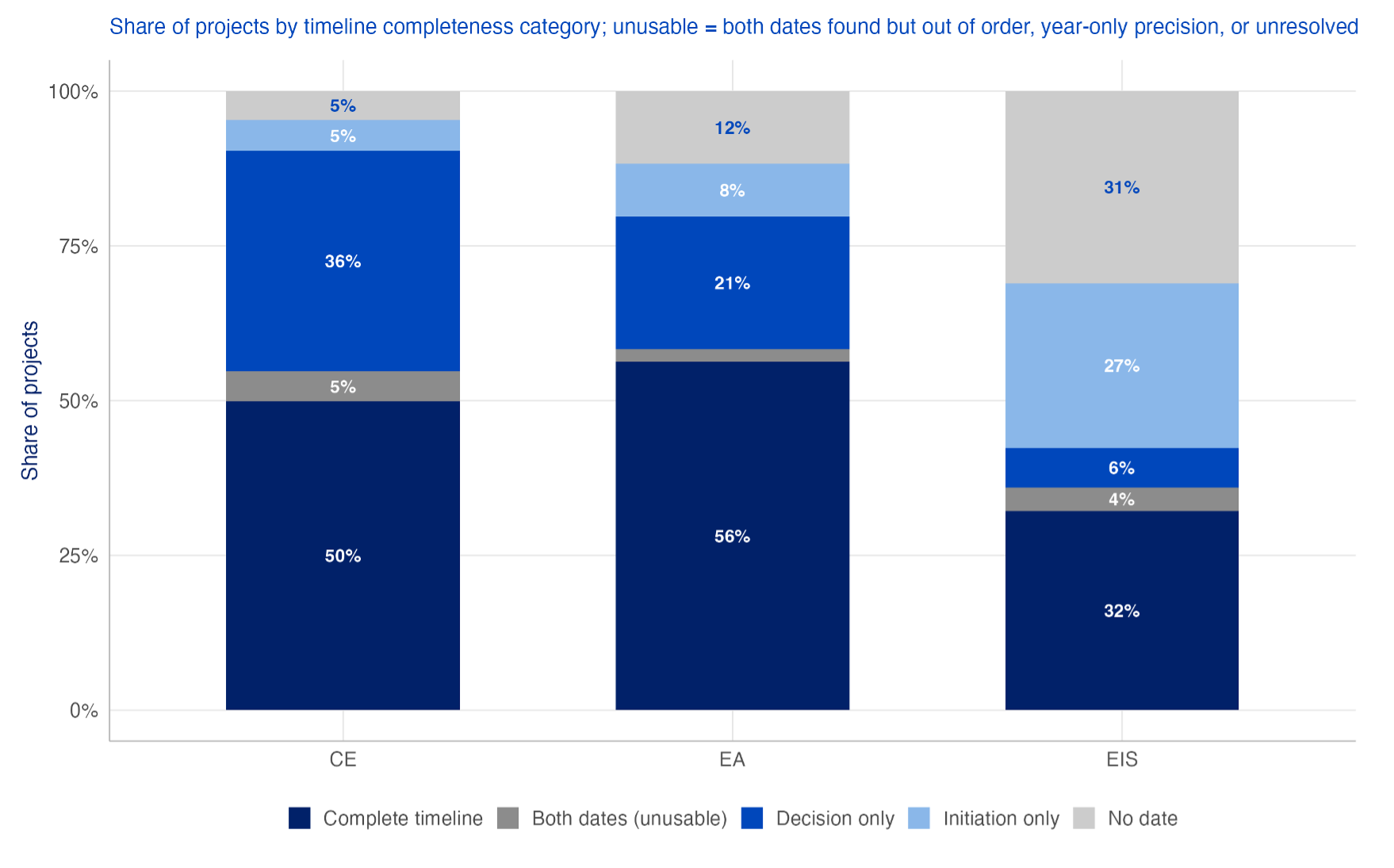
Data completeness varies sharply by review process (Figure 1), and the gaps are structural rather than fixable by better parsing:
- CE: 50% have complete timelines. Many CEs are single-signature determinations with no recorded start date.
- EA: 56% have complete timelines. Although EAs have the most complete documentation of the three review processes, many have no NOI requirement, so start dates are often not documented.
- EIS: 32% have complete timelines. Initiations are well documented (an NOI is required), but RODs are usually separate documents outside the corpus — only 42.3% of EISs have a recoverable decision date.7
Figure 1: Timeline Coverage by Review Type
All duration findings below use complete timelines only. Because incompleteness is driven by document availability rather than by project characteristics, medians are a reasonable estimate for each process — but readers should keep the completeness rates above in mind, particularly for EISs.
Results
Review duration for energy technologies increases with the level of NEPA review
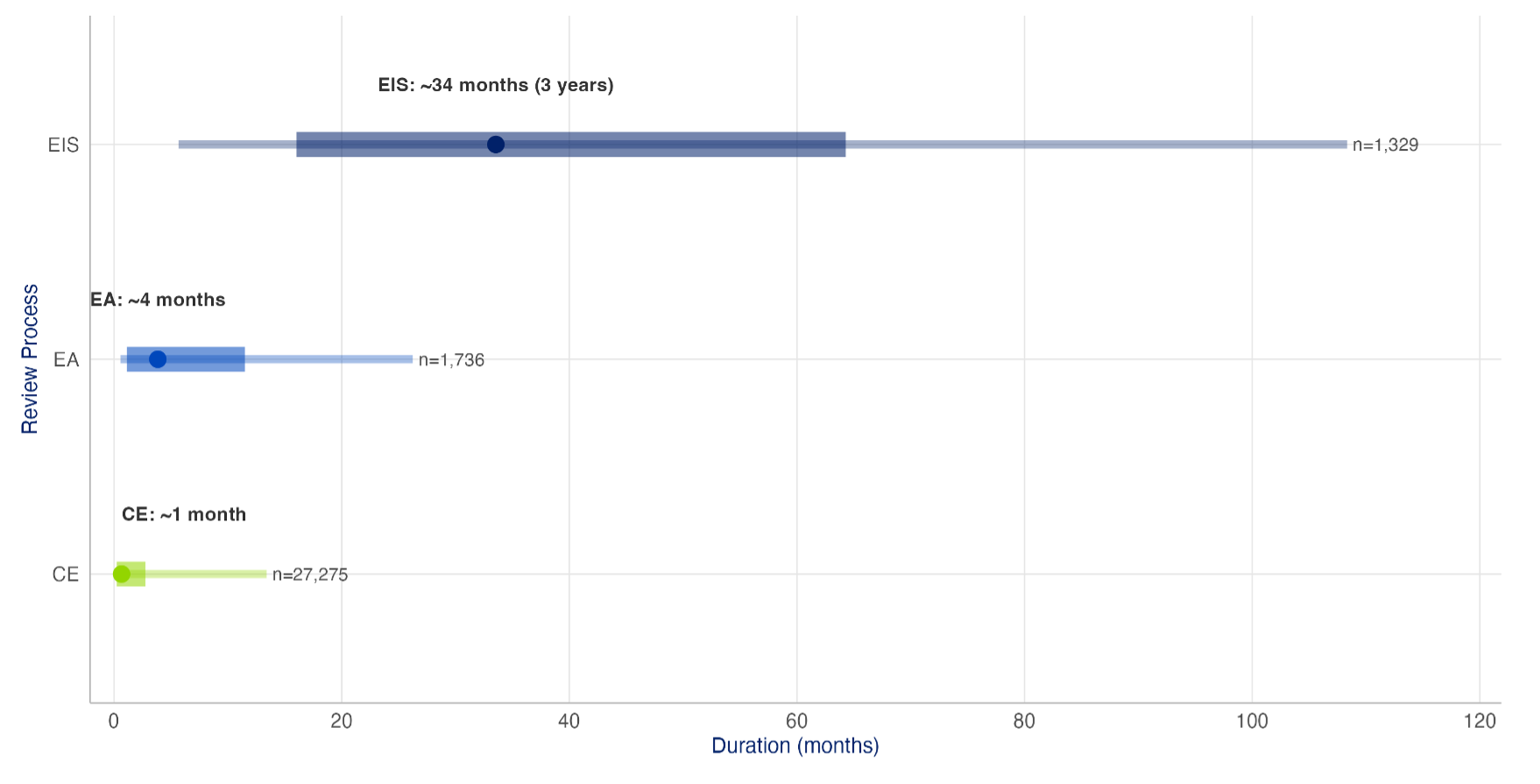
As expected, more intensive reviews take longer to complete (Figure 2). The median CE is completed in 20 days; the median EA in 117 days (~4 months); and the median EIS in 1,021 days (~2.8 years).
Figure 2: NEPA Review Duration for Energy Technologies Climbs from Days (CE) to Months (EA) to Years (EIS)
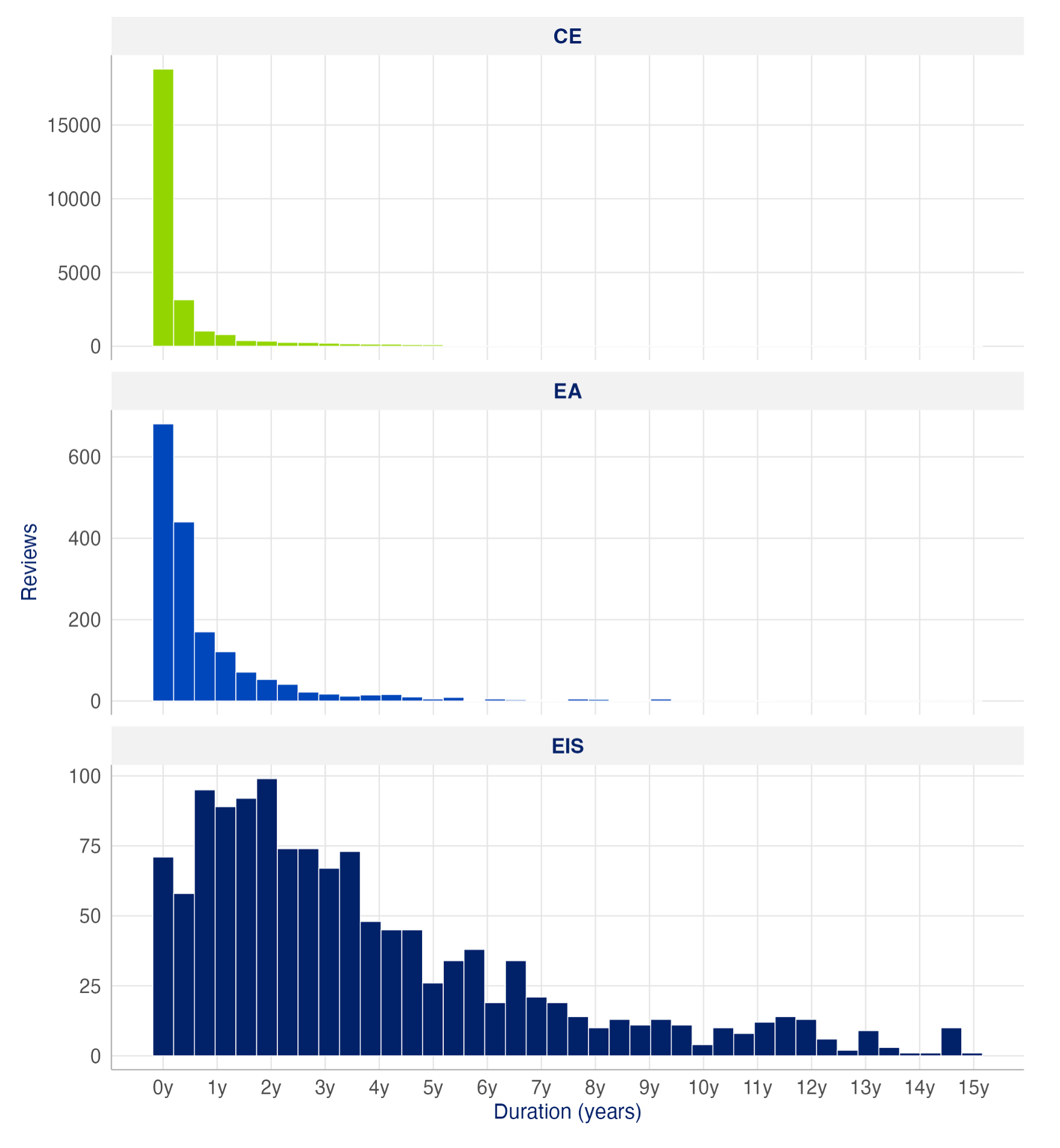
The full distributions (Figure 3) show the link between review complexity and time as a shape, not just a median: CE durations pile up near zero; most EAs (76%) conclude within a year, with a tail stretching past two years; and the EIS distribution is broad and heavy-tailed — 27% of EISs run longer than five years, and one in ten runs nine years or more.8
Figure 3: Review Duration Distribution
Each NEPA review process takes broadly similar amounts of time for fossil and decarbonization projects
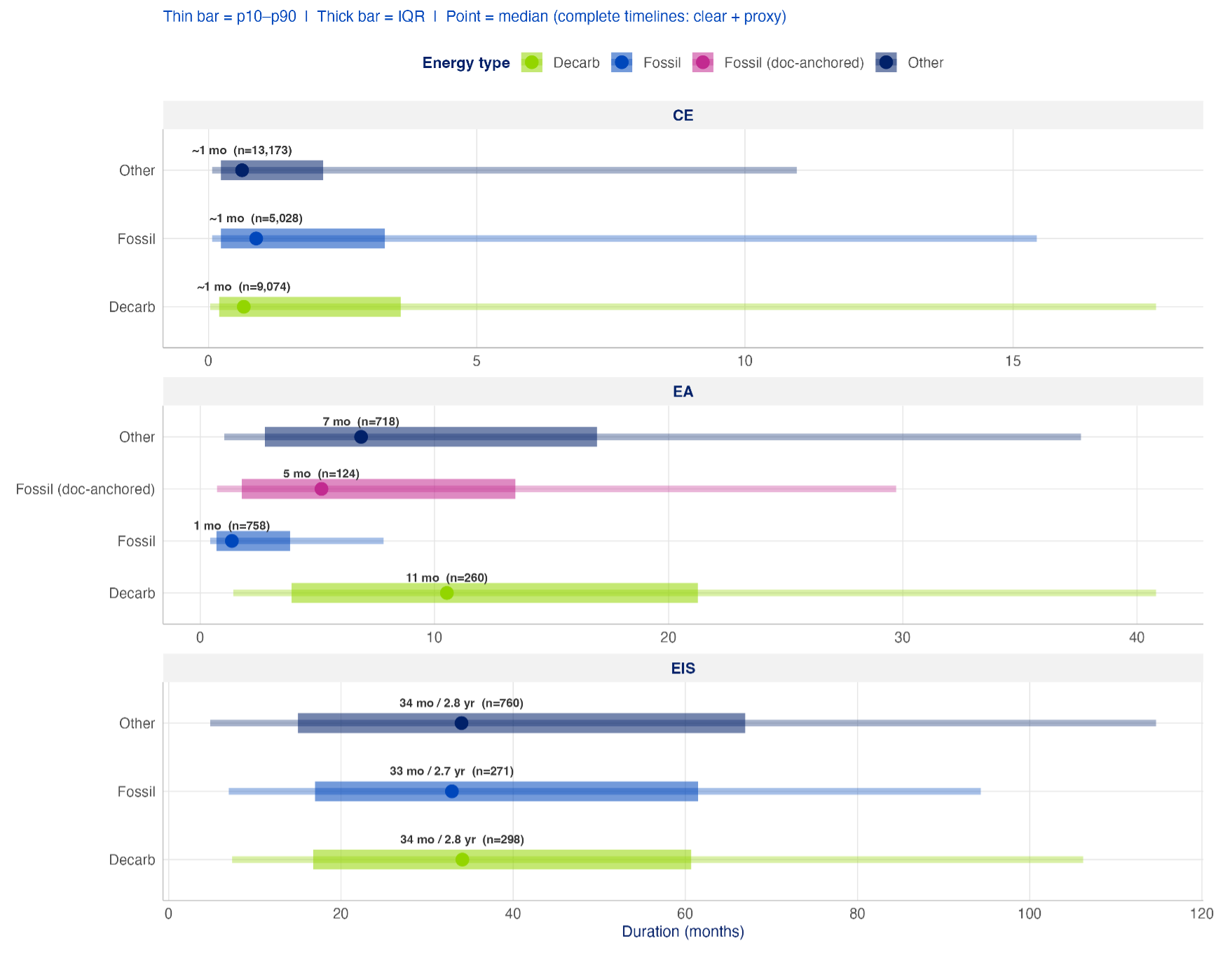
Within each review process, decarbonization and fossil projects take roughly similar amounts of time (Figure 4). Decarbonization and fossil EISs have similar median durations (~34 vs. ~33 months), and CE determinations are fast for all technologies.
While fossil EAs appear to be completed far faster than those for decarbonization projects (a ~1-month median vs. ~11 months for decarbonization), this is a data artifact rather than a real speed difference. 84% of fossil EAs take their start date from BLM’s ePlanning National NEPA Register,9 where the recorded “project start” is frequently a late administrative entry made within days of the decision. Restricting fossil EAs to document-stated start dates lifts their median to ~5 months, much closer to the decarbonization figure.
Figure 4: Timeline Duration by Process and Energy Type
Breaking review durations down by technology shows the same conclusion at finer grain: all energy technologies take broadly the same amount of time to complete reviews. Among technologies with meaningful samples, transmission EISs sit at the high end (~42-month median); and hydropower’s median is higher still, but rests on only 16 complete timelines. Wind EISs sit mid-pack on median but carry the longest upper tail — one in ten runs past 11 years. Solar EISs take less time than the average for decarbonization technologies.
Preliminary findings on programmatic reviews and solar timelines carry forward
Two findings from our previous analysis10 on decarbonization timelines carry forward:
- Programmatic and tiered EIS reviews remain uncommon but show potential to streamline reviews. Tiered EISs — site-specific reviews that build on an umbrella programmatic review — were faster on median (593 days) than standard (1,087 days) or programmatic (914 days) EISs, though samples are small (n = 7 tiered EISs). Tiered EAs took longer than standard EAs (734 vs. 421 days), suggesting the real efficiency gain from tiering comes when it lets an agency avoid a full EIS altogether.
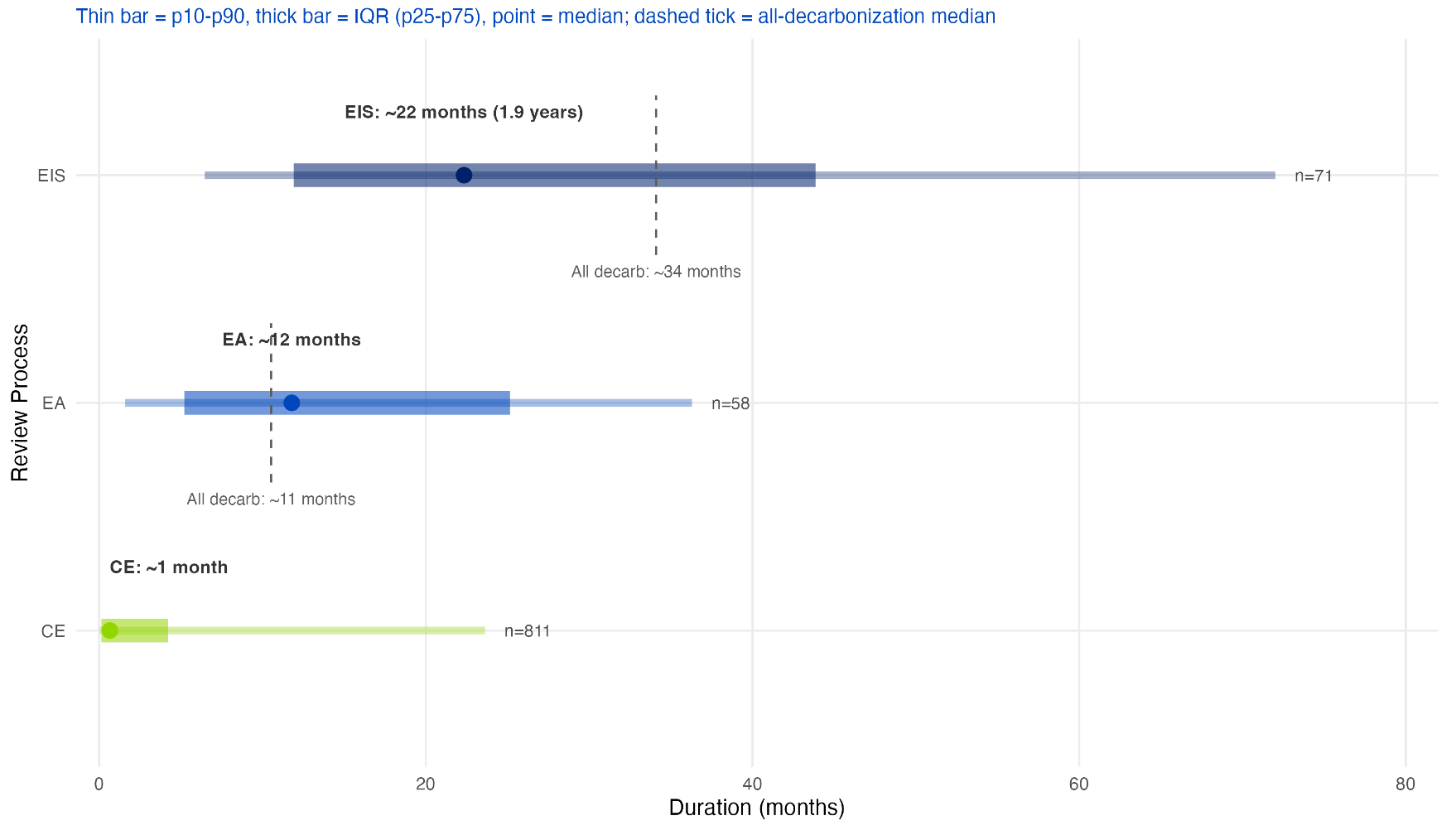
- Solar projects generally complete NEPA reviews faster than other decarbonization projects. Our updated timelines in this analysis (Figure 5) show that solar EISs are completed about a year faster than the all-decarbonization EIS median (~22 vs. ~34 months), replicating our previous findings on a larger sample; solar EAs run on par with decarbonization EAs (~12 months).11
Figure 5: Timeline Duration by Review Process: Solar Projects
NEPA review volumes trend with federal funding legislation
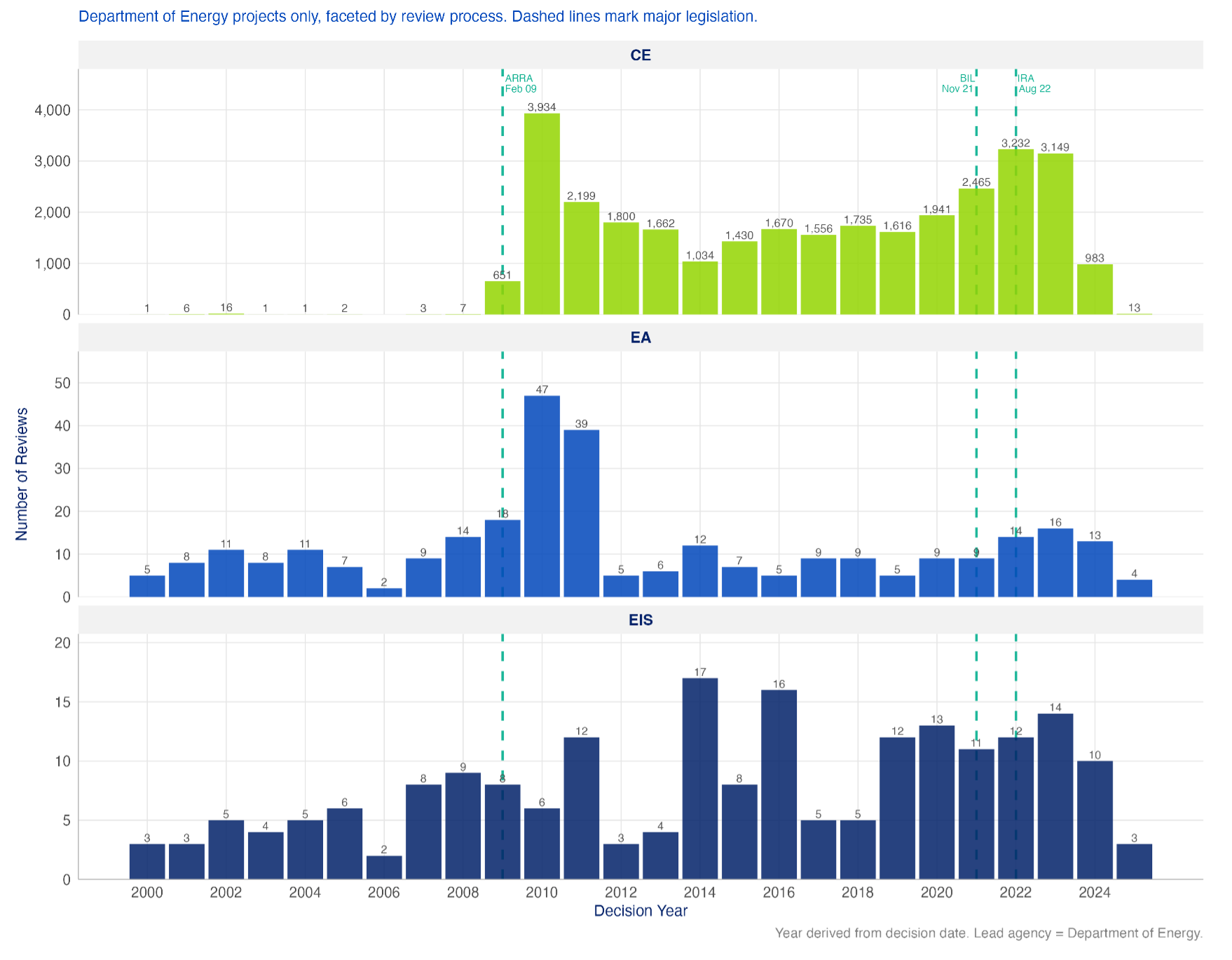
NEPA review volumes appear to be driven in part by major federal funding legislation. Following the American Recovery and Reinvestment Act of 2009 (AARA), CE volumes increased. A second rise in the early 2020s correlates with the bipartisan Infrastructure Investment and Jobs Act 2021 (IIJA) and Inflation Reduction Act of 2022 (IRA). EIS decisions lag CEs and EAs by several years, reflecting longer review timelines. The pattern is most prominent at DOE (Figure 6), the single largest agency in the dataset, and also the home of many grant-and-loan programs from the ARRA, IIJA, and IRA.
Figure 6: DOE Projects by Decision Year
Note: Deadlines in the Fiscal Responsibility Act of 2023 (FRA)
The FRA (enacted June 3, 2023) set statutory timeline targets and page limits. Because the deadlines it promulgated were not retroactive, many of the reviews completed after the FRA was enacted were already well underway and running under pre-FRA requirements. As such, it is still too early to draw conclusions about the FRA’s effect on review timelines. There is a limited, non-representative number of reviews that have completed a full review since FRA enactment, and many more recent reviews are still in progress.
Review durations and changing CEQ NEPA regulations
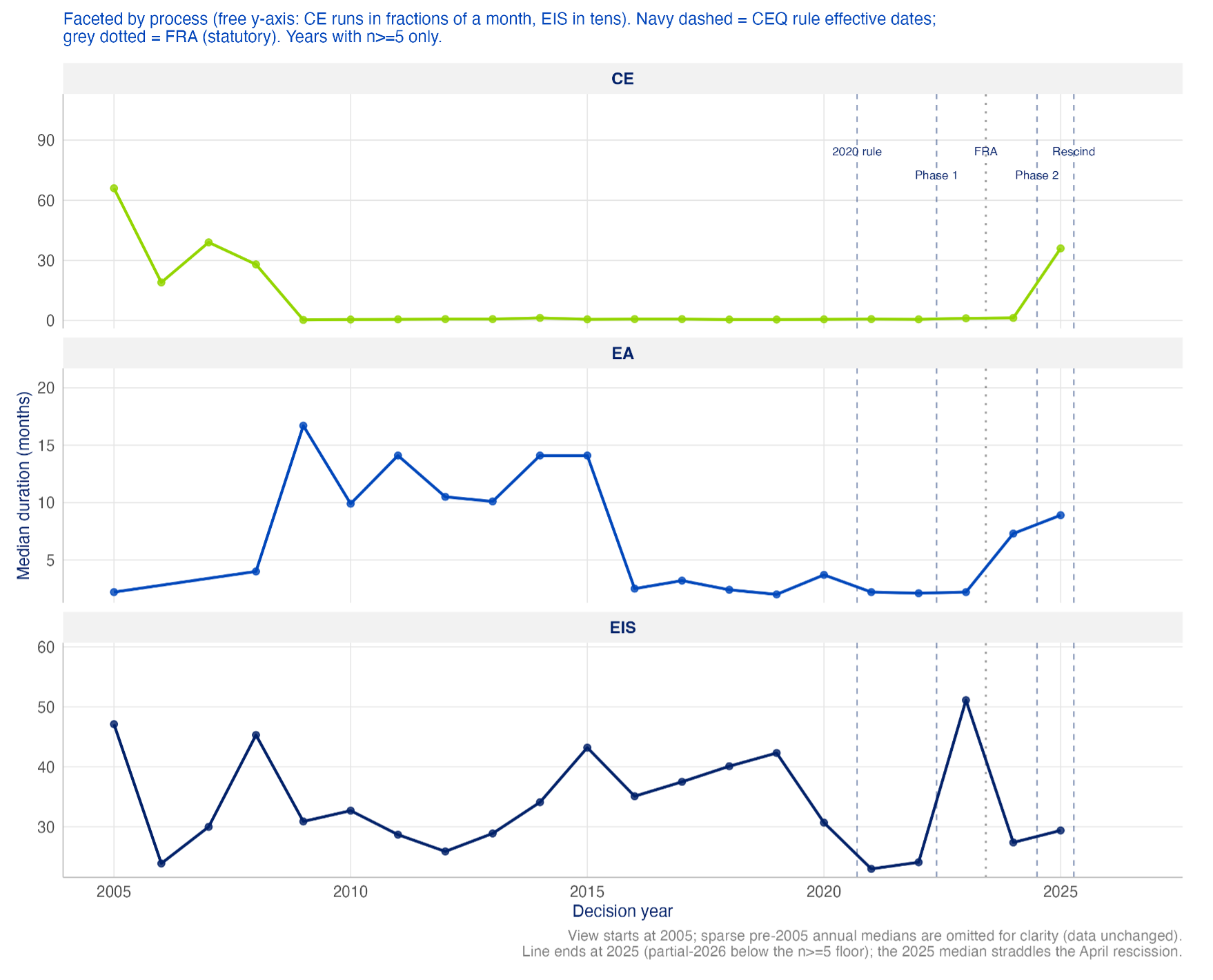
After four decades under 1978 rules, the Council on Environmental Quality (CEQ) significantly altered NEPA’s implementation regulations three times in four years (the 2020 rewrite, the 2022–24 revisions, and the 2025 rescission). Assigning each review process to the rule in effect at its decision date shows no clean before/after breaks in review durations (Figure 7). Median durations under the three pre-2024 regimes sit close together within each process — EIS medians of ~34 months (1978 rules), ~29 (2020 rule), and ~39 (2022 revisions); EA medians in a 2.2–4-month band; CE medians under a month throughout. It is still too early to assess post-2024 trends. The sample of reviews with complete timelines is small and may not be representative. Notably, review times have crept up gradually over the decades — a long-term trend that is independent from changes to NEPA regulations.
Figure 7: Review Duration by CEQ Regulatory Regime
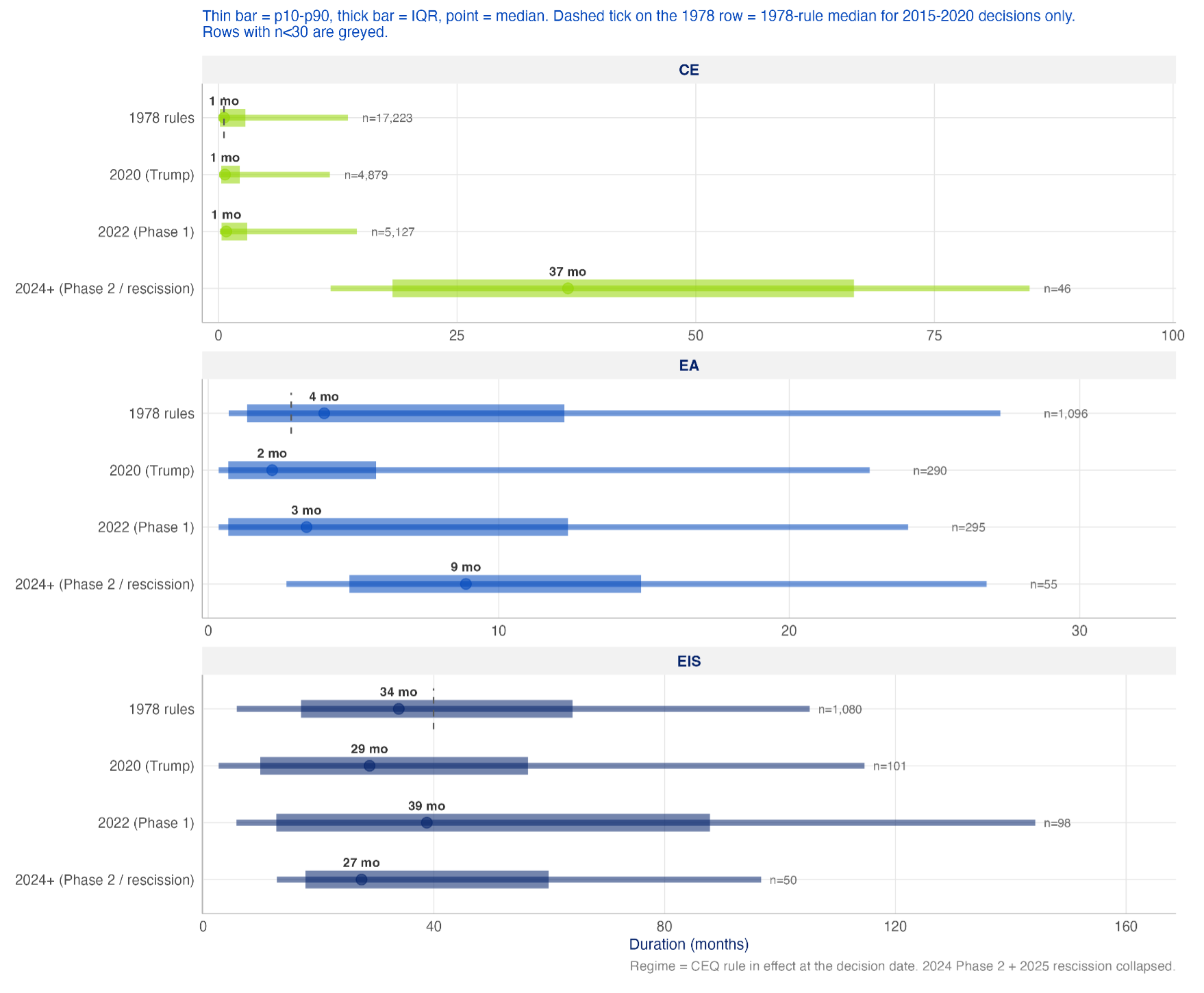
For the final five years that the 1978 regulations were in place (2015-2020), median EIS duration was ~40 months, as denoted by the vertical dashed line in Figure 8. A comparison of this final stretch of 1978 rules to the most recent rule changes shows that no single rule substantially changed review durations.
Figure 8: Median Review Duration by Year, with CEQ Rule Markers
Timeline outliers: The longest reviews
The longest NEPA reviews are often the most elevated in policy discussions. To better understand the outliers, we examined the longest-running reviews in the database to distinguish genuinely lengthy reviews from extraction errors.
- EIS outliers are mostly real. While the median EIS duration is ~3 years, there are genuine EIS outliers that take 14–15 years, including some transmission projects.
- CE outliers are mostly errors. CEs are fast determinations, so a multi-year CE almost always reflects a mis-extracted start date (typically a decades-old citation, such as an original land grant or a covering programmatic review, selected as the initiation). These were flagged and excluded.
An example of a long NEPA review from the dataset
| Project | Years | Initiation | Decision |
|---|---|---|---|
| SunZia Southwest Transmission Project | 14.6 | 2008-09-15 | 2023-04-19 |
The review for the SunZia Southwest Transmission Project’s start and end dates was verified against the documents’ own procedural text. SunZia’s 14-plus-year NEPA timeline is the exact kind of protracted, multi-administration review that dominates the permitting-reform debate. Per this report’s findings of a 42-month median for transmission EISs, SunZia’s long timeline is an outlier.12
Conclusion and Policy Implications
Across all technologies, review durations increase, as expected, with the level of NEPA review. The median CE takes weeks, the median EA about four months, and the median EIS about three years; within each process, fossil and decarbonization projects take roughly similar time. For decarbonization deployment, this reinforces a conclusion from previous research:13 because the vast majority of decarbonization actions are resolved through relatively fast CEs, reforms that focus solely on accelerating EISs would only affect a small share of projects, though often some of the largest and most consequential projects.
Comparing timeline data to CEQ rule changes does not point to a clear association, but review durations have increased over time. Median durations moved little across the 1978, 2020, and 2022–24 rule regimes, and no rule change lines up with a break in the year-by-year trend — so far, procedural changes have mattered less for review speed than other factors when it comes to review duration.
The single highest-value reform for understanding NEPA timelines is better data. Every date in this analysis had to be recovered from document text or agency registers because no federal system records when reviews begin and end — and structural gaps (missing RODs, unrecorded CE/EA start dates) cap what any extraction method can achieve. Agency adoption of the CEQ NEPA and Permitting Data and Technology Standard — recording initiation, milestones, and decision dates as structured metadata — would make complete, real-time timeline accountability possible not just for researchers but for the agencies themselves.
Data: NEPATEC 2.0. Methods and full results: Phase 2 Deliverable 4.
Appendix: Definitions
- Categorical Exclusion (CE): The lowest and least complicated level of NEPA review, used for categories of agency actions with a record demonstrating that the category does not normally significantly affect the environment; takes days or weeks for agencies to complete.
- Environmental Assessment (EA): The middle level of NEPA review, used for agency actions that do not have a reasonably foreseeable significant effect on the quality of the human environment, or if the significance of such effect is unknown; agencies have a statutory limit of one year to complete.
- Finding of No Significant Impact (FONSI): A determination by a federal agency, based on an environmental assessment, that a proposed agency action does not require the issuance of an environmental impact statement because the proposed action will not have significant effects.
- Notice of Intent (NOI): A public notice in the Federal Register alerting the public that the lead agency will prepare and consider an environmental impact statement or, as applicable, an environmental assessment.
- Environmental Impact Statement (EIS): The highest and most complicated level of NEPA review, used for agency actions that have a reasonably foreseeable significant effect on the quality of the human environment; agencies have a statutory limit of two years to complete an EIS, or three for agency actions of extraordinary complexity.
- Record of Decision (ROD): A public record that the lead agency publishes in the Federal Register stating the agency’s decision and alternatives considered by the agency in reaching its decision.
- Programmatic Review: An EA or EIS that analyzes all or some of the environmental effects of a policy, program, plan, or group of related actions.
- Tiered review: A site- or project-specific EA or EIS that typically uses the programmatic review as a base of analysis.
- Decarbonization Technology: Defined using the following metadata tags from Pacific Northwest National Laboratory’s NEPATEC 2.0 dataset: carbon capture and sequestration, conventional energy production – nuclear, conventional energy production – other, electricity transmission, nuclear technology, renewable energy production, utilities.
- Fossil fuel technology: Defined using the following metadata tags from Pacific Northwest National Laboratory’s NEPATEC 2.0 dataset: conventional energy production – land-based oil & gas, pipelines, conventional energy production – coal, conventional energy production – offshore oil and gas, conventional energy production – rural energy.
Footnotes
- For full definitions of NEPA terminology, see the appendix.
- E.g., Fraas, A., et al (2025, August 4). How Long Does It Take? National Environmental Policy Act Timelines and Outcomes for Clean Energy Projects. Resources for the Future. https://www.rff.org/publications/reports/how-long-does-it-take-national-environmental-policy-act-timelines-and-outcomes-for-clean-energy-projects; Manitius, N., Cavert, J., & Kelly, C. (2024, March). Contextualizing Electric Transmission Permitting: Data from 2010 to 2020. Clean Air Task Force & Niskanen Center. https://www.catf.us/resource/contextualizing-electric-transmission-permitting; Council on Environmental Quality (2025, January 13). Environmental Impact Statement Timelines Report: 2025. Executive Office of the President. https://nepa.gov/reports-publications/eis-timelines-report-2025
- Zapatka, K. & Landau, K. (2026, September). NEPA by the Numbers: New Insights on Environmental Reviews for Energy Infrastructure. Clean Air Task Force. https://www.catf.us/resource/nepa-by-numbers/
- Full methodological detail is can be found in the accompanying report: Zapatka, K. (2026, August 21). NEPA Decarbonization Technology Analysis: Deliverable 4. https://www.kaseyzapatka.com/nepa/phase2/reports/deliverable04.html
- Bureau of Land Management. BLM National NEPA Register. U.S. Department of the Interior. https://eplanning.blm.gov; U.S. Department of Energy. Office of NEPA Policy and Compliance. https://www.energy.gov/nepa
- A step-by-step description of the extraction pipeline can be found at Zapatka, K. (2026, August 21). NEPA Decarbonization Technology Analysis: Deliverable 4. https://www.kaseyzapatka.com/nepa/phase2/reports/deliverable04.html#how-timeline-dates-are-extracted
- While CEQ has compiled start and end dates for a subset of EISs, that data is not linked to NEPATEC 2.0. To keep timelines comparable across CEs, EAs, and EISs for this analysis, we used dates recovered from NEPATEC documents using a similar extraction approach for every review.
- This analysis aligns with previous research focused on Forest Service reviews, which found overlap in timelines between CEs and EAs and notable timeline outliers for EISs. Ruple, J., Pleune, J., & Heiny, E. (2021, November 17). Evidence-Based Recommendations for Improving National Environmental Policy Act Implementation. Columbia Journal of Law (Vol 46: Spring 2022). https://journals.library.columbia.edu/index.php/cjel/article/view/9479/6000
- Bureau of Land Management. BLM National NEPA Register
- Zapatka, K. & Landau, K., NEPA by the Numbers: New Insights on Environmental Reviews for Energy Infrastructure
- Previous research by Bennon and Wilson (2023) has also found that solar EISs were completed faster than reviews for other types of projects, but that they have a higher litigation rate (two-thirds of solar projects that they analyzed were litigated, compared to only 26% of new highway projects). They attribute this distinction to the higher levels of private investment in energy generation and transmission and attendant risk tolerance. While we do not examine litigation rates in this report, the connections between upfront speed and backend litigation are worthy of additional study. Bennon, M. & Wilson, D. (2023, October). NEPA Litigation Over Large Energy and Transport Infrastructure Projects. Environmental Law Reporter Volume 53, 10836-10589. https://www.elr.info/sites/default/files/files-general/53.10836.pdf
- See a case study on the SunZia Southwest Transmission Project in our April 2024 “Evidence-Based Recommendations for Overcoming Barriers to Federal Transmission Permitting” report: Clean Air Task Force & Niskanen Center. (2024). Evidence-Based Recommendations for Overcoming Barriers to Federal Transmission Permitting. https://www.catf.us/wp-content/uploads/2024/04/evidence-based-recommendations-overcoming-barriers-federal-transmission-permitting.pdf
- Zapatka, K. & Landau, K., NEPA by the Numbers: New Insights on Environmental Reviews for Energy Infrastructure
Credits
Data management, analysis, and visualization: Kasey Zapatka, PhD
Clean Air Task Force project team: Kelsey Landau, Nicole Pavia, Natalie Manitius, Alan Mitchell, and Frank Sturges
Project advisor: Keith J. Benes, Adjunct Professor and Senior Researcher, University of Nebraska-Lincoln College of Law
GitHub: https://github.com/kaseyzapatka/nepa/blob/main/phase2/architecture/deliverables/deliverable04.md
Browse environmental reviews for energy technologies with the NEPA Document Explorer: https://huggingface.co/spaces/kaseyzapatka/nepa-document-explorer

