
EU Emissions Trading System: Domestic Permanent Carbon Removals

The integration of permanent carbon removals into the EU Emissions Trading System (ETS) is one of the most consequential design decisions for the current revision. The Commission proposal calls for the centralised procurement of 250 million tonnes of certified, domestic permanent carbon removals by 2040, which would be matched by the addition of an equivalent number of allowances to the EU ETS cap.
The case for integration
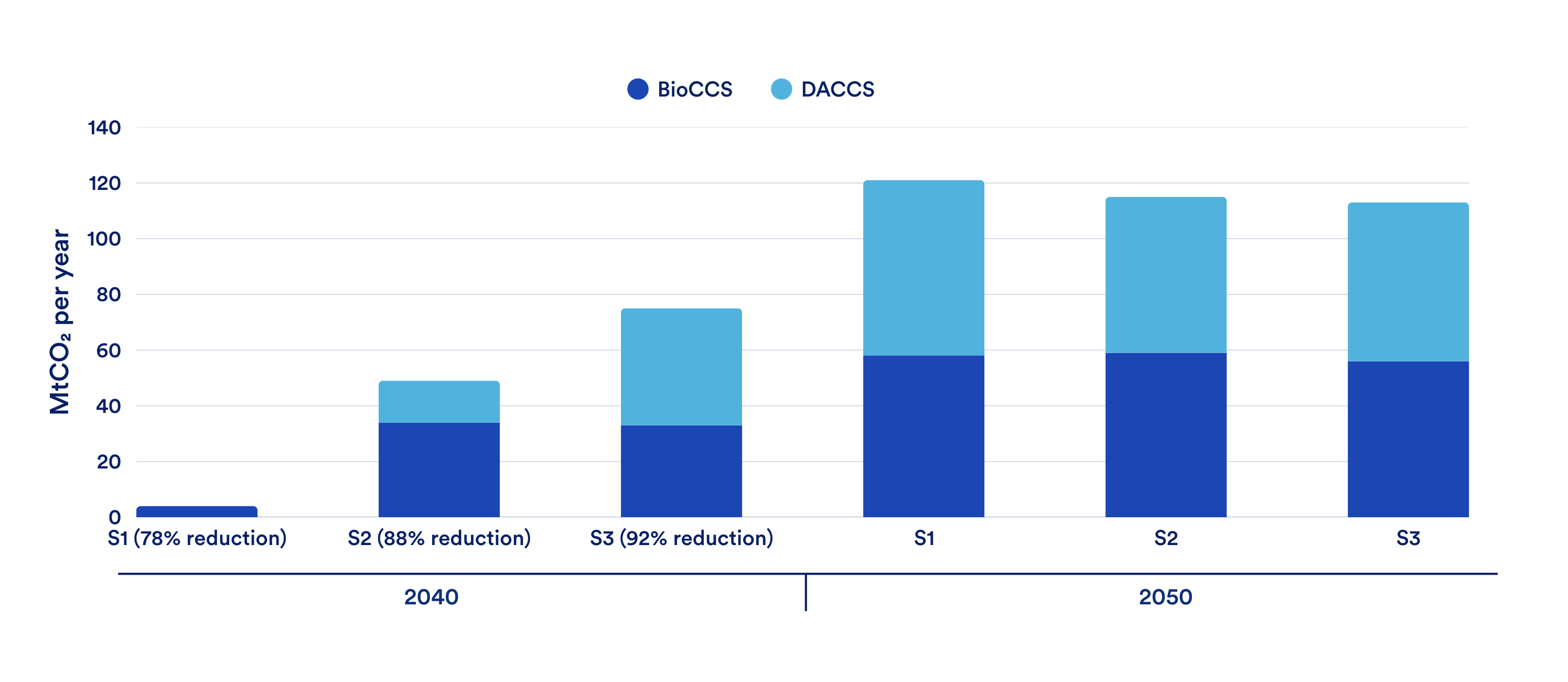
As the EU advances towards its 2040 climate target and net zero by 2050, carbon dioxide removal technologies – particularly biogenic carbon capture and storage (BioCCS) and direct air carbon capture and storage (DACCS) – will be essential to address residual emissions from hard-to-abate sectors that cannot be fully decarbonised through direct mitigation alone. The Commission’s modelling for the EU’s 2040 climate target indicates that 49 million tonnes of removals via these technologies would need to be delivered annually by 2040, in order to achieve an 88% reduction in net emissions.
Figure 1. Deployment of permanent removal technologies in the modelling for the EU’s 2040 climate target. Three scenarios were modelled, with varying levels of greenhouse gas emissions reduction by 2040 (relative to 1990), and each reaching climate neutrality in 2050.1
The EU Carbon Removal and Carbon Farming (CRCF) (Regulation (EU) 2024/3012) has established a foundation for certifying permanent carbon removals, but mechanisms to drive the deployment of these technologies remain underdeveloped. The ETS revision represents one of the most credible existing mechanisms to create durable demand at scale, provided that supporting policies are developed in tandem.
Carbon removals also offer a potential solution to the so-called ‘endgame’ challenge of the ETS: as the emissions cap approaches zero, issues of price volatility and market liquidity as well as cost-efficiency are expected to intensify. Integrating permanent carbon removal allowances could help stabilise the system by sustaining traded volumes and mitigating scarcity-driven volatility as the cap declines, offering emitters a cost-effective means to address their residual emissions with carbon removals. However, integrating removals into a cap-and-trade system designed around emissions reductions requires careful design to preserve environmental integrity and avoid deterring the abatement action the ETS is built to drive: these challenges were examined in a joint CATF and Concito report in 2024.
The Commission’s proposal
CATF welcomes the Commission’s proposal to gradually integrate 250 Mt of certified BioCCS and DACCS credits into the ETS in the period 2031 to 2040, which represents a landmark increase in efforts to deploy permanent carbon removals and can help bring these technologies on to a trajectory compatible with climate neutrality by 2050. The Commission’s proposed role as an intermediary procurer of these credits can help ensure that a strategically diverse mix of high-integrity removal projects is developed in a timely manner.
However, the proposed integration relies heavily on the assumption that the revenue from the auction of 250 Mt of additional allowances, in addition to up to 10 Mt of existing allowances, will be sufficient to procure an equivalent volume of domestic permanent removals. The impact assessment determines that the net funding gap could range from net positive to a €3 billion cost for deployment of 175 and 330 Mt of removals, respectively. This calculation is highly sensitive to factors including the cost of early BioCCS and DACCS projects, the technology mix procured, future allowance prices, and – crucially – the relative timing of auction revenue streams and removal procurement within the period to 2040 and beyond. The costs of BioCCS used in the PRIMES model are at the low end or below the cost range determined by the Impact Assessment’s review, while the assumed cost of DACCS declines steeply to 2040 – in reality, such a cost learning curve will strongly depend on global deployment rates.2
shows an illustrative scenario of how permanent removal credits could be procured over the period to 2040, with a mixed portfolio which gradually incorporates DACCS over time (overall, around 20% of procured credits are DACCS). Technology costs are based on the average costs identified by the impact assessment, which decline over time.3 The 250 Mt of auctioned allowances are increased near-linearly from 5 Mt in 2031 to 48 Mt in 2040 (as per the proposal), and carbon prices are based on the Joint Research Centre’s POTEnCIA 2025 modelling – rising to €300/t in 2040.4 This scenario generates a net deficit of €6.2 billion, equivalent to 28 Mt of allowances at the average price of auctioned allowances over the decade.5
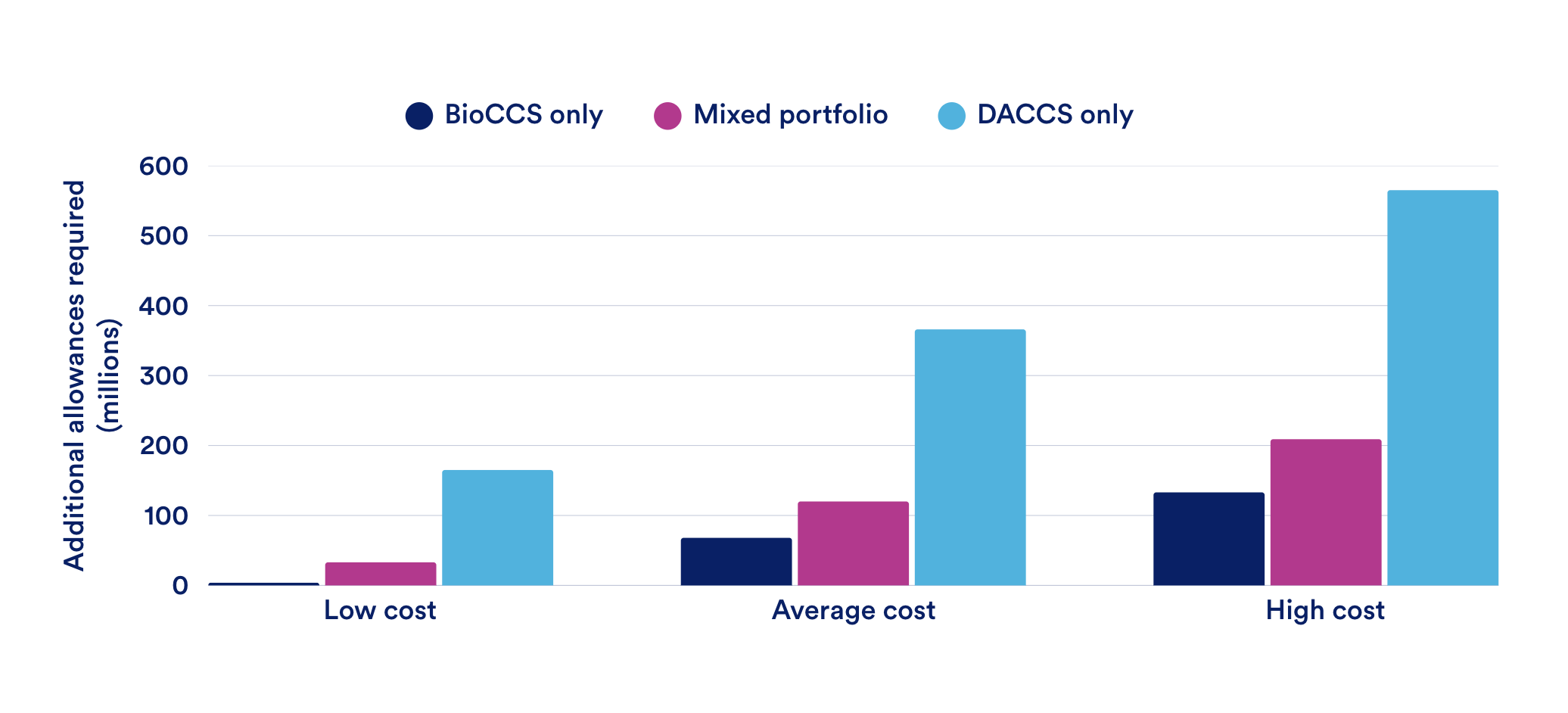
However, more recent projections of the EU ETS based on the Commission proposal have shown a weaker price trajectory, potentially remaining below €200/t in 2040.6 Assuming the carbon price reaches only €200/t in 2040, the deficit for a mixed portfolio and average technology cost scenario increases more than threefold and the revenue generated by each allowance is also reduced, with the result that an estimated 126 Mt of additional allowances would need to be auctioned to cover the cost gap (Figure 3.B).
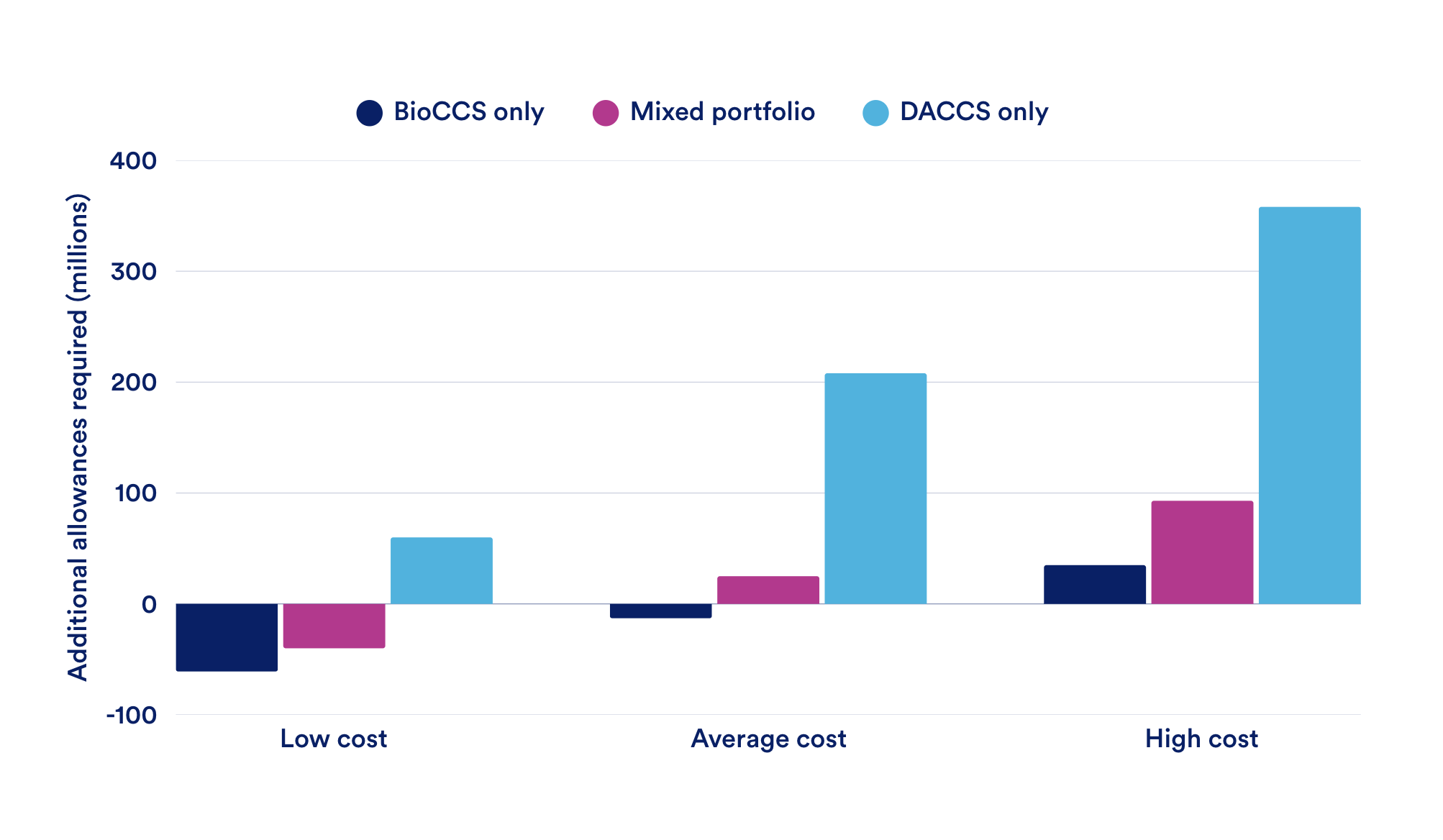
Figure 3 shows how this deficit could vary under different technology mixes and cost assumptions, under the same overall procurement ramp up and for high (Figure 3.A) and low (Figure 3.B) carbon price trajectories. The lower and upper bounds for costs are again taken from the review conducted in the impact assessment. In the high-cost and high carbon price scenario, the same mixed portfolio generates a deficit of €20.9 billion, or 95 Mt of allowances at average prices. Costs also increase significantly as the contribution from DACCS is increased.
Figure 2. Illustrative procurement of a mixed portfolio of BioCCS and DACCS credits from 2031 to 2040, alongside procurement cost and revenue from auctioned allowances.
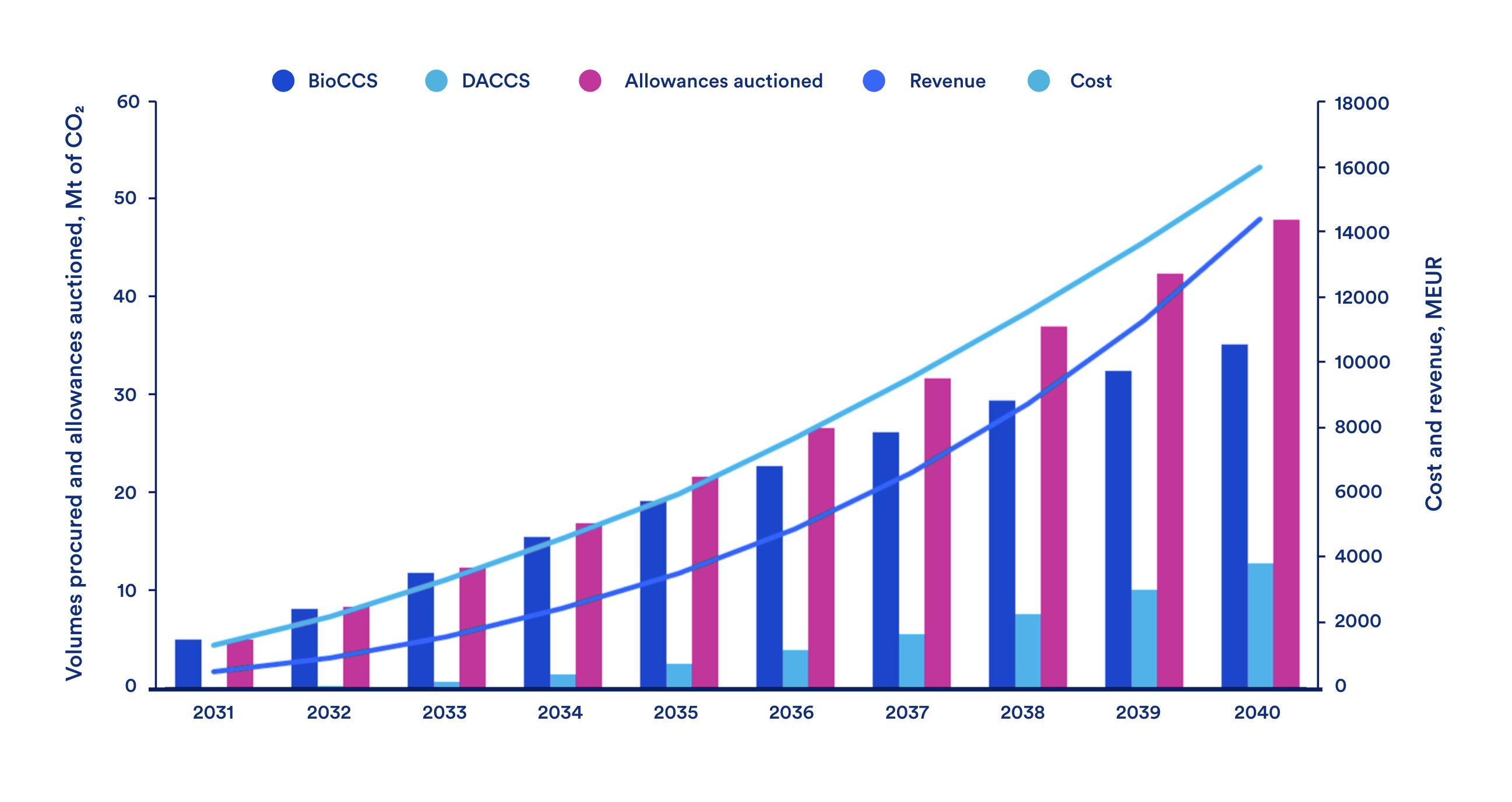
Figure 3. The additional allowances required to cover the cost gap for different removal portfolios and cost assumptions. Negative values indicate a scenario with net revenue.
A. The EU ETS price increases to €300/t in 2040.
B. The EU ETS price increases to €200/t in 2040.
CATF therefore finds there is a significant risk that permanent removals will be underdelivered as a result of revenue shortfall, resulting in a net increase in emissions due to the additional allowances placed on the market.
Market outlook for BioCCS and DACCS
CATF’s project tracking database identifies 63 proposed projects in the EU which have the potential to deliver large-scale BioCCS, including waste-to-energy, biomass-fired heat and power, and cement plants (which are able to co-fire a portion of biomass fuel).7 Together, these projects could store up to 23.7 Mt of biogenic CO2 annually, although the net, certified removals delivered would be less than this total, due to associated emissions.
There are relatively few commercial DACCS facilities proposed in the EU, and these are mostly small. Technology provider RepAir are collaborating with storage developers in France and Greece, with a view to scale towards Mt-scale DACCS projects in the 2030s.8 Norway has also seen interest from DACCS developers, with two projects aiming to scale up to 100 and 500 kt per year.9 Given this limited project pipeline and estimated costs roughly twice that of BioCCS, it will be challenging for DACCS to make a significant contribution to the procured portfolio.
Bridging the revenue gap and preserving climate integrity
Currently, the proposal’s main mechanism to address the revenue shortfall is through a Commission progress report due in 2034 (i.e. Article 9c (8)), which will assess progress in the purchase of domestic permanent carbon removals, accounting for available supply and price of such units relative to the allocated budget. It will also examine the possible contribution of nature-based removals and carbon farming. CATF cautions against the implied replacement of permanent carbon removal units with temporary removals and those methods which are inherently challenging to monitor and carry a material risks of reversal without appropriate liability mechanisms in place, such as biochar.
The revision should therefore provide alternative means to address an impending shortfall, including:
- Securing additional revenue to procure permanent carbon removal units in the event of a funding shortfall; and
- Releasing fewer allowances or cancelling released allowances to match the volume of removals being procured.
The timing of the available revenue and delivered removals should be carefully considered. The proposed gradual increase in auctioned allowances to 48 Mt of allowances in 2040, suggests that a large proportion of the procured removals will be delivered post 2040. This backloading of revenue and procurement should favour increased revenue and give time for the removal project pipeline to grow and for costs to decline. However, there is an urgent need to progress projects in the near term, given many are already in an advanced stage of development and lacking a business case. This can also maximise the proportion of the 250 Mt which can be removed in the period to 2040 and ensure alignment with EU climate targets.
CATF also welcomes the provision for operators, aircraft operators and shipping companies to offset their own ETS emissions via the internal generation of certified BioCCS removals, which could help provide an additional – potentially faster moving – driver for the deployment of BioCCS projects. However, these credits are more likely to be sold on voluntary markets where they can command a higher value than the prevailing ETS price.
To deliver the necessary scale up of CDR in the EU, ETS integration must be accompanied by comprehensive supporting policies to ensure sustainable deployment, such as public procurement programmes, reverse auctions, or carbon contracts for difference schemes. These should be developed outside or in conjunction with the EU ETS to bridge cost gaps between allowance prices and permanent carbon removal costs, particularly for DACCS, while avoiding weakening support for other critical emission reduction technologies.
Policy recommendations for the revised EU ETS:
- Ensure that only permanent carbon removals meeting the conditions necessary for integration into the EU ETS, such as DACCS and BioCCS, are eligible for purchase. For BioCCS and DACCS, geological storage is already embedded in the established regulatory architecture under the ETS and CCS Directive. This includes requirements governing monitoring, leakage, corrective measures, financial security and the surrender of allowances in the event of leakage. By contrast, methods for which equivalent safeguards have not been demonstrated, such as biochar carbon removal should not be considered within the EU ETS, in line with the Commission proposal, even if they are considered permanent under the CRCF Methodology.
- Complement Article 9c(8) by appropriate follow-up actions in cases where the Commission assessment report identifies shortcomings affecting the delivery of the quantity of permanent carbon removals referred to in Article 9c(1), or a funding gap undermining the procurement of those removals. Some of the corrective actions include:
- A mechanism to source limited additional revenue for the procurement of permanent removals should be incorporated into the revision, in the event that a shortfall of funding is projected in the report produced according to Article 9c(8). For example, such revenue could be derived from auctioning a specified quantity of additional allowances in the period 2036-2040, including any of the free allowance allocation to hard-to-abate sectors which has not been allocated due to failure to meet the proposed requirements under Article 10a(3).
- In the event that a shortfall of permanent removals persists by 2040, including the projected delivery from projects contracted beyond 2040, the Commission should be empowered to remove from the market a volume of allowances corresponding to the shortfall.
- Ensure that the future delegated act concerning the modalities for the purchase of permanent carbon removals includes a mixed portfolio of BioCCS and DACCS to guard against the long-term over-dependency on biomass and enables the use of forward offtake agreements which can be signed pre-2031. This will establish an incentive for first-mover projects and maximise delivery of removals in the 2030s.
- Require the Commission, in its assessment report pursuant to Article 9c(8), to evaluate the environmental integrity and functioning of the system, abatement costs, and the evolution of relevant Union policy measures.

