

U.S. clean energy investments: 2026 Quarter 2 analysis
Federal policy and executive actions have a direct impact on private investments across the U.S. – either hindering investments or catalyzing them. CATF tracks private investments in clean energy projects that are eligible for federal incentives as well as the status of federal policies that may impact them. Each quarter, CATF highlights changes to federal policies and new executive actions and analyzes how these changes have affected investments across U.S. states and districts.
What’s impacting investments in Q2?
Key takeaways from Q2 2026:
- Electric power: Clean electricity investment remained strong in Q2, with solar and energy storage accounting for most investment activity. Q2 investments align with CATF’s earlier expectations that storage would see a strong investment year. The July 4, 2026, “begin construction” deadline for clean electricity tax credits was also a driver for Q2 investment activity, likely boosting investments in solar in the near-term, while increasing energy demand continues to drive interest in energy storage technologies.
- Industry: Policy uncertainty continued to impact investments in the industrial sector, particularly for hydrogen, where investments remain steady but lack any new announced investments in Q1 or Q2 2026. However, despite modest investment this quarter, several carbon management projects progressed on permitting and project milestones in Q2.
- Manufacturing: Battery manufacturing led Q2 investments and solar and critical minerals sectors also saw new Q2 announced investments. Battery manufacturing and installation experienced a record quarter driven by utility investments. Domestic clean energy supply chains continue to attract investments to meet rising energy demand and achieve energy security, and to comply with domestic content requirements for clean energy tax credits.
Federal Policy
Investments in this quarter were impacted largely by both tax credit deadlines and congressional appropriations.
- One Big Beautiful Bill Act (OBBBA) July 4, 2026 “begin construction” deadline for solar and wind projects to claim 45Y/48E clean electricity tax credits. Project developers had until July 4 of this year to begin construction on projects to remain eligible for the 45Y/48E clean electricity tax credits, as long as those projects are placed in service by December 31, 2029. Projects that began construction after the July 4, 2026, deadline would need to be placed in service by December 31, 2027, to claim the credits.
- Fiscal Year 2027 Appropriations. Congressional appropriators funded the federal government through September 30 but have yet to reach a deal on Fiscal Year 2027, which may hinder investments that rely on federal funding in future quarters. In September, a short-term continuing resolution was signed into law the funds the government through December 11.
Executive Actions
Investments in this quarter were impacted by the release of the President’s Budget Request and the administration’s associated energy priority setting.
- President’s Budget Request and DOE FY27 budget justification. In April, the White House released the President’s Budget Request (PBR) and DOE published its Fiscal Year 2027 budget justification to support the budget request to Congress. The DOE budget request prioritizes investments in energy dominance via firm baseload power (+$3.5B repurposed from IIJA) and AI (+$1.2 billion repurposed from IIJA), critical minerals (+$394M), refilling the Strategic Petroleum Reserve (+$89M), and increasing energy-water security (+$75M). The PBR for DOE re-proposes cancelling $15.2 billion in IIJA energy funding, and DOE’s budget justification proposes $3.25B in IIJA hydrogen hubs funding cuts.
- DOE internal review process concludes with project award “retain/modify” list submitted to Congress. In April, DOE submitted a list to Congress that included 1,951 awards that it intends to retain or modify after conducting a 16-month internal review process. A significant majority of these awards (1,667 out of 1,951) were not on the previous announced and reported DOE cut lists in 2025. DOE’s April 2026 retain/modify list did not address the majority of awards on the 2025 lists, with 364 awards still uncertain.
- DOE Office of Energy Dominance Financing (EDF) $17.5B nuclear conditional loan commitments. In June, DOE EDF announced up to $17.5B in conditional loan commitments for 10 AP1000 reactors across 5 sites to be jointly owned by Westinghouse and a utility or energy company partner. Westinghouse and the project partner must each commit $500M ($1 billion total) upfront prior to accessing the loan funds.
Findings
Electric Power
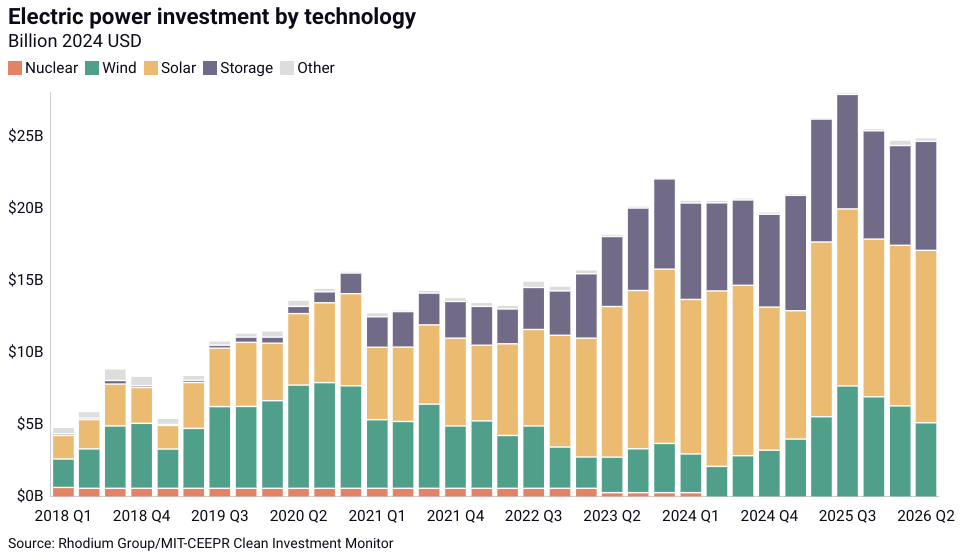
Rhodium Group data shows clean electricity production investment totaled ~$24.79B in Q2 2026. Announced investments totaled ~$23.3B. Cancelled investments totaled ~$9.6B.
Figure 1. Actual electric power investment by technology
Solar, Wind, and Storage
Solar Q2 investments1 totaled ~$11.94B, announced2 investments totaled ~$12.4B, and cancelled investments totaled $3.2B.
Wind Q2 investments totaled ~5.1B and announced investments totaled ~$0.
Storage Q2 investments totaled ~$7.55B, announced investments totaled ~$10.9B, and cancelled investments totaled ~$6.4B.
Solar and energy storage had another strong quarter in Q2, likely supported by efforts to secure federal tax credit eligibility prior to OBBBA statutory deadlines. Utilities were the major driver of manufacturing batteries to strengthen the grid: SEIA reported that 17.9 GWh deployed, the vast majority in Q2, was for utility-scale projects. Solar and wind project developers had until July 4 (beginning of Q3) to begin construction on projects to remain eligible for the 45Y/48E clean electricity tax credits, as long as those projects are placed in service by December 31, 2029. Projects that began construction on or after the July 4 deadline need to be placed in service by December 31, 2027, to claim the credits. These statutory deadlines are likely pulling investments forward, but it is unclear what the investment pipeline will look like in future quarters amid federal tax policy changes.
While solar and storage represented the majority of clean electricity investments in Q2, these industries also experienced continued uncertainty and, in some cases, cancellations. Notably, 97 GW of solar and storage capacity across 445 projects are uncertain due to delays in federal permitting. In Q2, 26 solar projects totaling $3.2B were cancelled across Arizona, California, Florida, Georgia, Louisiana, North Carolina, New York, Ohio, South Carolina, Texas, and Virginia. Compared to other states, Texas saw the highest number of cancelled solar projects (6) and largest cancellation totals ($1.67B). 19 storage project investments totaling ~$6.4B were cancelled across Arizona, California, Georgia, New York, Ohio, South Carolina, Virginia, and Washington. Storage project cancellations were also concentrated in Texas compared to other states, with 8 cancelled projects totaling $3.75B.
Offshore wind development continued to see increased cancellations in this policy environment. In Q2, Golden Gate Wind and Bluepoint Wind ended their offshore wind leases for projects in early development off the coasts of New Jersey, New York, and California’s central coast in exchange for ~$900M in reimbursements for pivoting investments to fossil fuel projects. Also in Q2, Invenergy agreed to end four offshore wind leases early in development off the coasts of New Jersey, Maine, and California for reimbursements totaling ~$765M. Similar transactions occurred in both Q1 and early Q3, demonstrating a trend away from offshore wind.
Industry
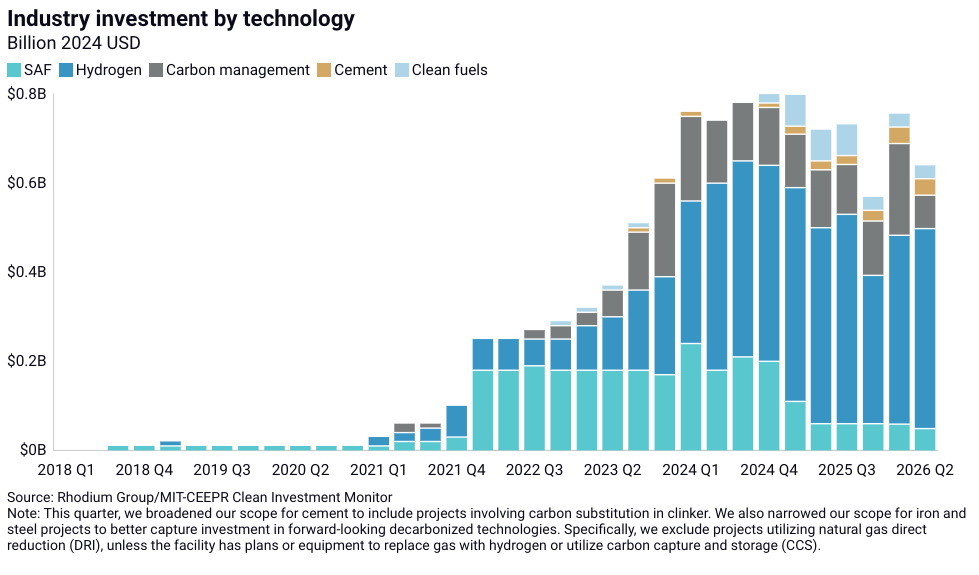
Rhodium Group data shows industry investment totaled ~$636.8M in Q2 2026. Announced investments totaled ~$2B. Cancelled investments totaled ~$7.7B.
Figure 2. Industry investment by technology
Hydrogen
Q2 investments totaled ~$449M, announced investments totaled ~$0, and cancelled investments totaled ~$7.1B.
Investment maintained a steady pace and was up slightly from recent quarters. Still, uncertainty over federal incentives continued to impact the hydrogen industry through Q2, evidenced by the lack of any announced investments. DOE’s April retain/modify list included five of seven regional hydrogen hubs. However, the FY27 PBR, also published in April, requests to “repurpose” $4.7 billion in funding from the Regional Hydrogen Hubs program and “permanently cancel” $3.25 billion in unobligated funding, which would eliminate the majority of the $8 billion Regional Hydrogen Hubs program. Additionally, hydrogen developers continue to face a compressed 45V tax credit eligibility window established by the OBBBA, which shortened the begin construction deadline to December 31, 2027, instead of the IRA deadline of December 31, 2032.
Air Products’ cancellation of its Louisiana Clean Energy Complex accounts for the full $7.1B in cancelled hydrogen investments in Q2. The company cited “expected financial returns not meeting stringent return criteria,” pointing to “challenging commercial conditions, project-specific economic factors, and slower-than-expected development in certain markets, largely hydrogen for mobility.”
Carbon Management
Q2 investments totaled ~$74.5M and announced investments totaled ~$0.
Carbon management investments were down by over half in Q2 (~$74.5M) compared to Q1 (~$206.5M), but policy signals improved through Q2, indicating investments could pick up in future quarters. Permitting and regulatory activity advanced as EPA issued Class VI permits for Marquis Carbon Injection in Illinois and PureField Carbon Capture in Kansas, while Front Range’s Colorado Class VI draft permit moved through public comment in April. DOE’s April retain/modify list indicates that some previously at-risk carbon management awards may move forward, including large-scale DAC hubs, carbon storage projects, and related demonstration projects. Carbon Capture Impact estimated that roughly 60% of previously awarded carbon management projects at risk in earlier cancellation lists appeared to be retained. However, federal funding remains uncertain. The retain/modify list did not include all of the carbon management projects under review by DOE or guarantee near-term disbursement.
While carbon management investments were less than the last quarter, several projects made progress in Q2. For example, natural gas power + CCS activity advanced with Tenaska announcing a proposed 1,700 MW natural gas plant within its Tri-State CCS hub. BKV also announced the start up of its Cotton Cove and Eagle Ford CCS operations natural gas processing facilities.
Hyperscaler interest in firm gas-fired power continued to build in Q2 as AI load growth increased demand for large-scale, reliable electricity. Q2 points to continued interest in gas + CCS as a potential low-carbon firm-power pathway, but cost and execution remain constraints. Wood Mackenzie argued in May that carbon capture on gas is one of the fastest decarbonization options for data-center power amid turbine backlogs. Looking ahead to Q3, Treasury and IRS released Notice 2026-50 in August, providing a path for claiming 45Q in calendar years 2025 and beyond. This added certainty may support increased investment in future quarters.
SAF
Q2 investments totaled ~$49.1M and announced investments totaled ~$215M.
SAF investments decreased this quarter, as the industry continues to be impacted by OBBBA’s changes to the 45Z tax credit structure that reduced the $1.75/gallon rate for SAF to $1.00/gallon, in addition to the shortened eligibility window of the 45V hydrogen production tax credit. Despite the changes to available tax credits, several SAF projects made notable progress in Q2. Par Pacific began operations of its Hawaii biorefinery and production of SAF and renewable diesel, and Twelve began operations of its AirPlant One facility in Moses Lake, Washington for E-Naphtha™ and E-Jet fuel, a power-to-liquid, drop-in SAF, made from CO2 and electricity.
Iron & Steel3
Q2 investments totaled ~$0 and announced investments totaled ~$1.9B.
While there are no actual investments in iron and steel in Q2, there are notable announced investments. The steel sector in the U.S. has seen greenfield direct reduced iron (DRI) project announcements over the past year and a half including the $5.8B Hyundai Steel DRI-EAF plant in Louisiana in early 2025. This quarter, US Steel Corporation’s $1.9B April announced investment to build a new natural gas-based direct reduced iron (DRI) facility at Big River Steel Works in Osceola, Arkansas. The Big River Steel Works DRI project accounts for almost the entirety of Q2 announced investments for iron and steel. Construction is anticipated to end in 2026, with expected production in 2029. US Steel selected MIDREX™ Flex as its DRI technology, which could allow for use of hydrogen to replace natural gas or the use of carbon capture in the future. Other recent sector developments include Mesabi Metallics’ September announcement to build a $15B DRI-EAF steel mill in Iowa, which should signal a significant bump in Q3 investments. Key things to watch for in the news include whether these facilities plan to transition to low-carbon steel production in the future or stick with unabated natural gas-based production.
Manufacturing
Rhodium Group data shows manufacturing investment totaled ~$8B in Q2 2026. Announced investments totaled ~$10.3B. Cancelled investments totaled ~$1.7B.
Figure 3. Manufacturing investment by technology
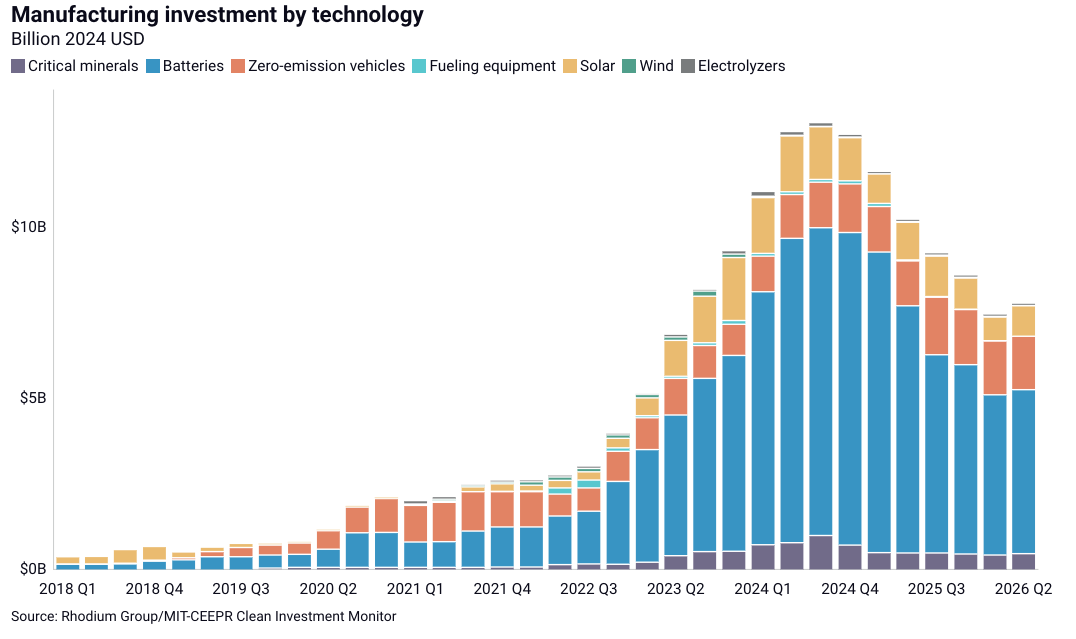
Batteries for EVs continued to make up the majority of manufacturing investments in Q2 (~$4.8B). Announced investments were concentrated in solar (~$8B), together with critical minerals ($1.8B), and EV batteries (~$495.8M).
Despite lack of federal policy support for EV manufacturers, federal policy and executive actions, like April’s White House Proclamation to strengthen steel, aluminum, and copper import tariffs, continue to signal interest in securing domestic supply chains and critical minerals processing. Access to domestic supply chains is becoming an increasingly important investment driver, including for taxpayers complying with PFE/FEOC requirements to claim certain energy tax credits.
1 Actual investment is the real dollars spent in the given quarter on retail purchases or new facility construction. Rhodium estimates actual investment by distributing the total investment proportionally over the construction window, based on either reported completion time (when available) or modeled completion time based on the average of past investments in that technology category. Rhodium conservatively assumes a facility advances through construction stages only when we can identify evidence of a groundbreaking. If evidence is lacking, facility timelines are adjusted accordingly, with start dates pushed back.
2 Announced investment is the total reported or estimated investment amount for a facility or project.
3 Note: In Q2 2026, Rhodium Group narrowed the scope for iron and steel projects to better capture investment in forward-looking decarbonized technologies. Specifically, they exclude projects utilizing natural gas direct reduction (DRI), unless the facility has plans or equipment to replace gas with hydrogen or utilize carbon capture and storage (CCS).

