

New federal funding opportunity for geothermal should prioritize extreme environments and deeper drilling


Overview of funding opportunity
On August 14, the Department of Energy’s (DOE) Hydrocarbons and Geothermal Energy Office (HGEO) and National Energy Technology Laboratory (NETL) released a $10.75 million funding opportunity available to U.S. colleges and universities for Innovative Research and Training for Subsurface Energy Production (DE-FOA-0003215). Geothermal is one of the three primary research funding focus topics. At a time when the United States needs abundant, reliable, and affordable clean energy to meet rising electricity demand, strengthen domestic industries, and sustain economic growth, this funding opportunity can help accelerate the subsurface breakthroughs needed to make next-generation geothermal a scalable contributor to both climate progress and long-term economic prosperity.
CATF’s new Geothermal Frontier platform includes profiles containing research capabilities of research groups around the world, and the catalogue can help applicants identify public-private partnership opportunities for this funding. The platform currently includes 41 institutions across the U.S. with resource characterization and modeling, drilling and well design, monitoring and instrumentation, reservoir creation and management, and engineering and power generation capabilities at different temperatures and pressures.
Significance and potential impact for derisking geothermal
Extreme environment drilling and production to expand geothermal potential
This funding has the potential to move the needle forward on the ability to successfully drill to deeper depths and complete wells at more extreme environments. Without research funding like this, next-generation geothermal technology remains limited to the few regions with relatively shallow heat, rather than advancing toward higher-temperature resources that can produce more energy per well and drive down the cost of geothermal power globally. Funding opportunities that help bridge the technology gaps for extreme environments can help make geothermal a source of cost competitive power wherever it is needed. Two of the primary hurdles to successfully commercializing geothermal technology on a global scale are around well completions in higher temperature systems and drilling to deeper depths (>7km) at a reasonable cost. This is where government funding can have the greatest impact. More details on technology gaps in advancing higher temperature geothermal systems can be found in our Superhot Rock Technology Gaps poster.
High potential: Where research and funding should focus
Drilling: Drill pipe coatings, insulated drill pipe, drilling at high angles, automation for rigs in hard rock conditions, maintaining straight larger diameter wellbores, innovative approaches beyond mechanical solutions (e.g., energy enhanced drilling), and drill rigs with higher hook load capacity.
Well design and construction: Novel and improved casing materials, cements, and reservoir engineering equipment (proppants, diverter systems, and zonal isolation tools for multistage stimulation).
Advanced modeling and characterization of the subsurface for cost-competitive deployment
A critical component to successful commercialization of cost-competitive geothermal energy is the ability to develop sophisticated modeling and digital twin capabilities. A digital twin is a virtual representation of a geothermal well or system that uses real-world data to simulate how it will behave under different conditions. It allows developers to test, for example, how a change in well design, flow rate, temperature, or pressure could affect performance across the entire system before making that change in the field. Reliable digital twin capabilities could dramatically reduce development risk, improve design decisions, and accelerate the path from laboratory innovation to field deployment. However, the industry doesn’t currently have sufficient data for high temperatures, pressures, and deeper depths to reliably develop these models.
The methods to site and characterize geothermal reservoirs at elevated temperatures and deeper depths are generally ready to use, but haven’t been sufficiently tested in more extreme, high temperature environments. This is because a limited number of superhot rock geothermal wells have been drilled, causing existing data to be insufficient to establish a consistent and reliable connection between geophysical signals and the temperature, stress, and permeability of the reservoir.
Additionally, there has yet to be a single integrated system-wide model that allows developers to model flow control, well configuration, and fracture design to optimize for thermal decline and flow decline, while accounting for Power Purchase Agreements (PPAs) and offtaker constraints up front. An integrated modeling tool that allows developers to weigh all these variables on one platform would be useful in early project planning stages and in extending the longevity of projects, planning for project resources, and increasing project certainty.
More details on technology gaps for siting and characterizing higher temperature geothermal resources can be found here.
High potential: Where research and funding should focus
Digital twin development: Data collection at high temperature, pressure, and deeper depths that can be used to develop and test a digital twin for a given region.
Site and characterize: Testing of methods to site and characterize potential geothermal sites at higher temperatures and deeper depths.
System-wide model: Development and testing of a system-wide geothermal model that could allow developers to model the essential elements of their project against PPA and offtaker constraints.
Benefits of public-private partnerships: Data sharing, technical expertise, and workforce development
Public-private partnerships have long played a key role in positioning the U.S. as a leader in energy innovation – take Utah FORGE, for example. Public-private partnerships incentivized through this funding opportunity are well suited to help tackle one of the primary challenges for next-generation geothermal: lack of publicly available and thoroughly vetted research of the subsurface. Exploratory drilling is necessary in the absence of adequate subsurface data but is too expensive and too risky for private developers to do on their own. University-led geothermal subsurface R&D, in partnership with non-academics and the private sector, can help decrease costs for future projects in unexplored regions and reduce unanticipated cost overruns associated with subsurface uncertainty that developers, researchers, and investors consistently cite as a primary barrier for next-generation geothermal development.
Research partnerships between universities and industry also have the potential to create the greatest impact in terms of advancing geothermal technology, since the research conducted is more likely to be a high priority for technological progress than university-only research. At the same time, research conducted with only industry may not have the technical expertise and research capabilities needed to run important experiments required to answer the highest priority questions.
Importantly, industry partnerships with universities allow research students to gather real world experience needed to work within the geothermal sector following graduation – building the future workforce for the geothermal industry.
Recommendations for proposals and awarded projects
We recommend that public-private partnership proposals pursue projects that focus on reducing the cost to drill deeper (target >7km depth) or successful drilling, reservoir stimulation, and production in more extreme environments (target >400°C temperature). This focus on either deeper drilling or more extreme environments will allow geothermal to progress to new areas while simultaneously lowering costs of developing new geothermal projects in regions with existing geothermal projects.
DOE should award funding to two types of projects:
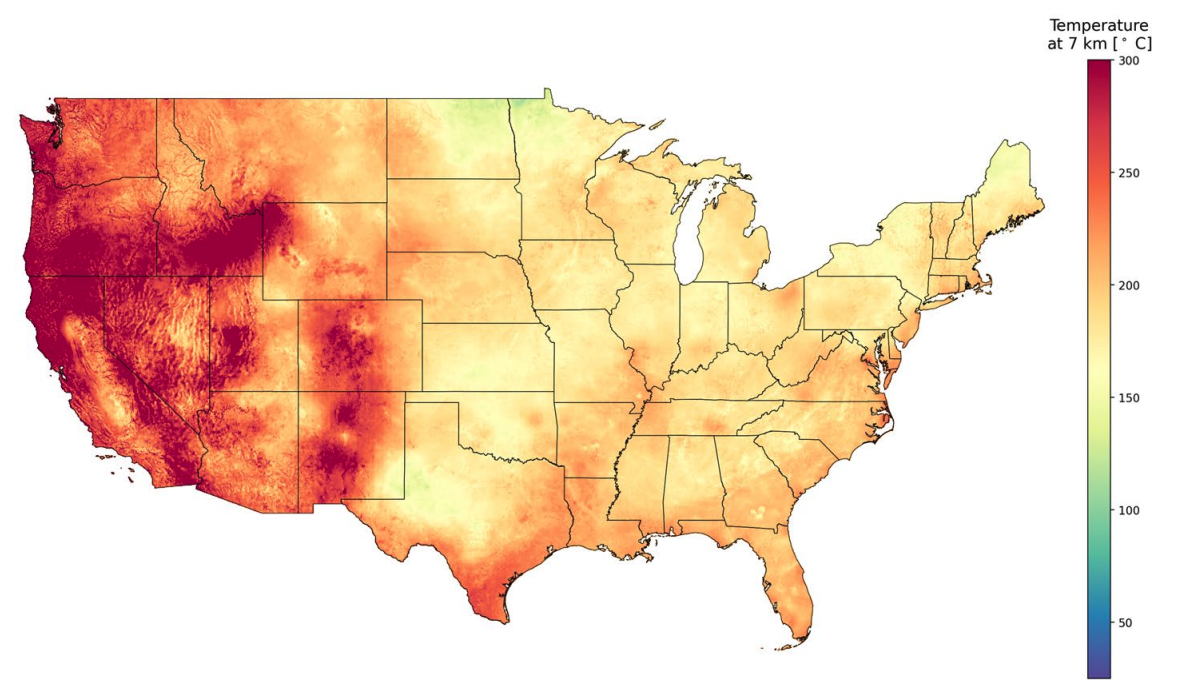
- Projects focused on technological breakthroughs in regions with shallow heat (e.g., red and orange regions in Figure 1) that focus on well field development at temperatures greater than 400°C.
- Projects focused on successfully drilling to 200°C at depths greater than 7km (e.g., yellow and green regions in Figure 1).
Targeted funding toward extreme temperatures and/or extreme depths will encourage research projects to focus on new learnings to maximize technical breakthroughs that will have the greatest impact on advancing geothermal technology to both higher temperatures and deeper depths, and therefore, into new regions at lower costs.
Figure 1. Map of predicted temperature at a depth of 7km across the U.S.
More on DOE’s funding opportunity
DOE is requesting proposals for university-led R&D projects that foster the development of a skilled workforce for careers in the energy sector and that emphasize early-stage research with demonstrable potential for technology market impact within 5-10 years after successful completion of the award. Anticipated technology readiness level (TRL) at the beginning of projects falls within the 2-4 TRL range, and 3-5 TRL by the end of the 3-year project. Proposals require a non-academic partnership and letter of their commitment, with the partner actively contributing to the research direction, technology market applicability, student mentorship, and work experience.
DOE is interested in funding subsurface geothermal R&D to advance EGS on:
- Extreme Environment Drilling and Production
- Development and testing of next-generation materials for life cycle reductions in well field development cost (e.g., alloys, composites, coatings, seals, smart materials) with enhanced durability for high-pressure, high-temperature geothermal environments.
- Enhanced Geothermal Systems (EGS) and Reservoir Engineering
- Advanced modeling and characterization of subsurface fracture networks to optimize EGS development and performance.
- Novel stimulation and operational strategies to create and sustain permeability in geothermal reservoirs.
Letters of intent are due on October 1, and full applications are due October 16. DOE expects to make up to 15, 3-year, $750,000 awards, with selections anticipated in January 2027 and awards in April 2027.

