

The Genesis Mission aims to accelerate fusion energy. It needs the data to do it.

The Department of Energy recently launched its first funding opportunity for the Genesis Mission, a $293 million Request for Application for interdisciplinary teams to address “Challenges of National Importance,” or key areas of frontier science and technology where AI-enabled breakthroughs could deliver outsized scientific, energy, or national security benefits. This is an important first step towards realizing the vision outlined by the administration to build an integrated “National Discovery Platform.” By uniting supercomputing resources with quantum technologies and AI systems trained on federal datasets, this National Discovery Platform will aim to double productivity and innovation in these key areas of energy and science over the coming decade.
An area of focus for the Genesis Mission is dispatchable, low-emissions energy sources, as reflected by the inclusion of fusion energy, nuclear fission, and geothermal energy within these Challenges of National Importance. If Genesis is able to accelerate the commercial deployment of fusion energy and other clean firm energy technologies, it would enable quicker delivery of zero-carbon, abundant, and reliable energy to enhance energy security, decarbonize our energy system, and even power the very data centers driving the artificial intelligence boom.
However, the Genesis Mission and its National Discovery Platform will only be as effective as the quality of data which is fed into its AI models. The Department of Energy explicitly recognized this with investments into the American Scientific Cloud in December 2025 to curate AI-ready datasets in preparation for Genesis. Yet many systems of future fusion energy machines will encounter novel physical phenomena. This results in data gaps which must be closed to fully harness the National Discovery Platform’s potential to accelerate fusion energy research. Therefore, for Genesis to succeed in shortening the timeline to commercial fusion energy deployment, a historic research infrastructure investment in fusion facilities to generate this essential data must be included as part of funding for the Genesis Mission.
Artificial intelligence is already playing a role in accelerating fusion energy development, as identified in CATF’s 2024 report on the intersection of fusion and AI. For example, AI-enabled surrogate modeling is reducing simulation run times by orders of magnitude to enable more rapid iterative design processes. However, for many key systems within future fusion energy machines, experimental data gaps will constrain how far and how fast the Genesis Mission can push fusion R&D forward. For example, structural materials in fusion machines will face unprecedented levels of high-energy neutron bombardment, which can cause swelling, creep, embrittlement, and induced radioactivity in those materials. Simultaneously, they will face extreme heat and plasma particle exposure, which can compound these interactions. No existing facility can replicate these conditions, resulting in a lack of fusion-relevant materials data for a National Discovery Platform to train upon to help determine the optimal materials to build a fusion energy machine. Similar gaps can be found across other “core challenges” laid out in the Department of Energy’s Fusion Science & Technology roadmap.
Infrastructure Streams Judged as “Critical” Towards the Development of Fusion Power Plants, from the DOE Fusion Science and Technology Roadmap
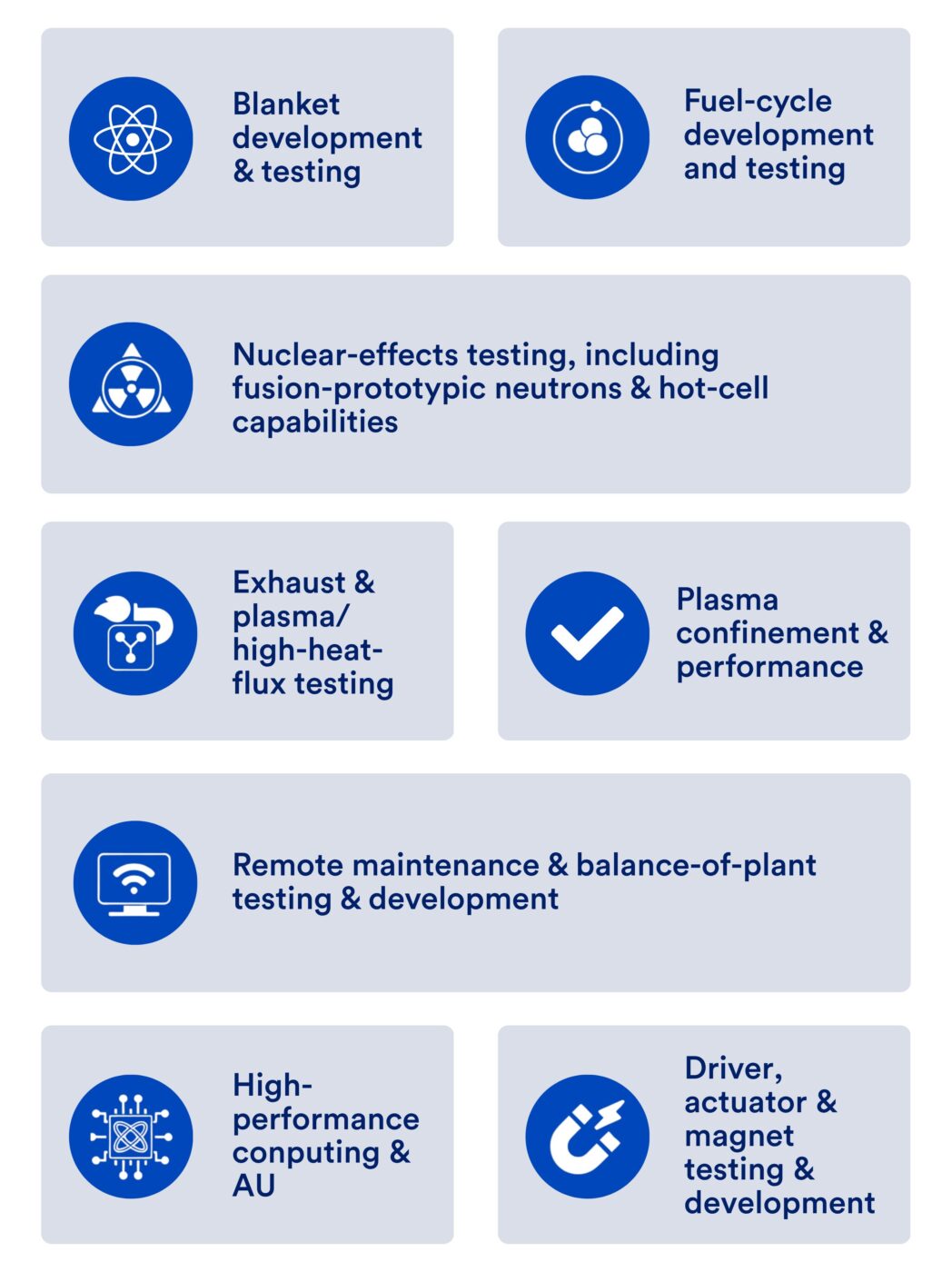
Fortunately, the Department of Energy’s “Build, Innovate, Grow” fusion strategy charts a clear pathway towards generating this essential data. The Science and Technology Roadmap provides an “Infrastructure Map” to build the test stands capable of generating experimental data to close these outstanding technology gaps. In the near term, new small- to medium-scale test stands must be built to better isolate and study these phenomena under fusion-relevant conditions. Construction must begin in earnest so that the Genesis Mission can produce results on the timeline of private sector developers. In parallel, large facilities identified as essential in the Science and Technology Roadmap, including an integrated Blanket and Fuel Cycle Test Stand as well as a Fusion Prototypic Neutron Source (FPNS), would generate data enabling the National Discovery Platform to act as a force multiplier for researchers validating materials, components, and integrated systems, compressing timelines and enabling new discoveries to drive forward commercial fusion energy deployment and scaleup.
These facilities are not ancillary to the Genesis Mission. They are inseparable from its success. However, unless annual appropriations for Fusion Energy Sciences are significantly enhanced, there will not be sufficient resources to construct these facilities. As a result, the National Discovery Platform would be starved of the experimental data it needs to train on to accelerate fusion energy commercialization, despite the fact that the Department of Energy has a clear plan to generate this data.
The following are key priorities for both Congress and DOE to ensure that the Genesis Platform has the necessary validated data to maximize the utility of the National Discovery Platform to accelerate fusion research.
- Congress must ensure that funding for the Genesis Mission includes robust funding for fusion facility construction as laid out in the Fusion Science & Technology Roadmap, including the small to medium test stands described in the BUILD section of the roadmap, as well as a Fusion Prototypic Neutron Source and an Integrated Blanket and Fuel Cycle Test Stand to generate essential experimental data to train the National Discovery Platform upon.
- Congress must fund the Fusion BRIDGE program outlined in the Fusion Science & Technology Roadmap to resource DOE to coinvest with private, philanthropic, state, or local stakeholders in new test stand construction, leveraging federal funding to catalyze broader investment and accelerate the build-out of fusion research infrastructure.
- Congress must continue robust funding for Public-Private Partnerships such as the FIRE collaboratives, INFUSE program, Milestone program and more which form the research apparatus through which the Genesis Mission can accelerate research and innovation.
- DOE should prioritize data curation programs to ensure that experimental fusion data is validated and findable, accessible, interoperable, and reusable (FAIR) to ensure it is AI-ready.
The Genesis Mission has stated ambitions on par with the Manhattan Project and the Apollo missions. Frontier AI models could make those ambitions technologically feasible, but realizing them for fusion energy will depend on whether the experimental infrastructure is built to generate the data the National Discovery Platform needs. With that infrastructure in place, Genesis would have the potential to accelerate the timeline to commercial fusion energy deployment and thereby strengthen energy security while reducing emissions. Getting there requires Congress to fund the necessary facilities and DOE to prioritize the programs generating the data at the heart of the Genesis Mission.

