
Understanding U.S. hydrogen demand through a Gulf Coast lens


The Gulf Coast is not just the leading industrial and hydrogen anchor in the U.S. today; it is a key geography for scaling clean hydrogen in the U.S. Existing industrial hydrogen use creates immediate clean hydrogen demand opportunities while enabling the growth of emerging hydrogen applications across transportation, fuels, and new industrial processes. In December 2025, CATF published the “U.S. Hydrogen Demand Assessment,” a data-driven analysis that shows hydrogen’s current role in the U.S. industrial economy, how much is needed, and where future demand might arise. This analysis is intended to guide state and federal strategies, particularly in a region as critical for energy production as the Gulf Coast.
What hydrogen is and why it matters
Hydrogen is a chemical element that exists as a gas under standard conditions. Hydrogen is a cornerstone of the U.S. industrial economy and a core industrial input for petroleum refining and chemical production, such as ammonia and methanol. In practice, hydrogen does not occur naturally in large volumes relevant for industrial use1, and therefore must be produced from other energy sources, most commonly through the steam methane reforming of natural gas, a commercial industrial process.
Hydrogen is used in a wide range of industries today, and its role is likely to expand in the future. This is the baseline context for clean hydrogen policy.
Hydrogen’s role in the U.S. economy
The “U.S. Hydrogen Demand Assessment” estimates that the United States currently produces and consumes approximately 11-14 million metric tons (MMT) of hydrogen annually, primarily across heavy industries. Louisiana, Texas, and California account for more than 60% of hydrogen production. Demand is highly concentrated across a small number of industrial sectors. Over 77% of U.S. hydrogen demand is tied to petroleum refining, ammonia production, and methanol production, with refining alone accounting for more than half of total consumption. Because these sectors are foundational to the American economy, hydrogen is already supporting major parts of the U.S. manufacturing base beyond these main hydrogen consumers.
Why the Gulf Coast is central to hydrogen production and use
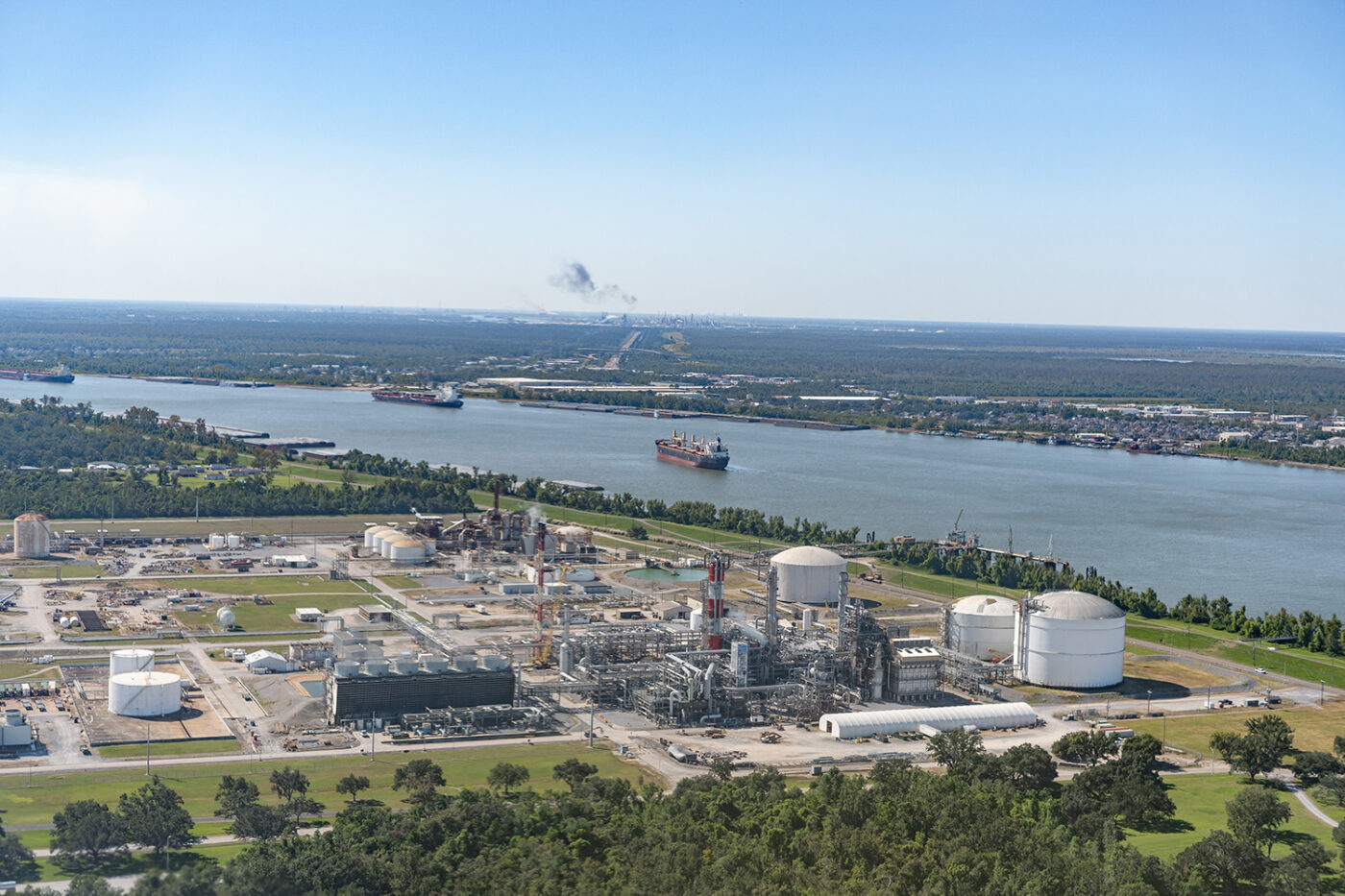
The Gulf Coast’s combination of existing industrial demand centers and enabling infrastructure makes it a cornerstone of hydrogen production and use in the U.S. Hydrogen demand closely tracks refining and chemical manufacturing, which are two sectors heavily concentrated in the Gulf Coast. Texas and Louisiana have the largest refining capacity across U.S. states. Louisiana ranks first in ammonia production capacity, more than doubling Oklahoma, which has the second largest capacity; Texas ranks fourth. Louisiana and Texas are also the nation’s largest producers of methanol. By any measure, the Gulf is a hydrogen powerhouse anchored in these sectors.
However, the region’s strength is built on more than its robust industrial base. The Gulf Coast’s hydrogen ecosystem has also benefited from deepwater ports, export capacity, a skilled workforce, and long-standing infrastructure, including the established hydrogen pipeline networks, connecting producers and end users in ways that create supply flexibility and market certainty. This combination of existing industrial demand centers and enabling infrastructure is why the Gulf Coast is positioned to play an outsized role as global markets transition towards clean hydrogen.
The promise of clean hydrogen growth
U.S. and global clean hydrogen demand has the potential to grow significantly over the coming decades, driven by the demand for lower emissions products from refining and chemicals and potential expanded use in sectors such as steelmaking, marine shipping and aviation fuels, and heavy-duty transport. That said, global demand remains around 100 MMT today and is still almost entirely concentrated in conventional industrial uses, with new applications accounting for only a negligible share.
However, international markets are beginning to create policy-driven demand signals for clean hydrogen and hydrogen-derived products. Large importers of U.S. goods, such as the European Union, South Korea, and Japan, have adopted ambitious hydrogen strategies. For example, Japan has set targets of 3 MMT per year by 2030,12 MMT by 2040, and 20 MMT by 2050. Meanwhile, South Korea targets approximately 3.9 MMT of clean hydrogen annually by 2030 and over 27 MMT by 2050, of which 1.96 MMT and 22.9 MMT of electrolytic hydrogen should be imported from overseas, respectively. Given limited domestic energy resources, a significant share of this demand is expected to be met through imports. In parallel, European policies such as REPowerEU, Renewable Energy Directive III, ReFuelEU Aviation, and FuelEU Maritime, along with carbon pricing mechanisms like the Emissions Trading System (ETS) and Carbon Border Adjustment Mechanism (CBAM), are expected to increase demand for clean fuels over time in the European market.
This growth in clean hydrogen is already being seen in the Gulf Coast through tens of billions of dollars of announcements in large-scale clean hydrogen and hydrogen-derived products, such as ammonia and methanol production facilities. An early example includes the CF Industries, JERA, and Mitsui partnership to produce clean ammonia in Louisiana for export to Japan, building on CF Industries’ existing CCS operations.
Taking action
The Gulf Coast’s leading edge in hydrogen is grounded in concentrated refining and chemical manufacturing, established industrial corridors, a skilled workforce, deepwater ports, and infrastructure that has supported the most concentrated region of hydrogen production and consumption in the U.S. for decades. These same advantages position the region to capture early economic benefits from clean hydrogen deployment, particularly where clean hydrogen can replace conventional hydrogen in existing industrial processes and expand to new end uses and where hydrogen derivatives can support emerging export markets.
Capitalizing on this opportunity will depend on policy alignment with market realities. Both Texas and Louisiana have taken initiative to attract and accelerate clean hydrogen investment in their states; Texas stood up the Hydrogen Production Policy Council and Louisiana the Clean Hydrogen Task Force. These state bodies developed reports with similar recommendations to drive adoption and accelerate deployment of large-scale clean hydrogen production facilities and offtake. Gulf states can strengthen their competitive advantages through the following policy tools to provide clarity and decisive leadership to developers:
- Modernizing the states’ regulatory environment to accommodate large-scale clean hydrogen production, transportation infrastructure, and emerging end uses, such as in steelmaking, heavy-duty trucking, and marine shipping fuels production;
- Exploring state support mechanisms to accelerate investment, including financing for infrastructure build out, demand-side incentives, and pilot programs for emerging end uses; and
- Coordinating and clarifying permitting roles across agencies to streamline and standardize project construction.
With state leadership laying the groundwork to attract new energy investment, it is now up to legislatures and executive agencies to carry these recommendations forward and translate strategy into action.
Footnotes
1. Geologic hydrogen may be an exception; however, there are currently no proven geologic hydrogen resources in the U.S. that are suitable for commercial use.

