
New CATF analysis highlights Brazil’s largest opportunities to cut waste methane


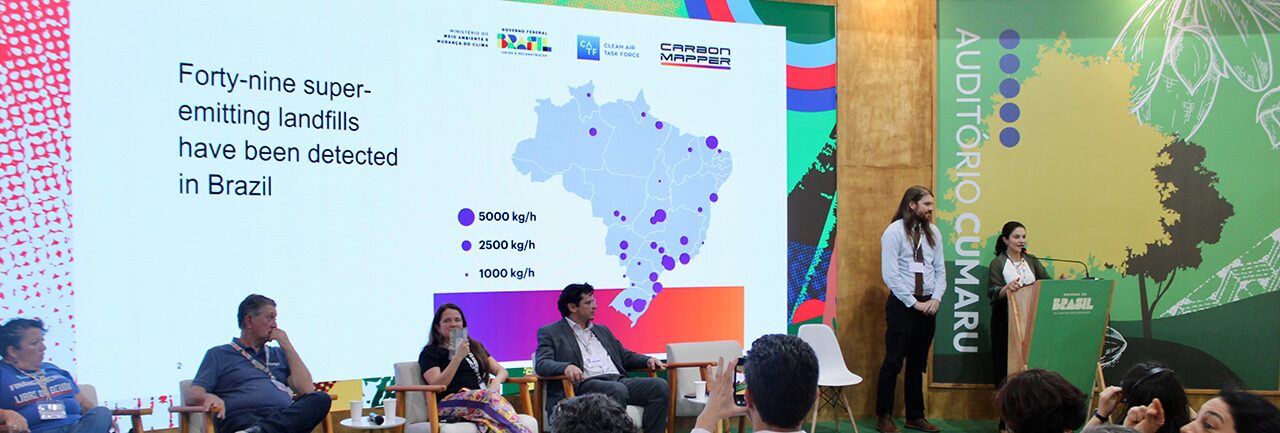
At COP30, the Government of Brazil announced the launch of a process to develop a first-of-its-kind national initiative to detect and mitigate methane emissions from the country’s waste sector, in collaboration with Clean Air Task Force (CATF), Carbon Mapper, and local partners. The effort will use emerging satellite and remote sensing technologies to identify high-emitting landfill and dumpsite locations and put actionable data into the hands of operators and municipal authorities.
This announcement marks a major step in Brazil’s methane leadership. It also highlights a broader opportunity. The waste sector represents one of the most cost-effective and politically actionable levers for near-term climate progress. As Brazil moves from commitment to implementation, new analysis from CATF and Instituto PNRS offers a detailed view of where policy reform, investment, and capacity building can drive further mitigation.
The waste sector has outsized climate impact and immediate mitigation potential
Methane is responsible for roughly 25 percent of Brazil’s total greenhouse gas emissions, and the waste sector contributes about 15 percent of national methane emissions, driven largely by the decomposition of organic waste in landfills and open dumps.
In 2023, Brazil generated 78 million tons of municipal solid waste, nearly half of which consisted of organic material. Yet only 36 percent of the population has access to separate collection services, and around 26 percent of collected waste continues to be sent to inadequate disposal sites. Approximately 9 percent of waste generated is not collected at all and is burned or dumped illegally.
These conditions make waste methane one of the country’s most concentrated and addressable climate challenges.
New CATF analysis identifies strategic gaps and high-impact opportunities
The Brazilian Waste Sector Methane Analysis, examines national waste generation, emissions, policy frameworks, and institutional capacity, identifying where the biggest opportunities for reduction lie. Key findings include:
- Significant infrastructure gaps remain. Brazil still has roughly 2,000 inadequate disposal sites in operation and large regional disparities in access to separate collection and treatment capacity.
- Limited enforcement and technical capacity hinder implementation of existing federal mandates, including the National Solid Waste Policy’s requirement to close open dumps.
- Data and financial gaps restrict the ability of municipalities to plan and deploy composting, anaerobic digestion, and landfill methane capture.
- Near-term mitigation technologies are established and scalable, including landfill gas capture, biocovers, improved landfill operations, and expanded organic waste treatment.
Examples across Brazil show the potential for progress. Brazil’s early experience with landfill gas recovery has already contributed to its first recorded year-over-year decline in solid-waste methane emissions. With strategic investment and implementation support, these reductions can accelerate.
A critical moment for policy reform and targeted investment
Brazil already has a strong policy foundation for waste and methane management, including the National Solid Waste Policy, PLANARES, and the Zero Dumpsites Program. But the report finds that enforcement, financing, and capacity remain uneven, particularly at the municipal level.
The development of the satellite-based initiative announced at COP30 is an important step toward building that capacity-and demonstrating that such a program is possible at the national level-but broader structural reforms will be needed to deliver sustained emissions reductions.
The report recommends several priority actions to strengthen Brazil’s broader waste methane mitigation efforts, including:
- Updating and enforcing landfill regulations, including new rules for landfill operations, methane use, and waste segregation at the source
- Expanding organic waste diversion and treatment, including composting, mechanical–biological treatment, and anaerobic digestion, supported through targeted policies, public awareness campaigns, and incentives for waste reduction and recycling
- Supporting methane capture and energy recovery at sanitary landfills, including the adoption of biocovers and mandatory methane recovery systems where viable
- Providing training and technical support for municipal authorities and waste professionals to strengthen operational practices and improve implementation of methane mitigation strategies
- Improving data systems, including standardized protocols for methane measurement and systems to monitor emissions across disposal sites
- Strengthening financing mechanisms, such as waste-fee systems and public–private partnerships, to help municipalities cover ongoing operational costs and invest in new infrastructure
These steps would help Brazil advance its stated climate targets, improve public health, and strengthen waste services across regions.
WasteMAP provides a foundation for long-term implementation support
The Brazilian assessment is part of a broader series of Waste Sector Methane Analysis reports for Ecuador, Mexico, and Colombia, produced as part of CATF and RMI’s Waste Methane Assessment Platform (WasteMAP). WasteMAP is an open platform that brings together waste methane emissions data with decision-support tools, supported by direct engagement with national and subnational governments, waste sector officials, and other key decision makers. The aim is to build capacity, improve data systems, and help governments accelerate methane mitigation in the waste sector.
Converting momentum into measurable methane reductions
Brazil’s new collaboration with CATF and Carbon Mapper demonstrates real momentum toward tackling waste methane. The Waste Sector Methane Analysis shows, however, that further progress will hinge on empowering municipalities, which are responsible for implementing waste policies, improving collection systems, closing dumpsites, and expanding treatment capacity. With targeted investment and continued national support, Brazil can turn better detection into measurable methane reductions and a stronger, more modern waste systems.

