

While Brussels finalises the EU Grid Package, three areas demand immediate action


The upcoming EU Grid Package offers a critical opportunity to unlock coordinated planning, accelerated permitting, and deploy proven technologies across Member States.
With the European Commission set to unveil its EU Grid Package-a key component announced under the Clean Industrial Deal and the Action Plan for Affordable Energy-Europe is entering a defining moment. The proposal, which is currently scheduled for December 10th, will underscore the central role of the electricity grid in meeting Europe’s climate ambitions, supporting industrial competitiveness, and keeping energy affordability. Robust grid infrastructure is now essential for timely delivery on all three.
Interconnected and stable electricity grids are the backbone of a well-functioning power market, the necessary link between generation and demand. Yet today, fragmented and uncoordinated planning frameworks and complex permitting procedures hold back grid project delivery. Grid bottlenecks are among the main reasons the EU cannot fully benefit from its significant installed renewable capacity, and why households and industry struggle to afford prices.
Europe needs approximately half a trillion euros in grid investments by 2030, according to the European Commission.1 Part of the solution to increasing public and private investment would be more coordinated and forward-looking planning and governance to increase investment predictability and ensure the best use of available funding to future-proof grids.
At a recent CATF webinar on this topic, featuring MEP Bruno Tobback (Belgium, S&D), the International Energy Agency’s Jacques Warichet, Compass Lexecon’s Fabien Roques, and CATF’s Alessia Virone, the consensus was unmistakable: The economic case is clear. The technical solutions exist. What’s needed now is the policy framework and the investment to deploy them.
Building the grid Europe needs requires greater coordination across Member States
Even before the recent surge in electricity demand from electrification and data centers, Europe’s grid was showing its age with over 40% of distribution grids over 40 years of age and approaching the end of their useful life. Climate change increasingly strains system resilience due to extreme weather events, increasing heating and cooling needs. And despite hundreds of gigawatts of clean generation capacity (including solar, wind, and battery storage) in connection queues, investment-ready projects cannot reach consumers.
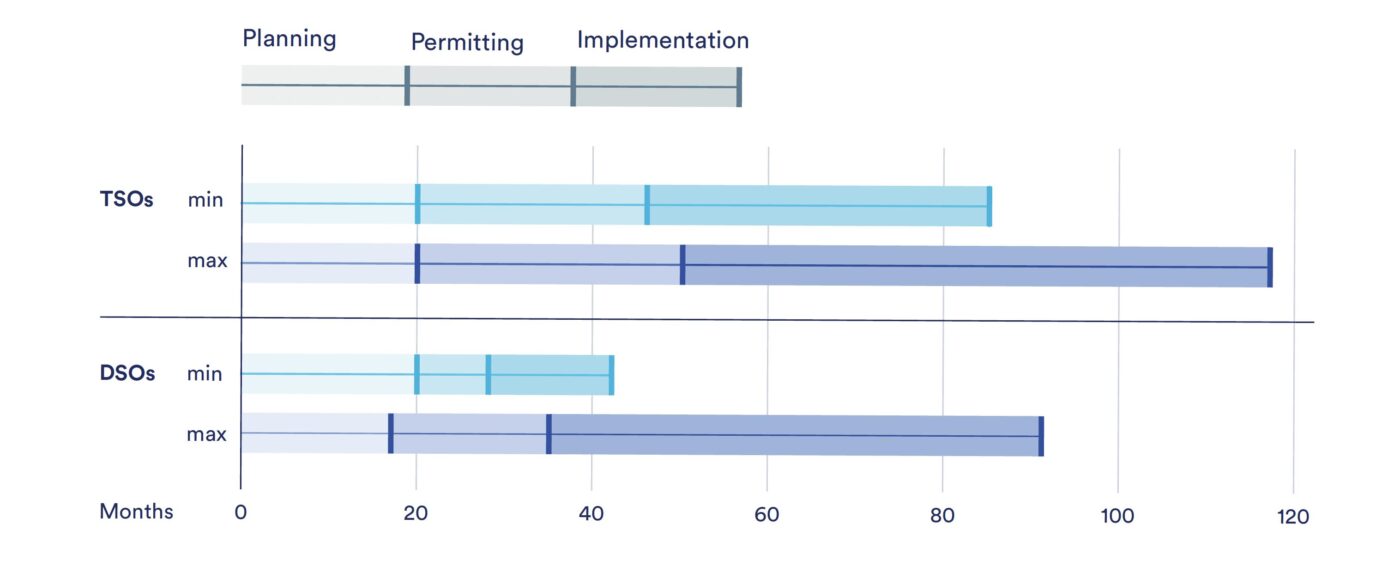
The problem isn’t a lack of ambition, it’s a lack of coordination. National and EU planning cycles misalign, using different methodologies, scenarios, and timelines. Permitting accounts for about 25% of total grid investment time and remains a main cause of delay.2 And proven technologies that could increase existing grid capacity by 20-40% remain systematically overlooked by system operators and national regulatory authorities.
As the webinar discussion revealed, Europe must plan regionally to power its internal market. That requires rethinking not just infrastructure investment, but how and when Member States coordinate planning, who pays for cross-border benefits, and how quickly we can modernise existing assets. This aligns with the priority areas identified in CATF’s recommendations for the EU Grid Package, which include ensuring a more consistent planning framework at the national and European levels for the timely and cost-effective development of the electricity grid, accelerating permitting, and supporting the modernisation of the grid.
Perhaps the most politically sensitive issue is who pays for cross-border infrastructure that delivers benefits across multiple Member States. Investments in transmission will serve Europe for decades, but current cost allocation mechanisms don’t adequately reflect regional and system-wide benefits.
As panellists noted, this requires revisiting cost-sharing frameworks and designing tariff structures that enable cost recovery while maintaining affordability. Europe needs innovative approaches that recognise infrastructure serving the internal market shouldn’t fall entirely on the Member State where it’s sited. Better coordination on investment decisions and cost allocation can unlock the efficient, strategic placement of infrastructure that Europe’s integrated energy system demands.
Three areas where the Grid Package can deliver impact
Based on CATF’s recommendations and expert analysis from Compass Lexecon, three critical action areas stand out where the Grid Package can deliver near-term progress:
1. Coordinate planning across borders and time horizons
Current planning is fragmented both geographically and temporally. National Network Development Plans operate on different cycles than the EU’s Ten-Year Network Development Plan (TYNDP), using inconsistent assumptions about technology costs, demand growth, and climate scenarios. Planning horizons of just 10 years fail to capture infrastructure synergies that will serve Europe for decades and support the achievement of its 2050 climate-neutrality goals.
What’s needed:
- Coordinate national and EU grid planning cycles on a two-year basis, harmonising methodologies and core scenarios
- Extend network development planning horizons from 10 to 20 years to capture long-term infrastructure needs and avoid piecemeal short-term approaches
- Enhance siloed sector planning with additional economy-wide analysis that integrates electricity, hydrogen, and carbon capture infrastructure to identify cross-sector synergies
- Improve the EU framework on Needs Assessments beyond just network expansion and adequacy to also cover system flexibility and climate resilience
As the webinar panellists emphasised, anticipatory investment requires Europe to decide strategically where to invest efficiently. That means coordinated scenarios that Member States follow, with justified deviations for region specific needs.
2. Accelerate permitting to deliver investment clarity and efficiency
Permitting delays project delivery and accounts for roughly a quarter of total grid investment timelines.3 While the EU has introduced meaningful provisions through the TEN-E Regulation and the revised Renewable Energy Directive, implementation remains inconsistent across Member States. Cross-border projects face particular challenges when national permitting authorities don’t coordinate.
Practical reforms:
- Establish national one-stop shops for network permitting, similar to provisions for Projects of Common Interest, serving as single points of contact responsible for interactions with developers and regulators, and facilitating cross-border coordination between national permitting authorities for projects crossing jurisdictions
- Speed up permitting procedures and work towards the full digitalisation of permitting and review processes with centralised online portals, tracking systems, and publicly available environmental and geological data
- For CO2 projects, encourage advance preparation of storage permit applications alongside exploration license work programs
Some Member States have already proven that these approaches work, and the Grid Package can help scale them across Europe.
Planning and permitting: Roughly half of the total time for grid infrastructure projects
3. Modernise existing infrastructure with grid-enhancing technologies
While new greenfield infrastructure is essential, Europe has an old grid that needs better utilisation now. Integrating grid-enhancing technologies–including dynamic line ratings, power flow controls, and advanced conductors–into existing transmission and distribution infrastructure could increase overall network capacity by between 20 and 40%.4
These technologies offer quick-to-deploy, cost-effective capacity improvements that modernise systems while reducing the magnitude of new construction needed. Because key infrastructure already exists in established rights-of-way, upgrades typically incur less permitting review time than new projects while delivering significant capacity gains.
Yet, as webinar discussions highlighted, these technologies are not systematically considered as solutions by operators and regulators. The Grid Package should ensure that grid enhancement is integrated comprehensively into system-level planning, with clear expectations for when and how these technologies should be deployed.
Member states must take a proactive role in implementation
While much attention focuses on Brussels, powerful levers for progress lie at national, regional, and local levels. Member States control key aspects of transmission planning, utility procurement, and project siting. National transmission and distribution grid operators (TSOs and DSOs), as well as National Regulatory Authorities, set market rules shaping which resources get built and when. Additionally, local governments influence permitting timelines and community acceptance.
The EU Grid Package will provide essential coordination frameworks and set expectations for harmonisation. But implementation will determine success. That means Member States must:
- Coordinate across jurisdictions even when not explicitly required by EU law
- Proactively design grid infrastructure as the backbone it truly is, enabling the integration of upcoming generation needs and electrification of industrial clusters, not an afterthought to generation policy
- Invest in adequate staffing and funding of permitting offices to process growing project pipelines
A defining moment for Europe’s energy infrastructure
Europe stands at an energy infrastructure crossroad. The Grid Package is a test of Europe’s ability to coordinate on critical infrastructure for a shared energy future. Grid bottlenecks that prevent renewable energy from reaching consumers, industrial facilities that cannot secure reliable, affordable power, and households facing energy cost uncertainty all wait on the decisions made in the coming months.
The alternative to coordinated action is clear: continued fragmentation means higher costs, slower decarbonisation, and missed economic opportunities. According to analysis cited in the Draghi report, a more efficient use of the European generation mix, which new cross-border transmission would enable, could reduce costs by about EUR 9 billion per year in 2040–far outweighing the EUR 6 billion annual grid, storage, and peaking unit investment needed for that same year.
Europe must now build the regulatory framework to deploy a grid at scale. The Grid Package offers the opportunity to finally match Europe’s grid governance with its climate and industrial ambition.
Read CATF’s full policy brief with recommendations for the Grid Package.
For further details, please see Compass Lexecon’s paper titled “Accelerating the Deployment of Clean Power Technologies to Reliably Decarbonise Europe through Enhanced Planning and Contracting Mechanisms”, commissioned by Clean Air Task Force.
1 Grids, the missing link – An EU Action Plan for Grids
2 Making the EU electricity grid fit for net-zero emissions
3 Making the EU electricity grid fit for net-zero emissions
4 P 11 brief, https://www.europarl.europa.eu/RegData/etudes/BRIE/2025/772854/EPRS_BRI(2025)772854_EN.pdf

