
Carbon capture and storage in Europe: Slow but significant progress in 2025



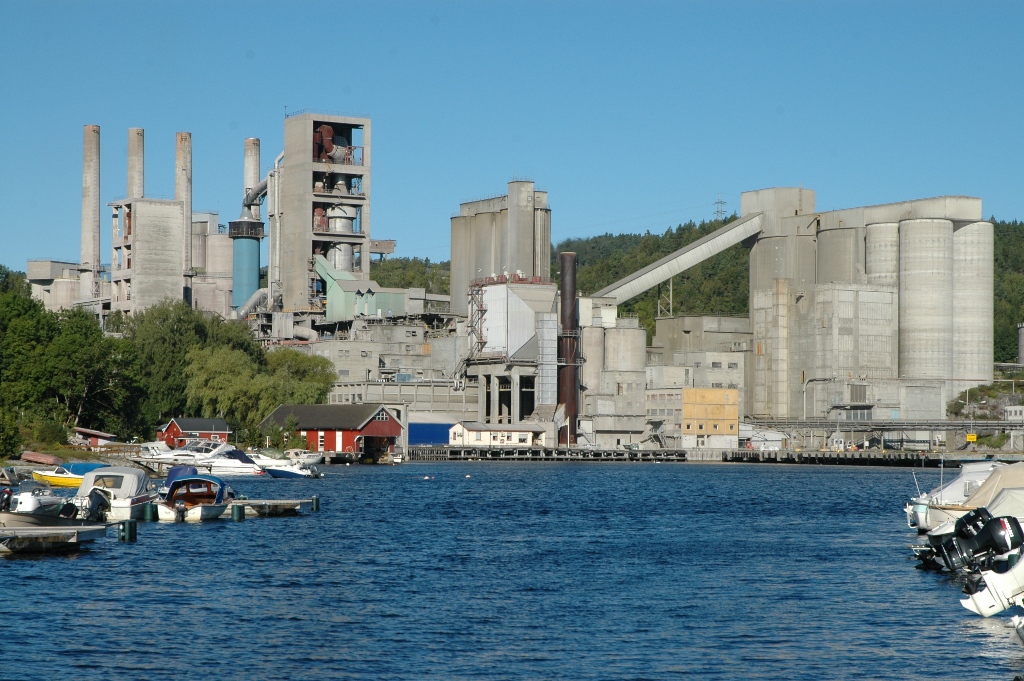
In 2025, Europe began deploying carbon capture and storage (CCS) at commercial scale. In Norway, Heidelberg Materials’ Brevik cement plant became the first industrial facility to capture CO₂ at scale and store it permanently through the Northern Lights project – a milestone that demonstrates Europe’s first fully operational CCS value chain.
Several other projects reached final investment decision (FID) in late 2024 and throughout 2025, representing ten projects in total, with about 4 million tons (Mt) CO₂ per year of capture capacity and around 14 Mt CO₂ per year of storage capacity (Table 1). This reflects a steady, if uneven, transition from planning to implementation.
In parallel, the EU advanced relevant policy. The Net-Zero Industry Act (NZIA), adopted in 2024, set a binding target of 50 Mt CO₂ per year of injection capacity by 2030 and introduced obligations for 44 oil and gas producers to help develop shared storage infrastructure. Member States submitted this year their first Article 21 reports, providing an initial overview of national plans for capture, transport, and storage. The Clean Industrial Deal, launched in February 2025, positioned industrial decarbonisation as a pillar of Europe’s competitiveness. It outlined new instruments to accelerate investment, including the forthcoming Industrial Accelerator Act (expected in late 2025) and a proposed Industrial Decarbonisation Bank (planned for 2026).
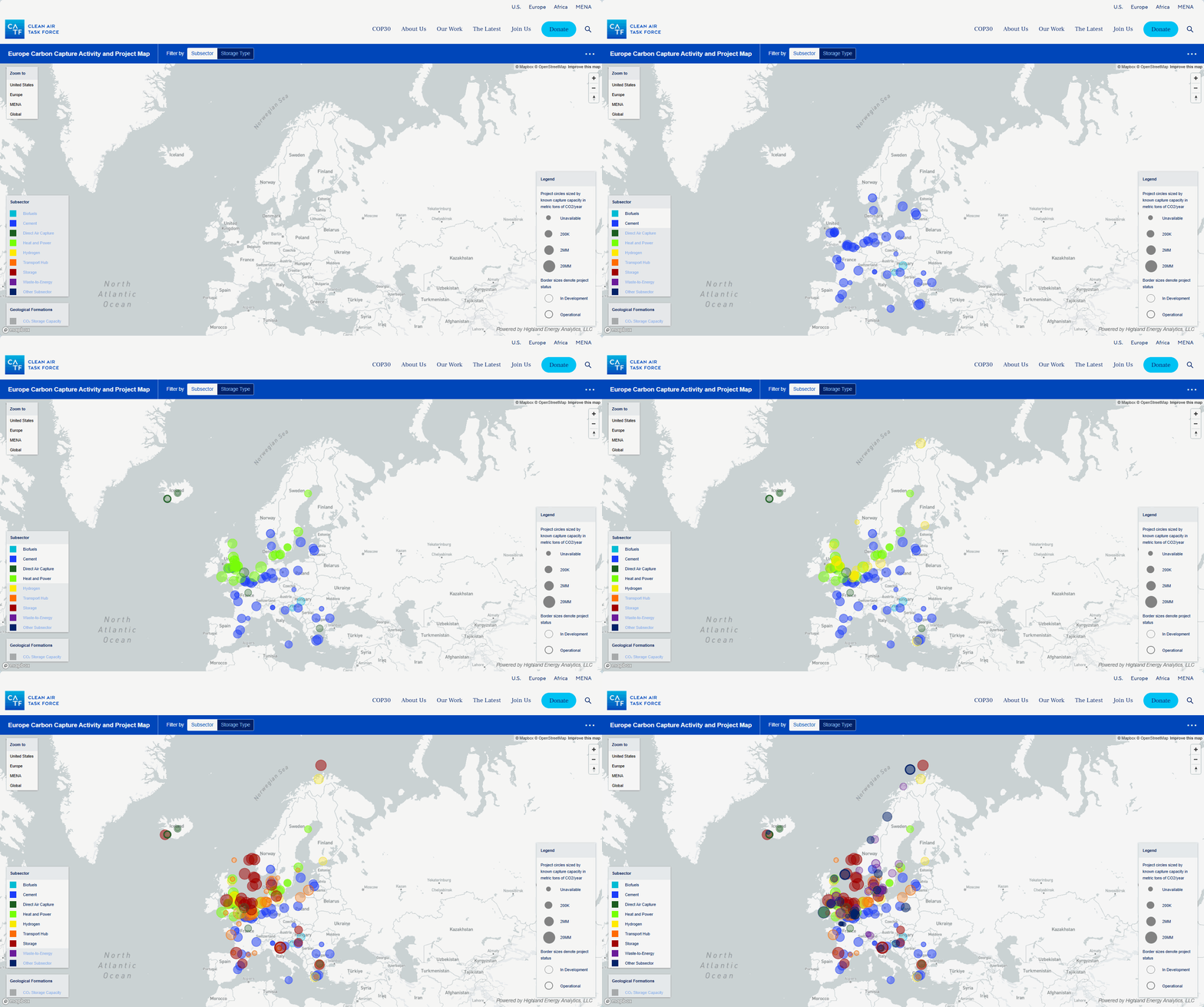
Despite these steps forward, progress toward FIDs remains slow, limited by permitting delays, slow infrastructure development, and inadequate regulatory or funding drivers to support project investment. To reach the recommended 90% net emissions reduction by 2040 and climate neutrality by 2050, the EU will need to be ready to capture around 280 Mt CO₂ per year by 2040 and 450 Mt CO₂ per year by 2050. Current deployment remains far behind that trajectory. CATF’s updated Carbon Capture Activity and Project Map shows that while the number of project announcements continues to grow, only a small share of them have advanced to FID – underlining the persistent gap between ambition and delivery.
Figure 1. Europe Carbon Capture Activity and Project Map
There’s been slow but steady progress on final investment decisions
Projects reaching FID in 2024 and 2025 include Stockholm Exergi’s BECCS facility in Sweden, Hafslund Oslo Celsio’s Klemetsrud waste-to-energy capture project in Norway, Project Greensand’s offshore CO₂ storage development in Denmark, and Fluxys’ c-grid transport infrastructure in Belgium. In the United Kingdom, several projects within the HyNet cluster also reached FID during 2025 across transport, storage, and industrial capture.
Earlier FIDs, such as Northern Lights Phase 1 (2020), Ørsted Kalundborg CO₂ Hub (2023) in Denmark and Yara Sluiskil and Porthos (2023) in the Netherlands, marked the start of commercial-scale CCS deployment in Europe’s industrial hubs.
Table 1. CCS Projects Reaching FID in Europe (Dec 2024–Oct 2025)
| Project | Country | Sector/Type | Annual capacity (tCO2/y) | FID | Funding Source |
|---|---|---|---|---|---|
| NET ZERO TEESSIDE POWER | United Kingdom | Natural Gas Power Generation | 2,000,000 capture capacity | Dec 2024 | Part of UK Carbon Capture, Usage and Storage (CCUS) Track-1 Cluster Sequencing Programme – East Coast Cluster. Supported by the UK government’s £21.7 bn UK CCUS and Hydrogen commitment (2024). Project-specific funding amount not disclosed. |
| NORTHERN ENDURANCE PARTNERSHIP | United Kingdom | CO₂ Transport & Storage | 4,000,000 storage capacity | Dec 2024 | Part of UK Carbon Capture, Usage and Storage (CCUS) Track-1 Cluster Sequencing Programme – East Coast Cluster. Supported by the UK government’s £21.7 bn UK CCUS and Hydrogen commitment (2024). Project-specific funding amount not disclosed. |
| PROJECT GREENSAND | Denmark | CO₂ Transport & Storage | FID taken on 400,000 storage capacity; full capacity up to 8,000,000 | Dec 2024 | EU Innovation Fund (€41 m), Danish Energy Technology Development and Demonstration Programme (DKK 197 m ≈ €26 m). In addition, it will store CO₂ from biogas projects supported by the fund for negative CO2 emissions (NECCS). |
| HAFSLUND OSLO CELSIO (KLEMETSRUD) | Norway | Waste-to-Energy | 350,000 capture capacity | Jan 2025 | Supported under Norway’s Longship CCS project (NOK 22 billion total, administered by the Ministry of Petroleum and Energy) and augmented by a 10-year CO₂-removal offtake with Microsoft (1.1 Mt CO₂). |
| STOCKHOLM EXERGI BECCS | Sweden | Bioenergy Power & Heat | 800,000 capture capacity | Mar 2025 | EU Innovation Fund (€180 m), Swedish Energy Agency BECCS Premium Programme support (SEK 20 bn ≈ €1.7 bn), Europe Investment Bank €260 m loan and 10-year CO₂-removal offtake with Microsoft for 5.08 Mt CO₂. |
| NORTHERN LIGHTS PHASE 2 | Norway | CO₂ Transport & Storage | 5,000,000 storage capacity | Mar 2025 | EU Connecting Europe Facility (€131m) and CO₂ offtake agreements with Stockholm Exergi and Hafslund Oslo Celsio. |
| ENI LIVERPOOL BAY CCS (HYNET T&S) | United Kingdom | CO₂ Transport & Storage | 4,500,000 storage capacity in initial phase | Apr 2025 | Part of the UK Carbon Capture, Usage and Storage (CCUS) Track-1 Cluster Sequencing Programme -HyNet North West. Supported by the UK government’s £21.7 bn CCUS and Hydrogen commitment (2024). Project-specific funding amount not disclosed. |
| FLUXYS C-GRID | Belgium | CO₂ Transport & Storage | N/A (infrastructure) | May 2025 | EU Connecting Europe Facility for Energy (CEF-E) grant (€25.8 m) under the €144.6 m Antwerp@C CO₂ Export Hub and additional co-funding from the Flemish Agency for Innovation & Entrepreneurship (VLAIO). |
| ENCYCLIS’ PROTOS ENERGY RECOVERY FACILITY (HYNET) | United Kingdom | Waste-to-Energy | 370,000 capture capacity | Sep 2025 | Part of the UK Carbon Capture, Usage and Storage (CCUS) Track-1 Cluster Sequencing Programme – HyNet North West. Supported by the UK government’s £21.7 bn CCUS and Hydrogen commitment (2024). Project-specific funding amount not disclosed. |
| HEIDELBERG MATERIALS PADESWOOD CEMENT WORKS (HYNET) | United Kingdom | Cement Manufacturing | 800,000 capture capacity | Sep 2025 | Part of the UK Carbon Capture, Usage and Storage (CCUS) Track-1 Cluster Sequencing Programme – HyNet North West. Supported by the UK government’s £21.7 bn CCUS and Hydrogen commitment (2024). Project-specific funding amount not disclosed. |
Blended funding remains essential for advancing new CCS projects. Most investment decisions continue to rely on a combination of EU and national funding, together with carbon dioxide removal (CDR) offtake agreements that provide long-term revenue certainty. Stockholm Exergi, Hafslund Oslo Celsio and Ørsted have all reached FID through this model, supported by public funding and long-term CDR offtake contracts from the voluntary carbon market (VCM) with Microsoft. These agreements provide important revenue stability for first-of-a-kind projects, where capture costs remain high and carbon-removal markets are still emerging.
The Northern Lights Phase 2 investment decision in March 2025 illustrates how public and private finance can align to expand cross-border transport and storage capacity. Phase 2 combined EU Connecting Europe Facility (CEF) support with commercial storage contracts from Stockholm Exergi and Hafslund Oslo Celsio, both of which reached FID using the blended-finance model.
While Northern Lights Phase 2 highlights increasing commercial participation, most new projects in Europe still depend on blended funding and corporate CDR offtake agreements to reach investment readiness. The exceptions are projects such as Porthos and Yara Sluiskil, where capture installations operate with relatively low capture costs, though both still benefit from national or EU support. Others, including the UK’s industrial clusters (HyNet North West and East Coast Cluster) and Norway’s Brevik project, remain heavily backed by government funding. Maintaining and scaling these funding frameworks and, critically, extending similar national funding frameworks to other Member States, will be essential to sustain momentum and extend CCS deployment across new regions and sectors.
New carbon capture and storage projects emerging across Europe
CCS development is expending beyond Europe’s established hubs in Norway, the Netherlands, and the United Kingdom. CATF’s project tracker identifies 37 proposed CCS projects across Southern and Central & Eastern Europe, signaling growing regional engagement and the potential for more geographically distributed CO₂ infrastructure, which would allow industries in Southern and Eastern Europe to access storage at lower costs than by depending on the ones located in Northern Europe.
Figure 2. CCS Projects in Europe by Region
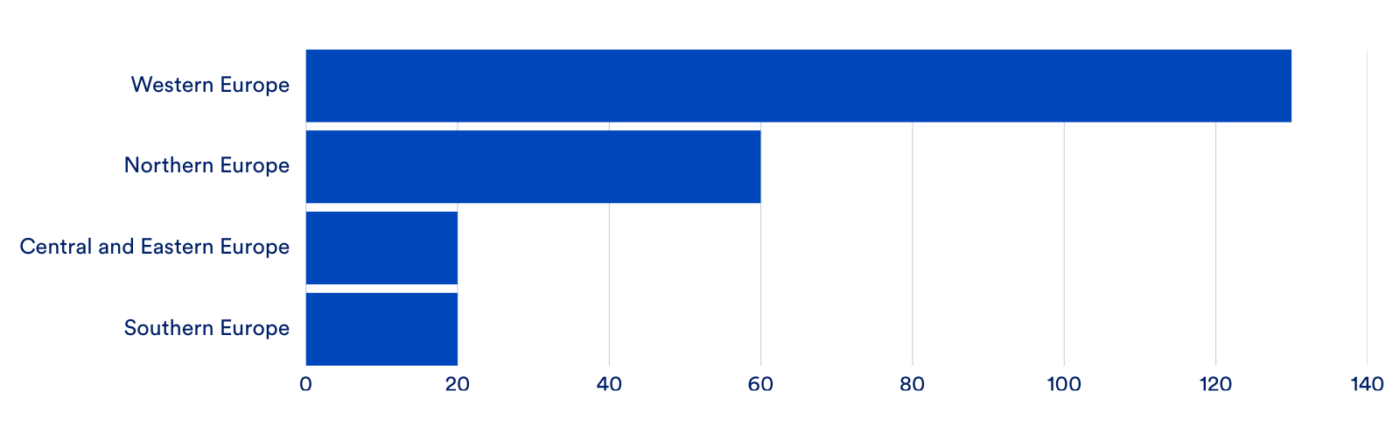
Northern Europe: Denmark, Finland, Iceland, Norway, Sweden
Central and Eastern Europe: Bulgaria, Croatia, Czechia, Hungary, Latvia, Lithuania, Poland, Romania, Slovakia
Southern Europe: Greece, Italy, Spain
In Spain, TarraCO₂-Storage aims to connect cement, chemical, and refining emitters in the Tarragona industrial zone to an offshore CO₂ storage site in the Mediterranean. The project targets around 54 Mt CO₂ total storage capacity, with an expected injection rate of about 2 Mt CO₂ per year once operational. In Italy, Heidelberg Materials’ Rezzato-Mazzano cement plant will aim to capture around 1 Mt of CO₂ per year, linking to the Ravenna CO₂ storage hub in the Adriatic Sea.
In Central and Eastern Europe, a growing number of projects are developing onshore CO₂ storage, often led by the cement industry. In Romania, Carbon Hub CPT01, selected under the 2024 European Innovation Fund, will link Holcim’s Câmpulung cement plant and a nearby Carmeuse lime facility to a large-scale onshore geological storage site. Starting in 2032, the project will produce around 2 million tons of near-zero cement per year. It will seek to demonstrate that full-chain CCS can work inland, away from the coast. In Bulgaria Beli Net Zero will develop an integrated capture-to-storage system in South-East Europe, transporting CO₂ from the Beli Izvor cement plant to an onshore saline aquifer. Anrav, also in Bulgaria, is advancing plans for CO₂ capture at the Devnya cement plant with both offshore and potential onshore storage options under consideration. In Slovakia, Engas CCS is advancing a full-chain CO₂ storage project, converting a depleted gas field into an onshore storage site that will store emissions from the Duslo Šaľa chemical facility. In Hungary, Danube Carbon Removals will aim to capture 0.5 Mt of biogenic CO₂ per year from the Pannonia Bio biorefinery to an onshore saline aquifer.
These projects signal the emergence of regional CCS hubs beyond the North Sea, an important step toward expanding CO₂ storage across Europe.
Steelmaking and hydrogen production arise as new industrial applications
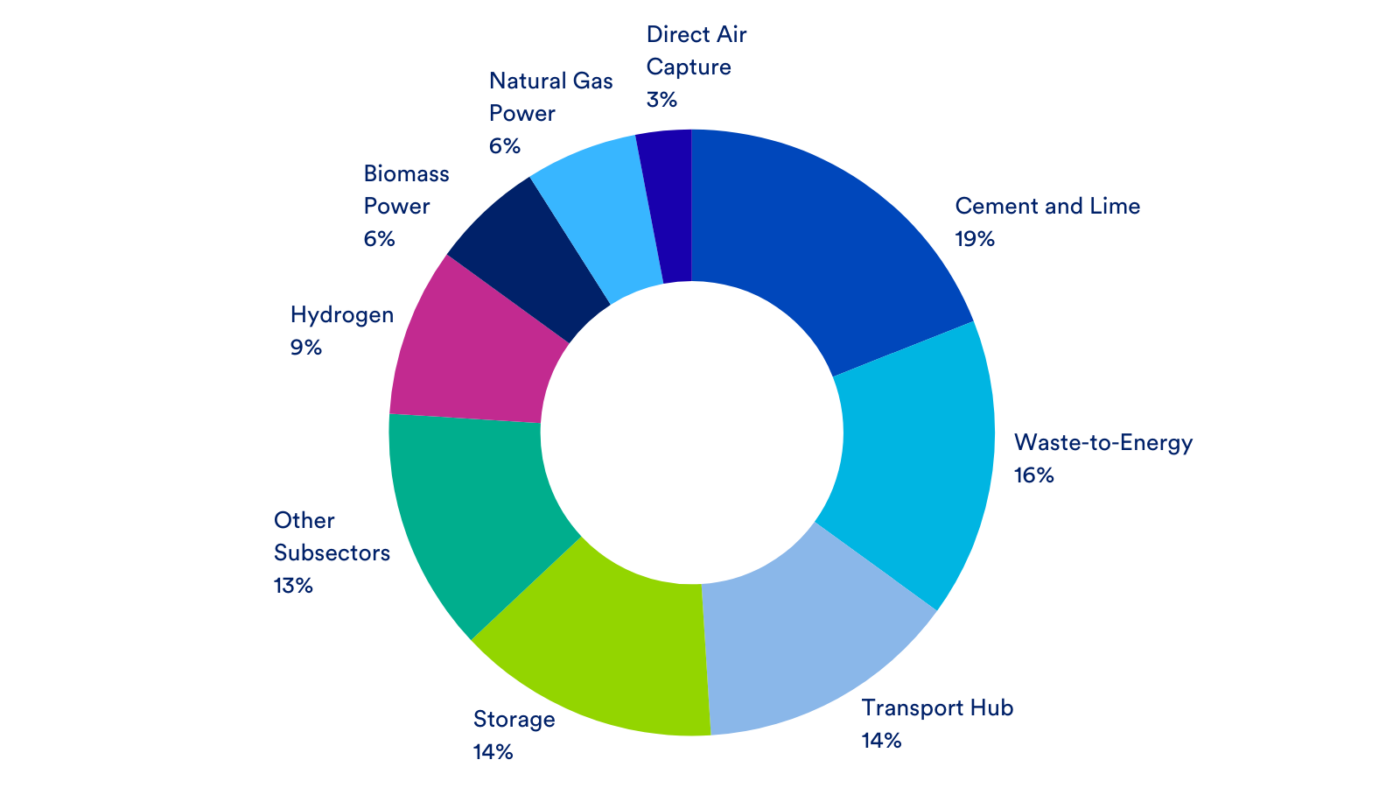
While most CCS deployment remains concentrated in the cement, lime, and waste-to-energy sectors, new projects are also emerging in steelmaking and hydrogen production.
Figure 3. CCS Projects in Europe by Sector
In Italy, AdriatiCO₂, will capture up to 112 kt of fossil and biogenic CO2 per year from a Marcegaglia steel plant, linking to the Ravenna CO2 storage hub in the Adriatic Sea.
In the hydrogen sector, H₂BE (Belgium) will produce low-carbon hydrogen through autothermal reforming (ATR) with integrated CO₂ capture. Captured CO₂ will be transported for permanent storage in the Norwegian North Sea.
European industry is driving technological innovation in carbon capture and storage
Alongside project deployment, European industry is advancing new carbon capture technologies aimed at reducing costs and energy use. In Germany, the CO₂LLECT project plans to deploy Linde’s HISORP® CC adsorption-based carbon capture process at a cement plant. The system will combine temperature-swing adsorption with a cryogenic separation stage to achieve capture rates above 99%. Entirely electrically driven and steam-free, HISORP® CC is designed to avoid solvent degradation and minimize energy demand.
In Italy, CapturEste will demonstrate Saipem’s Bluenzyme™ enzyme-based capture technology, which applies carbonic anhydrase enzymes to accelerate the conversion of CO₂ into bicarbonate. The project will capture about 60-70 kt CO₂ per year from a waste-to-energy plant, with the captured CO₂ transported for permanent geological storage at Ravenna CCS project in the Adriatic Sea. The modular, low-energy system offers high selectivity and cost efficiency, illustrating progress toward deployable biochemical capture solutions.
Europe’s CO₂ transport and storage take shape, but gaps remain
CO₂ transport and storage are advancing gradually across Europe’s CCS value chain. A number of projects including Northern Lights in Norway, Porthos in the Netherlands, Greensand in Denmark and the UK’s Northern Endurance and HyNet systems have reached FID. In addition to the binding target of 50 Mt CO₂ per year of injection capacity in the EU by 2030, the Industrial Carbon Management Strategy sets an ambition of reaching around 250 Mt CO₂ per year of injection capacity by 2040 across the European Economic Area.
Europe has sufficient geological storage capacity to meet long-term climate targets, but near-term delivery depends on rapid progress in project development, permitting, and infrastructure build-out. An analysis by Cavanagh and Lockwood of 33 planned CO₂ storage sites across the European Economic Area and the United Kingdom estimates potential injection capacity between 18 and 108 Mt CO₂ per year by 2030, with an expected mid-range forecast of around 60 Mtpa.
Figure 4. Announced CO₂ storage projects in Europe
Delivering these volumes will require an extensive new transport network of pipelines, shipping, rail links, and terminals linking emitters to geological storage sites. As highlighted by CATF, Europe has the technical expertise to deliver infrastructure on this scale; the challenge now is to channel that capability toward decarbonisation rather than fossil fuel supply.
Progress on cross-border CO₂ transport infrastructure is visible through 2025. In Belgium, construction began in May 2025 on the Fluxys C-grid Antwerp network, one of Europe’s first open-access CO₂ pipeline systems. Developed jointly by Fluxys Belgium, Pipelink, and Air Liquide, the project will connect emitters in the Port of Antwerp-Bruges to export and storage terminals. In Germany, the Bundeskartellamt stated in August 2025 that it had no competition concerns over two planned pipeline cooperations – OGE with ONTRAS and OGE with Fluxys – signalling regulatory support for joint infrastructure development. In November 2025, the Bundestag approved legislation classifying CO₂ transport and storage as projects of overriding public interest, streamlining permitting for future infrastructure. The law also enables offshore CO₂ storage in the German North Sea, while onshore storage remains subject to approval by individual federal states.
Recognising that infrastructure gaps remain the main constraint to scaling CCS, the European Commission launched a public consultation in October 2025 on new legislation for CO₂ markets and infrastructure.
Looking ahead
Europe’s CCS value chain is shifting from planning to delivery, though progress remains uneven and concentrated in a few frontrunner countries.
In 2025, commercial CCS deployment in Europe reached a major milestone, showing it can operate as an integrated system. Yet the gap between project announcements and FIDs persists.
Closing this gap will require both the EU and its Member States to provide revenue certainty and make projects bankable by improving funding frameworks and stimulating demand for decarbonised products and services. This must go hand in hand with accelerating permitting, expanding storage development, and strengthening cross-border coordination.
The priority now is delivery: scaling storage capacity, connecting infrastructure, and turning early progress into deployment across Europe.

