
Right on Queue: Opportunities for Interconnection Queue Reform in the United States

Executive Summary
The process of connecting new power to the grid –interconnection– has thwarted bringing new generation online for years. Increasingly long queues, project withdrawals, years-long studies without firm timelines, and uncertain costs have come to define the interconnection process across the country. And most interconnection processes are divorced from grid-wide, long-term transmission planning, even though combining or closely coordinating these processes would increase efficiency, reduce system costs, and bring clean power online more quickly.
But costly, protracted, and complex interconnection processes need not be the norm. Innovative reforms are surfacing, both in practice and in legislative proposals, that show promise in reducing system costs and delivering widely-shared benefits. At a time when changing dynamics and growing demands on the bulk power system require fresh thinking and innovative solutions, it is worth articulating what ideal interconnection reform should look like.
Principles to Guide Reform Efforts
Clean Air Task Force analyzed existing interconnection queue processes and proposed reforms nationwide, identifying seven principles to guide policymakers. Reforms should:
1. Ensure that federal reforms are effective across diverse market structures. The U.S. has a variety of electricity markets with unique characteristics, compensation structures, and resource adequacy mechanisms. Ideally, reform proposals should work and address key constraints as broadly as possible without the need for supplementary, market-specific reforms.
2. Link transmission and generator interconnection planning processes. Transmission planning and interconnection processes are frequently conducted independently, leaving behind opportunities to proactively identify and build needed grid upgrades to handle new generation and to simultaneously align upgrades with projected future supply and demand needs. Intentional coordination is required to sync these processes.
3. Clear the queues and bring power online quickly. Generation capacity waiting in queues far exceeds the nation’s installed capacity. Deliverability studies for generator interconnection, required in many markets to gain capacity accreditation, are stringent. Studies are further complicated by unstable queues—developers withdraw most projects eventually due to unpredictability in network costs, permitting, site control, and other aspects of project development. Reforms must aim to quickly clear queues, simplify studies, provide certainty, and get projects connected.
4. Allocate interconnection costs early, efficiently, and transparently. Interconnection costs pose two distinct policy challenges: who should pay upfront transmission network upgrade costs, and who should ultimately foot the bill. On the former, most interconnection customers (project developers) today pay 100% of network upgrade costs, which discourages new and less expensive generation. But other configurations are possible: in markets like ERCOT, the project developer and the transmission provider split upfront costs, with the project developer paying the cost of direct interconnection facilities and the transmission provider paying upfront network upgrade costs (at least, up to a certain point). On the latter, reforms should implement a transparent and direct “beneficiary pays” methodology to more fairly allocate interconnection costs.
5. Identify and proactively use surplus grid capacity. Interconnection processes typically require new generation resources and loads to secure network upgrades before interconnecting and beginning operations, even if no upgrades would be needed to accommodate their generation or demand in most hours of the year. An ideal interconnection process would identify where and when available grid capacity exists without requiring network upgrades and enable the rapid integration of resources that operate within those constraints.
6. Create a level playing field between incumbent generators and new entrants. Long interconnection timelines, uncertain costs, and strict study requirements create barriers to new entry during high price periods, inhibiting the ability of new entrants to respond in a timely manner to price signals and insulating incumbents from competition. Incumbents and new entrants should be allowed free and equal access to transmission infrastructure.
7. Prioritize equal treatment across resource types and sizes. Several transmission system operators have resorted to emergency fast-track interconnection processes to move large, high-capacity generators—generally new, unabated gas plants—to the front of queues. This choice may be justifiable as a one-time practical response to an unexpected demand spike that threatens grid reliability, but it is a sign of a broken process and cannot be the norm. Interconnection processes need to clear resources of all types and sizes on similar timelines and should make realistic assumptions about the operational practices of different resource types.
Applying Principles to Interconnection Frameworks
CATF applied our principles to two interconnection frameworks: Southwest Power Pool’s (SPP) Consolidated Planning Process (CPP), approved by FERC in March 2026, and Connect-and-Manage, which is implemented in the Electricity Reliability Council of Texas (ERCOT) market and is being considered more broadly.
SPP, like most U.S. markets, manages grid reliability through a capacity market that requires generators to secure a fixed amount of transmission capacity to meet peak demand. The purpose of the CPP is to streamline regional transmission and interconnection processes, and SPP plans transmission to meet forecasted generation over a 20-year period. ERCOT, on the other hand, addresses grid reliability by ensuring sufficient transmission capacity to meet peak demand and price signals to incentivize generation build out. Because ERCOT’s energy-only market depends upon rapid interconnection of new generation to maintain grid reliability, Connect-and-Manage allows generators to connect to the grid with only the minimum necessary upgrades, even if their power is not fully deliverable, resulting in significantly shorter generation interconnection timelines than other markets.
ERCOT and other U.S. market structures diverge significantly, so Connect-and-Manage approaches outside ERCOT are possible but would need to differ in some ways from ERCOT’s model. Consequently, our team explored how Connect-and-Manage could be implemented in markets outside of ERCOT and applied principles to those implementations.
Key characteristics of these evaluated frameworks are summarized in the table below.
| Consolidated Planning Process (SPP) | Connect-and-Manage |
|---|---|
| Plans for transmission and generation together over a 20-year period.20-year assessment performed every 3 yearsIdentifies planned interconnection locations (PIL) with existing transmission capacity and pre-runs studiesAny generator that chooses to interconnect at a PIL is guaranteed a fixed interconnection cost and study timeline upfront20-year analysis and PIL process inform an annual 10-year, nearer-term transmission assessment. Generators apply to interconnect as part of this 10-year process.Implements penalties for withdrawal and sets a quick study period | In ERCOT, allows generators to connect with only necessary upgradesIn ERCOT, ERCOT itself manages resulting congestion by deploying economically beneficial and needed transmission to ensure reliabilityOutside of ERCOT, even energy-only interconnection typically requires deliverability studies and payment for network upgrades. In these markets, energy-only interconnection services would need to be reformed or replaced to eliminate deliverability studiesOutside of ERCOT, where deliverable accredited capacity is a core market construct, implementation would require assigning capacity deliverability status dynamically to all connected generators, instead of assigning capacity deliverability rights via project-specific studies and upgrades. |
Our analysis found these two promising frameworks met complementary sets of CATF’s identified principles. The CPP framework plainly met Principles 1, 2, 3, and 5, and Connect-and-Manage met Principles 2, 4, and 6. Both frameworks could meet Principle 7, though the possibility remains that certain locations would not be prioritized under each framework, disadvantaging certain resources. Please see the report for in-depth comparisons of the frameworks against the seven principles.
| P1 | P2 | P3 | P4 | P5 | P6 | P7 | |
|---|---|---|---|---|---|---|---|
| CPP | X | X | X | X | ? | ||
| Connect-and-Manage | X | X | X | ? |
Opportunities to Learn from and Improve Current Practices
Both frameworks offer meaningful benefits, but both could also be improved. We identified two modifications to CPP and Connect-and-Manage that would better align each with the principles outlined above.
1. Leverage the best of CPP and Connect-and-Manage in capacity markets. The following reforms would combine promising attributes of both frameworks and be applicable in capacity markets common across the country. Via interconnection queue reforms, transmission providers would:
- Engage in long-term, multi-value transmission planning and use that planning to identify Planned Interconnection Locations (PILs) and associated costs, which factor into fixed, upfront rates.
- Pre-run relevant interconnection studies for these locations.
- Post PILs and upfront rates publicly before interconnection applications open and set fast application and study timelines.
- Apply a beneficiary-pays cost allocation method that equitably allocates final costs of network upgrades to load, generators, and other beneficiaries.
- Reform energy-only interconnection to eliminate deliverability studies and minimize network upgrades only to those necessary to ensure safe interconnection. Customers that opt not to demonstrate deliverability for the purpose of capacity market participation would not pay other network upgrade costs as a precondition to interconnection. Reforms to energy-only interconnection should help mitigate against identifying PILs in locations that disfavor certain resources.
2. Address the importance of capacity revenues for generators to fully unlock the benefits of Connect-and-Manage. Markets with centralized capacity constructs could be reformed to reduce the importance of capacity revenues for most generators or eliminate them altogether. This skirts the challenge of making Connect-and-Manage compatible with deliverability-based capacity accreditation. Reforms could:
- Replace or supplement energy-only interconnection for generators with a full Connect-and-Manage interconnection option similar to ERCOT’s
- Address the challenge of markets outside of ERCOT capping energy prices at relatively low levels and causing generators to rely on capacity revenues:
- Raise caps on energy prices (an option PJM is currently considering), which would unlock more revenue for energy-only generators and enable greater uptake of the Connect-and-Manage option
- Potentially eliminate centralized capacity constructs altogether, relying instead on energy market incentives and hedging requirements to ensure load-serving entities procure sufficient generation to meet reliability targets
Introduction
The need to get more clean power online quickly in the U.S. to meet high load growth projections, decarbonization requirements, and energy affordability concerns is now reaching crisis levels. Contrary to much of the political rhetoric around this topic, the problem is not an absence of new generation development; rather, the process of connecting new power to the grid––interconnection––has thwarted bringing new generation online for years. Increasingly long queues, project withdrawals, years-long studies, and uncertain costs have come to define the interconnection process across the country. On top of this, most interconnection processes are completely divorced from holistic, long-term transmission planning, even though combining or closely coordinating these processes is necessary to streamline system planning and reduce related costs.
With a few exceptions, most interconnection frameworks across the country share similarly costly, inefficient, and time-intensive processes that slow generation deployment and increase ratepayer costs. To start, transmission providers conduct bespoke upfront interconnection studies for applicants seeking interconnection to identify network upgrades required before a generator can come online. These studies often involve several phases and decision points before reaching an interconnection agreement. New generators generally must fund transmission network upgrades that transmission providers determine, through these studies, are needed for interconnection. But uncertainty over the (often high) costs of these upgrades, as well as the long wait in the queue, can cause those applicants to abandon projects. Applicants dropping out of the queue, in turn, triggers the need to re-evaluate the studies of other applicants. Transmission upgrades generally must be completed before new generators can come online, so this cycle of delay and cost uncertainty slows new generator additions, creating sustained scarcity that raises electricity costs for consumers. In PJM, for example, generators that connected to the grid in 2025 waited an average of eight yearsbetween their interconnection application and commercial operation.1
Meanwhile, bulk transmission planning processes do not adequately consider future generator interconnection needs and thus miss out on efficiencies from proactive regional and local transmission planning to develop new transmission system infrastructure needed to quickly and affordably interconnect new generation. Simply put, the interconnection process in most places is chaotic and inefficient, resulting in a long interconnection queue with many projects waiting to determine their interconnection fate.
But costly, protracted, and complex interconnection processes need not be the norm. Innovative reforms are surfacing, both in practice and in legislative proposals, that show promise in reducing system costs, speeding up interconnection timelines, and delivering widely shared benefits. At a time when changing dynamics and growing demands on the bulk power system require fresh thinking and innovative solutions, it is worth articulating what ideal interconnection reform should look like.
To this end, after an in-depth investigation of existing interconnection queue processes and reform proposals, we outline seven principles to guide interconnection reform:
- Ensure that federal reforms are effective across diverse market structures.
- Link transmission and generator interconnection planning processes.
- Clear the queues and bring power online quickly.
- Allocate interconnection costs early, efficiently, and transparently.
- Identify and proactively use surplus grid capacity.
- Create a level playing field between incumbent generators and new entrants.
- Prioritize equal treatment across resource types and sizes.
This paper applies these principles to two innovative interconnection frameworks that differ from the inefficient status quo: 1) Southwest Power Pool’s (SPP) recently approved Consolidated Planning Process; and 2) a “Connect-and-Manage” framework similar to current practice in the Electric Reliability Council of Texas (ERCOT). We evaluate how these frameworks perform on these principles and distill lessons learned to suggest what opportunities for improved interconnection reform could entail.
Organizing Principles
CATF reviewed interconnection queue processes across the country and identified core organizing principles that policymakers, regulators, and advocates should consider when proposing and debating reforms to these queues.
1. Ensure that federal reforms are effective across diverse market structures
The U.S. has a patchwork of electricity market and regulatory structures with differing interconnection processes. Much of the nation’s grid is administered by independent system operators (ISOs) (e.g., New York ISO, Midcontinent ISO) that manage interconnection and competitive market operation centrally. Other regions, including much of the U.S. West and Southeast, feature interconnection processes run by vertically integrated monopoly utilities that also own generation and act as the sole customer for any independent projects, or by federally-run transmission owners like the Tennessee Valley Authority (TVA) or Bonneville Power Administration (BPA).
One of these markets, ERCOT, allows generators and loads to connect to the grid with only the minimum necessary network upgrades. The tradeoff is that these generators and loads assume the financial risk of an inability to deliver or receive sufficient power to or from the grid if transmission constraints become binding. ERCOT is an “energy-only” market, with generator revenues determined exclusively by energy prices (as well as an array of ancillary services) in the day-ahead and real-time markets. As such, generators and loads do not need a guarantee of power deliverability to fully participate in the market. Generators or loads facing congestion can simply be curtailed when the local energy price becomes too low or too high, respectively.
By contrast, all other competitive U.S. electricity markets feature centralized resource adequacy mechanisms (e.g., capacity markets and other centralized capacity constructs) that are designed to provide steady streams of revenue to resources that can support electricity system reliability during extreme stress events but may not earn sufficiently predictable revenue in energy markets outside of these rare events. These mechanisms also minimize expected involuntary curtailment of loads by requiring that enough generating capacity be available to meet anticipated demand.
Across all these markets, generators can only contribute accredited capacity (and earn the associated revenue) if their power is assessed to be deliverable to demand under all conditions. To receive this status, generators must apply for Network Resource Interconnection Service (NRIS), under which the system operator conducts a deliverability study and requires the generator to fund any network upgrades necessary to ensure that its power is deliverable under peak demand conditions.2 Generators in these markets can also opt to pursue Energy Resource Interconnection Service (ERIS), which has less stringent standards for deliverability but typically prevents generators from qualifying as accredited capacity.3
Federal interconnection reform proposals should work across the diversity of existing market structures and ensure that recommended reforms address key constraints as broadly as possible, with minimal need for supplementary market-specific reforms.
2. Link transmission and generator interconnection planning processes
Transmission and interconnection planning are both key to ensuring grid reliability and getting power to consumers. Generators need readily available transmission to quickly deliver power to customers, which requires transmission owners to reasonably forecast upcoming supply and demand needs and build ahead to meet them. Yet for the most part, these two processes run on separate but overlapping tracks, reducing system efficiency and raising end-user costs.
Transmission planning currently consists of distinct local and regional planning processes. While some needed transmission upgrades can be addressed with local transmission, long-term, forward looking regional and interregional transmission planning will often achieve the most efficient and cost-effective results.4
Regional transmission planning itself occurs through two separate, federally-driven processes. First, the Federal Energy Regulatory Commission’s (FERC) Order 1000 requires transmission providers to engage in regional planning.5 Some planning regions conduct this regional planning on an annual basis, while others do so every two years.6 But to date, Order 1000 processes have primarily resulted in near-term, reliability-only planning focused on local transmission buildout rather than regional projects able to concurrently address reliability, economic, and public policy needs.7 And while Order 1000 planning attempts to forecast demand growth (albeit on a relatively short-term basis), it generally does not “identify the transmission upgrades needed to integrate future, forecasted generation growth.”8
The second federally-driven process, initiated by FERC Order 1920, requires transmission providers to engage in long-term regional planning. Order 1920 implementation is in relatively early stages, with transmission planners submitting compliance filings on a rolling basis.9 Under Order 1920, planners must forecast transmission needs over a 20-year period based on a set of scenarios that consider seven required factors driving regional transmission demand.
Unlike Order 1000, the Order 1920 process attempts to forecast generation in ways that should complement interconnection processes by planning transmission around anticipated future electricity supply.10 But Order 1920 alone, even when fully implemented, is unlikely to fix the lack of coordination between transmission planning and interconnection. For one, Order 1920 planning cycles occur infrequently––generally only once every 5 years––such that it may miss rapid changes in new generation coming online. For another, even under this Order, the transmission planning process remains separate from interconnection processes in most parts of the country. As a result, there is a lost opportunity: transmission planning is not generally used to inform (and improve) interconnection processes.
Instead, identification of the transmission upgrades required for new generation to come online is mostly left to a separate interconnection process run by regional grid operators or utilities. Interconnection applicants are approved based on studies that assess the transmission system’s capacity to handle the generation capacity of all existing resources plus those applying to interconnect. Where the system is deemed inadequate to handle new generation, interconnection studies identify necessary transmission network upgrades that would be required to safely incorporate new resources.
These upgrades tend to be incremental in nature, as they are meant to connect one or a handful of new generators already in the queue, but the costs of the upgrade – which can range from $100-500 per kilowatt, making up an appreciable fraction of total project costs11 – are generally allocated to the generator(s) first triggering the requirement, even if others will benefit from it. FERC’s Order 2023 chips away at the inefficiencies of the existing processes by requiring project developers seeking interconnection to be studied in “clusters,” but it does not lay the groundwork for holistic, long-term planning needed to identify the most efficient transmission solutions outside the cluster level (see Text Box for more information).
Network upgrades are not designed with comprehensive future supply and demand needs in mind and therefore tend to be underbuilt—or, when cost-prohibitive for the triggering generator, not built at all. And because network upgrades are planned around current interconnection applicants, generators that then withdraw from the queue disrupt the assumptions used to assess the entire applicant pool, leading to restudies, delays, and higher costs for those still in the queue. The lack of coordinated transmission and interconnection planning thus inhibits connecting new power to the grid, directly and materially raising electricity costs for ratepayers.
FERC Order 2023 and long-term planning gaps
FERC Order 2023 requires transmission providers to use first-ready, first-served cluster study processes (evaluating project developers seeking interconnection in groups) as opposed to serial first-come, first-served study processes (evaluating interconnection requests one at a time as they come in). But conducting cluster studies still does not involve long-term, holistic planning to identify the most efficient transmission solutions outside of the particular cluster being studied. The growing size of queues has increased the difficulty of administering cluster studies without triggering restudies that delay interconnection and cost project developers. Many planning regions also already used cluster studies before Order 2023, yet those regions nonetheless faced growing interconnection backlogs. For example, the Midcontinent ISO (MISO) used cluster studies for over a decade before the Order, yet MISO continued to experience significant interconnection delays by the time FERC proposed Order 2023.12 There are still important opportunities to better integrate interconnection queue reforms and longer-term planning exercises that clarify and speed processes for grid planners and developers entering queues.
Interconnection reform should combine proactive transmission and interconnection planning processes into a single, streamlined, integrated process that “shifts the identification of some network upgrades and use of grid-enhancing technologies (GETs) from interconnection to transmission planning and builds transmission in advance of expected need, with different options for cost allocation.13 While some new generation resources may still require network upgrades, proactive transmission planning that prepares for upcoming supply and demand shifts creates efficiencies that expedite interconnection and reduce system costs.14
Figure 1. Status quo transmission and interconnection planning verses consolidated planning.
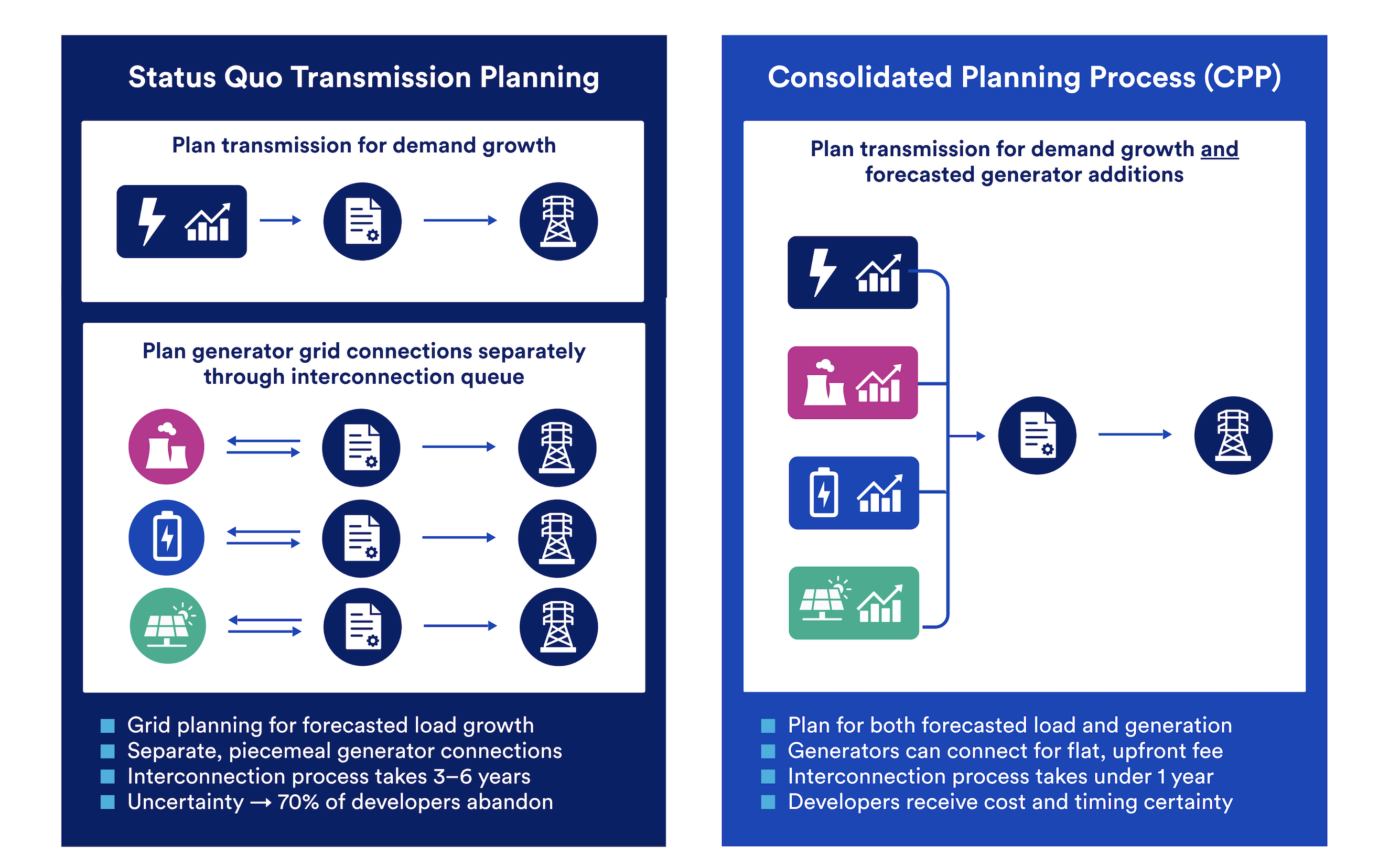
Source: Order Accepting Tariff Revisions, Subject to Condition, 194 FERC ¶ 61,192 (March 13, 2026) (Rosner, concurring)
Coordinated planning may involve using both short- and long-term forecasts to identify the best points of interconnection, like the Southwest Power Pool’s (SPP) new Consolidated Planning Process (CPP, discussed in detail below), or the California Independent System Operator’s (CAISO) zonal approach, where “zones identified for new transmission are prioritized for development and procurement in the independent system operator’s (ISO) interconnection process to ensure that resource and transmission planning are complementary and co-optimized.”15 In both regions, transmission planning informs (and streamlines) the interconnection process.
A unified process will result in cost certainty and savings to planners, generators, and ratepayers, as well as greater efficiency in the interconnection process. The Midcontinent Independent System Operator (MISO)-SPP Joint Targeted Interconnection Queue (JTIQ) process provides a useful example. JTIQ began with a study identifying transmission projects needed to address transmission constraints impeding interconnection along the MISO-SPP border.16 The study resulted in a portfolio of five 345 kilovolt (kV) transmission projects expected to enable interconnection of between 28 and 53 gigawatts (GW) of new generation.17 The JTIQ process differs substantially from the usual interconnection process (see Figure 2). Rather than identifying piecemeal network upgrades in response to new interconnection requests, JTIQ forecasts where future generation will require transmission to interconnect and “focuses on backbone projects.”18 Coordinated transmission and interconnection planning under JTIQ provides a host of benefits: project construction can begin earlier, and project developers have greater cost and timing certainty.19
Figure 2. Contrast between MISO’s current interconnection process and the JTIQ process.
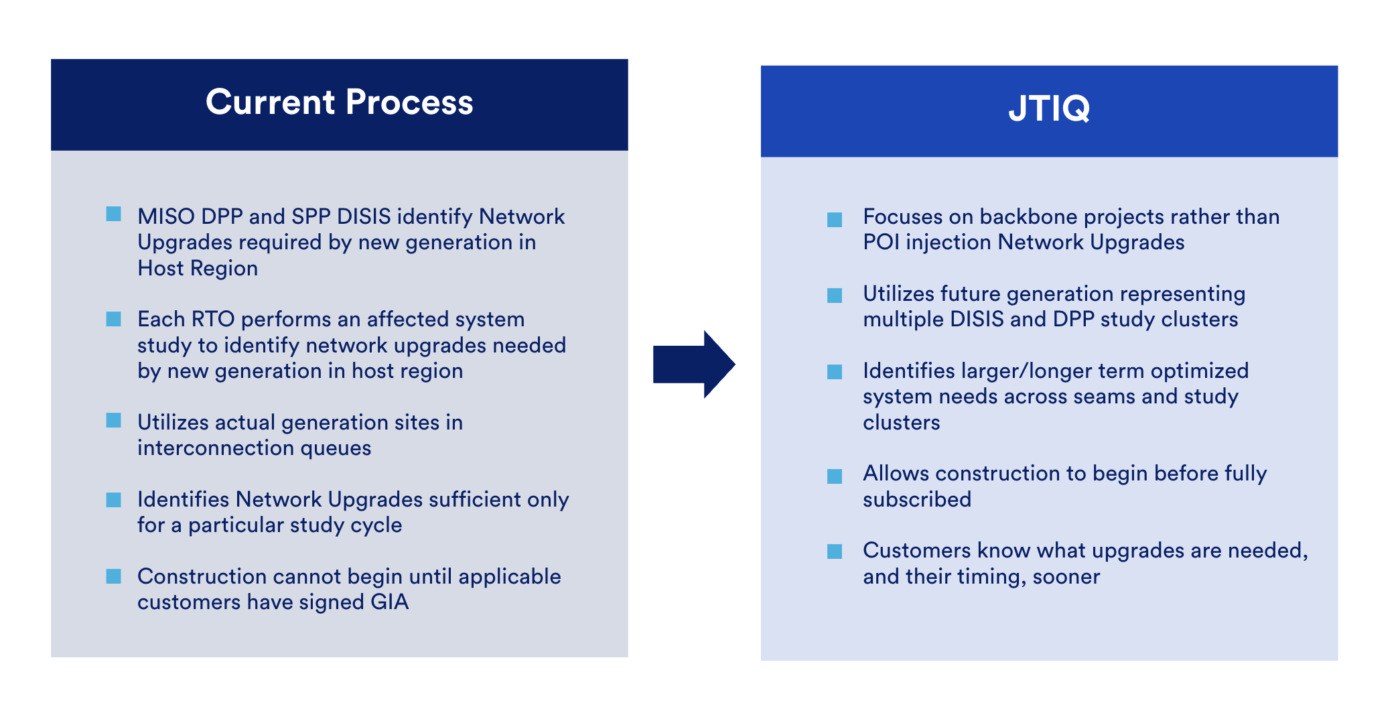
Source: Joint Targeted Interconnection Queue (JTIQ) Study, MISO at 7 (June 18, 2024).
One study demonstrated that generator interconnection costs under JTIQ would be $58 per kilowatt (kW) (and $28 per kW when accounting for adjusted production cost savings), less than half MISO and SPP’s individual generator interconnection costs, which range from around $95-$126 per kW.20 Overall, JTIQ is anticipated to provide savings of $724 million in MISO and $247 million in SPP.21 Any proposal to reform interconnection processes should link interconnection to transmission planning to gain similar efficiencies and cost savings.
3. Clear the queues and bring power online quickly
Over the last 25 years, the U.S. has developed plenty of new generation projects that are now ready to be deployed, but projects are stifled by the grid connection process. Between 2000-2020, most generation that requested interconnection never reached the grid – only 13% of generation capacity submitted to queues in that timeframe was connected as of the end of 2025.22 Indeed, capacity stuck in U.S. queues in 2025 was significantly higher than the nation’s entire installed generation capacity (see Figure 3).
Figure 3. Entire U.S. Installed Capacity vs. Active Queues.
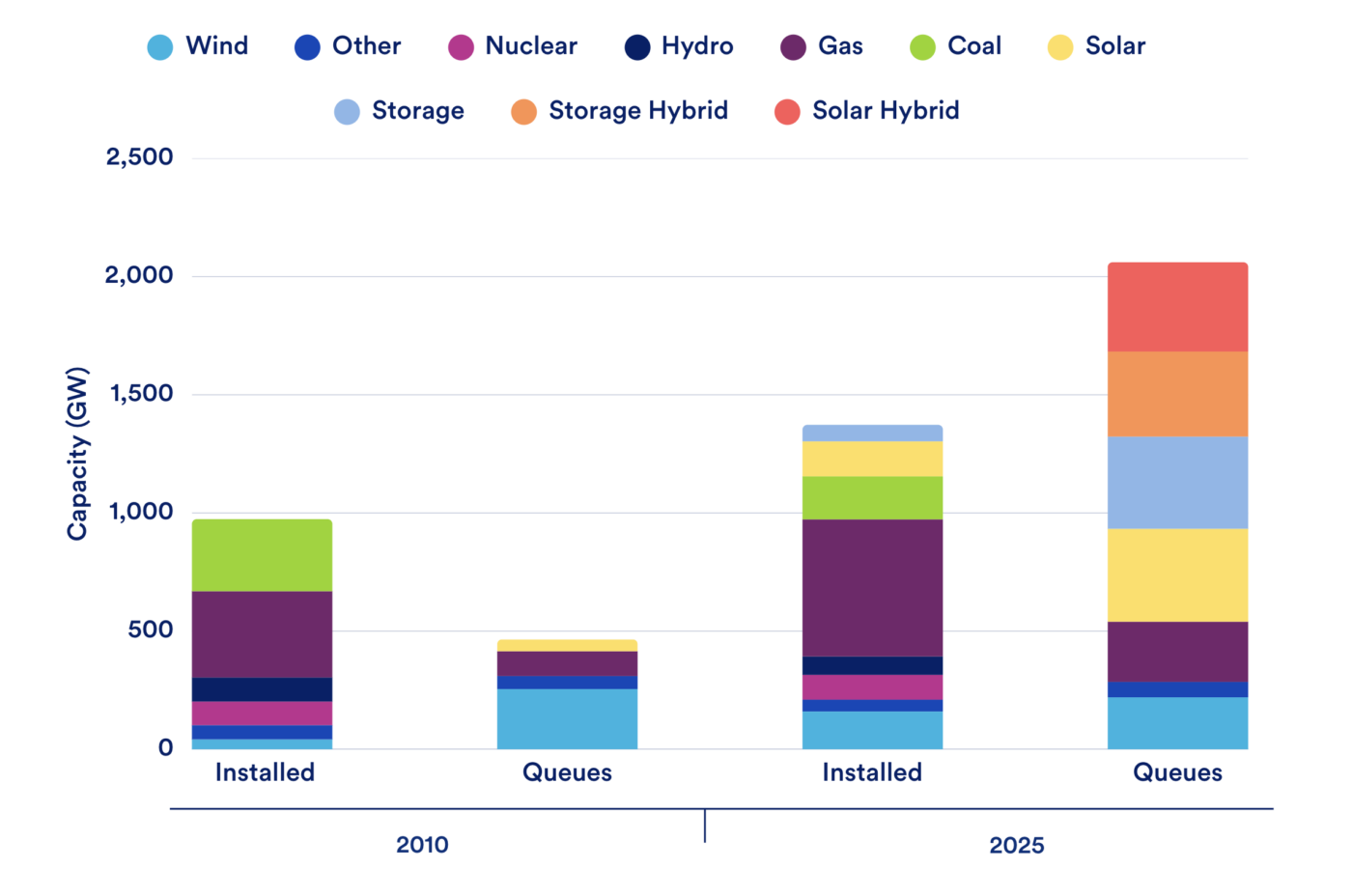
Source: J. Rand et al., Queued Up: 2026 Edition, supra at 18.
Even projects that eventually make it onto the grid face lengthy timelines between their initial interconnection request and commercial operations (see figure 4). The timeline for 100-200-megawatt (MW) projects is over 4 years on average, while 200+ MW projects take nearly 5 years.23 This lengthy process is fueled by several challenges: lengthy NRIS processes, project withdrawals that require restudies, and required network upgrades. Fundamentally, interconnection reforms must take steps to overcome these challenges and move projects more quickly through the queues.
Figure 4: Time between interconnection request and commercial operation date, in years
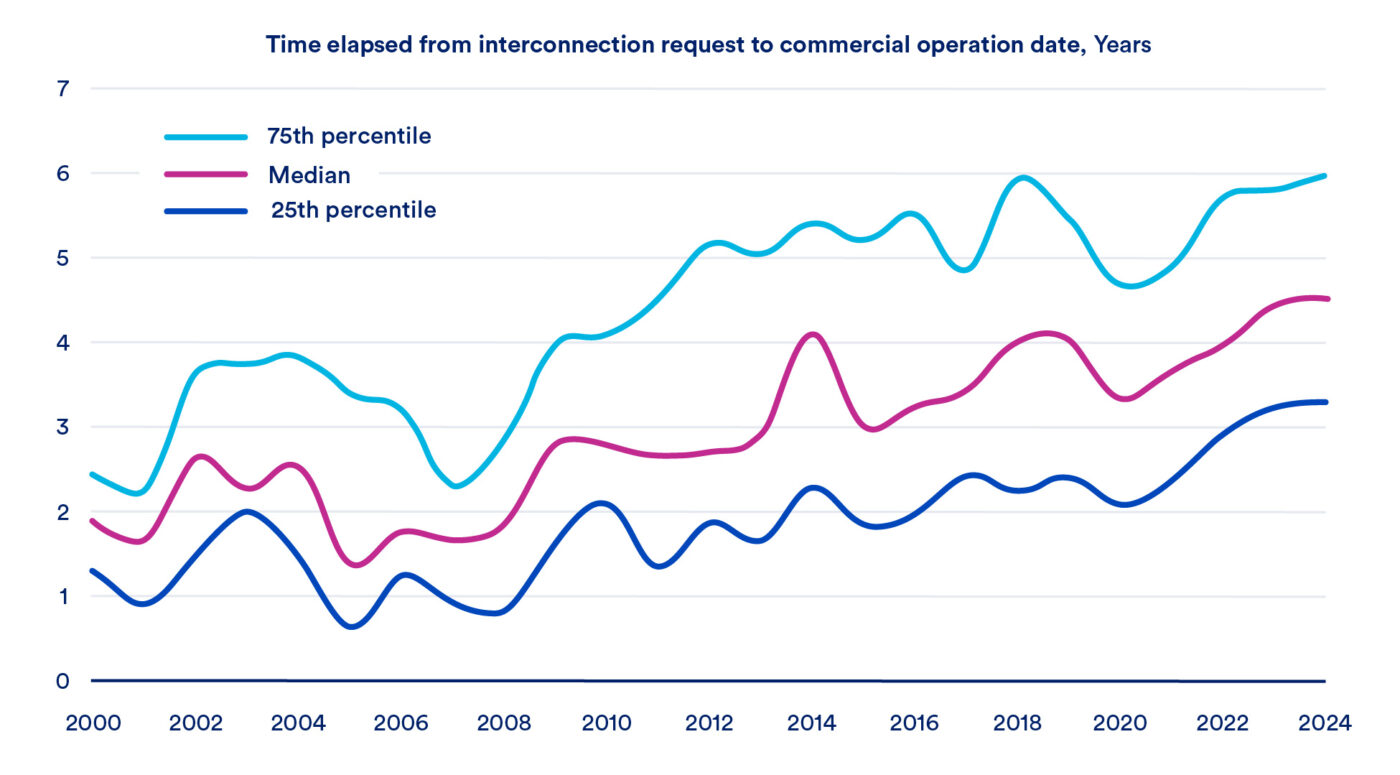
Source: M. Cembalest, Fighting Words: The Energy Transition in 2026, J.P. Morgan (March 2026), https://cdn.jpmorganfunds.com/content/dam/jpm-am-aem/global/en/insights/eye-on-the-market/fighting-words-amv.pdf.
First, most generators seeking interconnection apply for NRIS,24 which tests for sufficient transmission to deliver a specified amount of power to customers during peak demand conditions. NRIS is in most cases required for generators to be accredited as capacity resources and participate in centralized resource adequacy programs, which are features of most U.S. electricity markets and account for a key portion of the value stream for many generators in these markets.25 But the study requirements for NRIS are stringent and take time, and the more NRIS requests are jammed into queues, the more complicated interconnection studies become. Further, actions of other participants in the queue (including withdrawing from the queue) can force restudies, a process where much of the study work is no longer valid and must be redone.26
In theory, more straightforward study options exist. Indeed, FERC’s Order 2003 provided for two distinct types of transmission services: the more “comprehensive” NRIS, and the more “basic or minimal,” energy-only ERIS.27 But energy-only requests are generally not much faster or cheaper than NRIS full deliverability requests. The average duration between interconnection request and interconnection agreement for customers requesting ERIS is 37 months, compared to an average of 41 months for NRIS.28 Recent research indicates that ERIS applications are still studied in the same lengthy cluster process as NRIS applications, still require deliverability studies and, in many cases, must still wait for mandatory network upgrades to be constructed before they can operate.29 Unsurprisingly, few project developers outside the territory of the Electric Reliability Council of Texas (ERCOT)—which does not have a resource adequacy program based on deliverable accredited capacity—make use of energy-only interconnection requests given the lack of timeline or deliverability advantages.30, 31
Second, project withdrawal rates are high – over 70% of interconnection requests submitted between 2000-2020 were withdrawn32 – delaying projects that remain in the queue. In 2025 alone, 750 GW of capacity – nearly half the installed generation capacity of the entire U.S. grid in that year– was withdrawn from queues.33 Projects withdraw from interconnection queues for a host of reasons, including uncertain and/or high network upgrade costs that are not known until at least after initial studies, but often much later in the process due to restudies, submission of low-quality, speculative interconnection requests,34 permitting issues, and interconnection delays that impact contract deadlines, land options, or changes in supply chain costs or availability. Most withdrawals occur during the study process (which itself delays studies), but many withdrawals occur later in the interconnection process, including after project developers sign interconnection agreements.35 These later-stage withdrawals may “disrupt assumptions built into other projects’ interconnection studies”36 and trigger restudies that result in “significant increases to the interconnection costs attributed to those [developers] and the timeline for completion of interconnection studies, which can result in further late-stage withdrawals, thus exacerbating the interconnection queue backlogs and delays.”37
Third, studies often identify network upgrades that are necessary before the new resource can connect to the grid. These network upgrades themselves can require complex permitting, engineering, and construction, and thus can cause significant delay in bringing new generation online even after the interconnection study.38 As one example, PJM estimated that construction of several identified network upgrades for interconnection requests in its Transition Cycle 1 Phase III could take over five years.39
4. Allocate interconnection costs early, efficiently, and transparently
The costs of interconnection can be broken into two categories: (1) who pays upfront costs and (2) who ultimately foots the bill.
Who pays upfront costs. Most generators seeking interconnection pay 100% of the upfront network upgrade costs associated with bringing them online, where costs are allocated based on an estimation of each generator’s contribution to the need for the specific upgrade in a cluster study.40 This may seem logical, but it hampers interconnection by foisting high (and unexpected) costs on project developers seeking that interconnection. As noted in the previous section, because the required scale of transmission network upgrades can vary significantly depending on other entities connected to the grid, the final cost of interconnection often remains uncertain until late in the years-long interconnection process.41 This has several consequences, including uneconomic projects clogging up the queue, generators submitting multiple requests to hedge, and generators paying higher financing costs due to greater project risk.42
To the extent interconnection processes continue to require project developers pay upfront costs of interconnection, those costs must be determined ahead of time and fixed through proactive, holistic transmission planning. Indeed, recognizing the consequences of cost uncertainty, the Department of Energy recommended “delinking the interconnection process and network upgrade investments to increase upfront interconnection cost certainty.”43 This recommendation fits alongside our first principle of linking transmission planning and interconnection, such that network upgrades come from proactive, long-term transmission planning, not piecemeal interconnection requests. To the extent proactive transmission planning identifies needed network upgrades at particular grid locations, transmission planning can help identify anticipated costs of required upgrades prior to the interconnection process and fix costs early in the process for project developers.
But preferably, interconnection reform should move away from requiring project developers to shoulder the full upfront cost and instead require parties best positioned to mitigate the cost of interconnection to foot upfront bills. ERCOT provides a model framework. In ERCOT, the project developer seeking interconnection pays the costs of direct interconnection facilities, such as step-up transformers and protective devices at the point of interconnection.44 But the transmission provider is responsible for upfront costs of necessary transmission network upgrades (as of 2026, up to a fixed allowance, above which the project developer is responsible), which are eventually socialized to ratepayers (see more below).45 Such a system lowers barriers to entry for generators seeking interconnection.
Interconnection reform that moves away from requiring project developers to pay upfront costs should follow the ERCOT model and require transmission providers (who ultimately determine what network upgrades are required) to pay those costs. To ensure that transmission providers do not run up costs they can eventually recover from ratepayers, proactive transmission planning must be used to identify locations on the grid that will require transmission buildout, predict the costs of doing so, and set those costs early on such that they are transparent and do not allow transmission providers to inflate costs they can ultimately recover from ratepayers.
Who ultimately foots the bill. Interconnection reform should implement a “beneficiary pays” method, under which “the beneficiaries of transmission infrastructure must fund those facilities in a manner ‘roughly commensurate’ with the benefits they will receive from them.”46 This means that costs of interconnection are eventually passed through to beneficiaries – most commonly to electricity customers through retail rates, although generators may also bear some costs. This method socializes the cost of new transmission infrastructure needed for interconnection, recognizing that such updates benefit multiple stakeholders beyond just the generator seeking interconnection. Again, ERCOT provides a useful example, where the transmission provider can eventually recover upfront costs from ratepayers (beneficiaries).
While the ability to pass costs through to ratepayers may seem like a problem, a “participant-funded” cost allocation system (under which project developers foot the bill) still costs consumers, even if indirectly. This is because project developers ultimately pass costs on to consumers by raising energy prices and capacity bids to compensate for the high costs of interconnection. A beneficiary-pays method simply makes this relationship more direct and transparent. In contrast, requiring generators to fund transmission system upgrades both decreases supply (by deterring new generation with high costs and high uncertainty) and increases the price of energy (by preventing competition among existing supply and forcing new generators to raise the price to recoup costs).
5. Identify and proactively use surplus grid capacity
Transmission infrastructure in the U.S. is utilized below its rated capacity the vast majority of the time, even accounting for the need to protect against line loss contingencies by maintaining excess capacity.47, 48 Most transmission constraints that would trigger network upgrades for new generation or load only appear during peak-demand conditions, meaning these new assets could inject electricity the vast majority of the time without violating network limits.
The existing ERIS pathway is designed to recognize that generation resources can still contribute substantial amounts of energy to the system during times of low network utilization, even if they may require network upgrades to contribute toward resource adequacy needs during peak demand periods. But rather than providing an easy pathway for these resources to interconnect and allowing them to contribute energy whenever the grid can accommodate it, the current implementation of ERIS in many cases still requires verifying deliverability under typical conditions, leading to interconnection study times that are nearly as long as those for NRIS.22 It also fails to recognize or value the reliability benefits of resources that may not be deliverable under peak demand conditions, but could still support resource adequacy in other circumstances. A recent analysis indicates that periods of resource adequacy stress in PJM are much more strongly associated with a lack of sufficient generating capacity than with a lack of network deliverability, suggesting that ERIS resources can contribute significantly to reliability even without network reinforcement.49 These reliability benefits are not currently recognized in markets with centralized capacity constructs, disincentivizing deployment of resources that would increase reliability and reduce consumer costs.
Similar to generators, new loads may be able to interconnect and consume power in all but a few hours of the year without the need for any network upgrades (Figure 5).50 Loads with sufficient flexibility could avoid consuming in these hours and in theory interconnect with minimal upgrades, but current interconnection processes largely assume that all loads require fully firm transmission service at all times. Recent orders by FERC have recognized this issue and called for reforms that provide transmission service for flexible large loads.51
Figure 5. Modeled transmission constraints for a hypothetical large load in Pennsylvania.
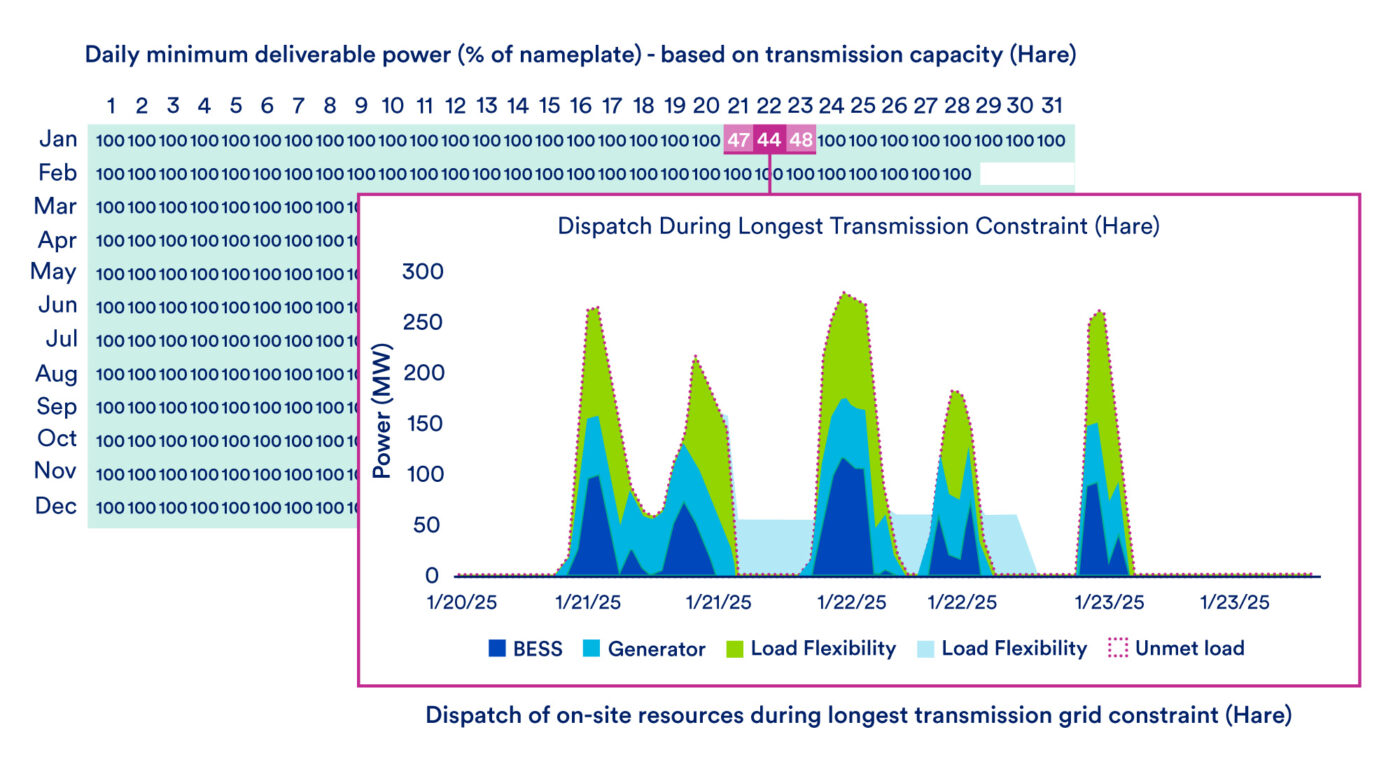
Source: C. Brancucci et al., Flexible Data Centers: A Faster, More Affordable Path to Power, Camus, encoord, & Princeton ZERO lab (December 2025), https://www.camus.energy/flexible-data-center-report.
Finally, the capacity of the transmission system can be underutilized even under peak-stress conditions if generators hold rights to transmission capacity that they do not fully use. This can happen if, for example, a generator applies for NRIS interconnection at a level that matches its expected accredited capacity but later has its accredited capacity reduced. This generator would no longer be able to utilize its full interconnection capacity when participating in resource adequacy programs, yet it would continue to hold exclusive rights to that capacity – which could otherwise in theory be used to support additional resource adequacy contributions from other generators.
FERC recognized this gap in Order No. 845, where it created Surplus Interconnection Service (SIS). SIS allows a new generator to make use of an existing generator’s surplus interconnection capacity without an interconnection study, but implementation has been inconsistent and has not always enabled smoother access for qualifying resources in line with the order’s intent.52 It also applies only to resources that share the underutilized resource’s point of interconnection, even if all relevant network constraints originate elsewhere.
An ideal interconnection process should identify the times and places where participation in the grid – either as demand or supply, with firm or non-firm service – would not require network upgrades and should support rapid integration of assets that can commit to operate only in such times and places.
6. Create a level playing field between incumbent generators and new entrants
Electricity markets only function properly if new generators can easily and rapidly enter the market when high prices create favorable conditions. In this way, high prices can become their own cure, as they incentivize new competitive supply that drives prices back down. But if significant barriers delay new entry, supply shortfalls will lead to sustained periods of high prices that allow incumbent generators to reap windfall profits while consumers pay the cost.
Long interconnection timelines and uncertain costs create barriers to new entry, inhibiting the ability of new entrants to respond in a timely manner to market price signals and insulating incumbents from competition. Similarly, interconnection processes can structurally favor incumbents if they place more requirements on new generators than are strictly necessary to facilitate market access. The existing ERIS process is an example of this kind of barrier. ERIS is intended as a pathway for resources to quickly enter and participate in energy markets in exchange for forgoing capacity revenues and the need to demonstrate deliverability under peak demand.
In theory, as is the case in ERCOT, no deliverability assessment at all is needed for resources to participate in energy markets or for these markets to operate reliably and efficiently. Grid congestion caused by additional generation from new resources will result in reduced locational marginal energy prices, which in turn incentivize generators with the highest operating costs to reduce output.53 However, ERIS processes outside of ERCOT are designed to avoid these local energy price reductions by requiring that new energy market entrants undergo lengthy and costly deliverability studies and, in many cases, pay for network upgrades to ensure that their generation does not increase grid congestion under typical conditions.31 This practice effectively reserves existing network capacity for incumbents that insulates them from congestion and reduced prices, instead of allowing equal access to transmission infrastructure as required by federal law.
An interconnection process that is excessively long or creates unnecessary barriers to entry for new resources will act as a competitive moat for incumbent resources, greatly harming consumers in the process.
7. Prioritize equal treatment across resource types and sizes
Faced with challenges bringing online new supply due to interconnection backlogs, many system operators have resorted to emergency fast-track interconnection processes that move large generators with high capacity contributions – generally new unabated natural gas plants – to the front of the line.54 It is worth noting that all the regions that have initiated these proposals simultaneously have generation interconnection queues with years-long backlogs well in excess of their peak load amounts, suggesting that, had they moved faster on interconnection and transmission development, they would not need to pursue these emergency actions.
While this response may be justifiable as a one-time practical necessity to help address an unexpected demand spike that threatens grid reliability, it is the sign of a broken process and cannot become the norm. To do so would be to structurally and unlawfully disadvantage smaller generators – largely wind, solar, and storage projects – and skew market outcomes in favor of resources with access to streamlined special interconnection processes rather than those that deliver the most competitively-priced power. Similarly, some interconnection processes have structurally disadvantaged specific resource types through unreasonably pessimistic assumptions about their operational practices – for example, studying energy storage as firm demand even though it would almost certainly not consume power under peak stress conditions.52
Interconnection processes should clear resources of all types and sizes on similar timelines and should make realistic assumptions about the operational practices of different resource types.
Applying Principles to Interconnection Frameworks: Two Examples
Southwest Power Pool’s Consolidated Planning Process (CPP)
Overview
In March 2026, FERC approved Southwest Power Pool’s (SPP) new Consolidated Planning Process (CPP), a “framework to streamline its regional transmission planning and generator interconnection processes.”55 Under the CPP, SPP plans transmission to meet both forecasted demand and generation over a 20-year period in compliance with Order 1920. This “CPP-20” assessment is performed every 3 years and identifies planned interconnection locations (PILs) on the grid that have existing or future transmission capacity to which new generators can connect. Interconnecting at PILs is meant to be streamlined; studies are pre-run, rather than conducted after projects are proposed. The standard study process still applies for projects that connect at unplanned interconnection locations (UPILs). SPP will also use the results of the CPP-20 analysis to inform its annual “CPP-10” transmission assessment, which uses the same factors and methodologies to evaluate more immediate transmission needs in a near-term, 10-year planning horizon and updates available PILs accordingly. Generators apply to interconnect at PILs as part of the CPP-10 process.56
SPP also uses CPP-20 to calculate fixed and generalized upfront payments from generators to enter the queue, called “Grid-C rates.” These rates reflect estimated engineering and construction costs of network upgrades identified in the CPP-20. While SPP stated that it expected Grid-C rates to be more expensive than what generators currently pay, it also expected the costs to be better allocated based on benefits (and to be fixed and predictable). Both PILs and GRID-C rates are posted before interconnection applications open. SPP explained that generators that interconnect at a PIL would generally not be responsible for network upgrade costs beyond the Grid-C rate.
Finally, the CPP sets out a quick study period that provides one decision point for generators and significant withdrawal penalties. Each year, there is a 60-day window for new generators to submit new interconnection requests. Generators submit an application fee, study deposit, and site control demonstration for 100% of generating facility and 50% of generating facility tie-line (or financial security if site control demonstration is not available). Additionally, generators must show financial security equal to the greater of 20% of GRID-C charge or $8,000/MW of their requested ERIS or NRIS maximum injection capability. There is then a 60-day review period, followed by a 20-day period for project developers to decide whether to proceed (the single decision point in the process), at which point they must make further deposit payments. Generators connecting at PILs can then proceed to interconnection agreements, while customers at UPILs require a facilities study (and may require further restudies). Generators that withdraw after the cluster study commences are penalized equal to any unused portion of the study deposit plus two times the actual allocated cost of all studies performed for customer’s request until that point in study process. Additionally, generators that withdraw after the decision point forfeit their financial deposits.
Applying the principles to SPP’s new framework
Principle 1: Ensure that federal reforms are effective across diverse market structures.
SPP’s framework should be easily applicable to nearly any jurisdiction and market structure in the U.S. The process of pre-planning network expansion, identifying PILs, and offering rapid, fixed-price NRIS or ERIS to generators that interconnect at PILs can be implemented across ISO regions, vertically-integrated utility territories, and federally-owned systems like BPA and TVA. Proactive transmission planning is equally possible in a market structure like ERCOT’s that lacks a concept of deliverability, as demonstrated by the Competitive Renewable Energy Zones initiative,57 though PILs would be relatively less important in this context.
Principle 2: Link transmission and generator interconnection planning processes.
The CPP is, in many ways, the perfect example of this principle. Rather than reacting to the interconnection queue with piecemeal network upgrades, CPP starts with long-term, regional transmission planning that forecasts new demand and new generation and plans for interconnection accordingly. The PILs that come out of CPP-20 planning “signal[] to generators on the front end—rather than years later—where they should interconnect to minimize costs and maximize benefits to the entire grid.”58 In this way, linked transmission and interconnection planning under CPP efficiently and quickly organizes prospective generators into locations on the grid that can actually accommodate their interconnection.
Additionally, using transmission planning to identify network upgrades required to connect new generation at PILs ahead of time has several benefits. First, identifying needed upgrades early speeds up the process of getting them built. Second, proactively identifying needed network upgrades takes pressure off new generators who may not want to be the first to cause the need for a network upgrade, as doing so can lead to the costs of those upgrades being allocated in a way that does not fully reflect other parties (i.e., other project developers and load) that benefit from those projects. Third, identifying network upgrades needed for new interconnection as part of a holistic transmission planning process means the upgrades selected will be multi-value, helping not just prospective generators but also ratepayers by providing additional benefits that are part of the Order 1920 planning process. Finally, proactively planning needed network upgrades will save money: SPP estimated that the efficiencies gained from integrated transmission and interconnection planning would result in over $100 million in savings every planning cycle from avoided duplication of high-voltage transmission projects.59
Principle 3: Clear the queues and bring power online quickly.
The CPP will speed deployment for new generation. First, CPP sets up fast application and study timelines. The application and review period lasts 180 days, after which generators seeking interconnection at PILs receive the results of the facilities study, which for them also serves as the interconnection facilities study. At that point, those generators have 20 business days to review the results of the cluster study to decide whether to proceed, after which they can begin interconnection agreement negotiations (unless a 30-day “refresh” is required due to withdrawals or modifications). All told, generators seeking to connect at a PIL should reach an interconnection agreement within 9-10 months from the close of the application window.60 Contrast this with the 30-month median duration between interconnection request and interconnection agreement for developers of projects 20 MW or larger.61 Importantly, the SPP process pre-runs all relevant interconnection service studies before generators join the queue, as opposed to after projects are proposed.
Second, the CPP makes it far less likely generators will withdraw from queues and trigger restudies for remaining generators. CPP has one decision point (as opposed to three decision points in most jurisdictions), after which generators face high withdrawal penalties. But more importantly, CPP alleviates the main driver of withdrawals: unpredictable costs. Grid-C rates provide cost certainty before a generator even enters the queue, making it less likely the generator will have to withdraw because of unexpected high costs that arise later in the process.
Principle 4: Allocate interconnection costs early, efficiently, and transparently.
Project developers are responsible for the upfront costs of interconnection in SPP, and it would be preferable for transmission providers to shoulder these costs. But the CPP’s reforms make cost determinations transparent and early, which should help lower barriers to entry for project developers. The CPP publishes upfront Grid-C rates before opening the interconnection application process. This means that generators interconnecting at PILs will know the bulk of their interconnection costs before they enter the queue. In turn, everything else becomes easier: financing, contracting, siting, and permitting all benefit from speed and certainty. While generators still pay for their own direct cost interconnection (i.e., at the point of interconnection), they need not worry about the cost of uncertain network upgrades or restudies occurring late in the application process.
In addition to upfront costs, the CPP equitably allocates cost between load and generators.62 In sharing costs between these parties, SPP explains that “because generation in addition to load will significantly benefit from the CPP upgrades, generation will be allocated a portion of the costs of new transmission facilities in the form of GRID-C charges, which SPP will collect from project developers seeking interconnection and use to offset load’s obligations.”63 SPP’s use of a beneficiary-pays cost allocation method is consistent with this principle.
Principle 5: Identify and proactively use surplus grid capacity.
The CPP does not directly address this issue. It leaves the basic requirements for ERIS and NRIS unchanged, instead updating the order of operations in the interconnection process. ERIS would still require a deliverability study and potential network upgrades, and study timelines would remain prohibitive for generators pursuing ERIS outside of PILs. It is possible that the centralized CPP could lead to more efficient utilization of surplus grid capacity than the current decentralized system, as the grid operator with its greater system visibility may be able to identify points of interconnection low upgrade costs more efficiently than individual project developers.
The CPP is entirely a supply-side solution, and does not address utilization of surplus grid capacity on the demand side. It would need to be supplemented by policies that recognize and value flexible demand in interconnection and transmission planning.
Principle 6: Create a level playing field between incumbent generators and new entrants.
The CPP would partially address the challenges that bias current interconnection processes in favor of incumbent generators. By drastically speeding up interconnection timelines, it would allow new supply to enter the market much more efficiently. However, it would not address the fact that, whether at PILs or elsewhere on the system, access to both energy and capacity markets is still locked behind deliverability studies and, in many cases, mandatory network upgrade costs. Maintaining this status quo insulates incumbent generators from market competition, leading to inflated prices.
Principle 7: Prioritize equal treatment across resource types and sizes.
In theory, the CPP does an excellent job of leveling the playing field between small and large generators. By allowing any proposed project to connect for a fixed cost at a PIL up to that PIL’s capacity, it avoids the need for unwieldy cluster studies and thereby obviates the need for emergency processes that fast-track large projects. In practice, however, it could be possible for CPP-style mechanisms to structurally favor certain resource types over others. If a system operator only creates PILs in locations that favor specific resource types (e.g., in locations near load centers where only resources with low land footprints can be deployed), it would result in a system that fast-tracks some resource types while leaving others to languish in traditional interconnection studies. It is therefore crucial that any CPP implementation offers sufficient interconnection opportunities to the full set of resource types with local development interest.
Connect-and-Manage
Overview
Generator interconnection timelines are significantly shorter in ERCOT than in the rest of the U.S. This is often attributed to ERCOT’s “Connect-and-Manage” interconnection approach, which allows generators to connect to the grid with only the minimum necessary upgrades, even if their power is not fully deliverable and they face risk of frequent curtailment or low local energy prices due to grid congestion. ERCOT itself is responsible for managing this congestion by deploying any new transmission capacity that is assessed to be economically beneficial or necessary to ensure reliability. Generators that are sited prudently with respect to planned or anticipated transmission expansion benefit from increased deliverability. The rest of the U.S. takes the opposite approach, requiring that generators wait to interconnect until any transmission upgrades necessary to ensure that their power is deliverable have been completed.
ERCOT can implement Connect-and-Manage because it operates an energy-only market that does not require assessment of deliverability. Instead, it relies only on locational marginal energy prices to communicate the near-real-time value of generation in a particular location, with the assumption that these price signals will incentivize deployment of sufficient energy resources to ensure reliability. By contrast, deregulated electricity markets outside of ERCOT feature centralized capacity constructs that require the system maintain enough deliverable generation to meet demand under anticipated peak-stress conditions. NRIS and its strict deliverability requirements ensure that generators contributing accredited capacity toward these system resource adequacy targets can be relied on deliver that capacity even under extreme conditions.
Even energy-only interconnection via ERIS in these markets still requires that generators participate in lengthy deliverability studies and, in many cases, pay for network upgrades before interconnecting. This requirement serves primarily to ensure that sufficient new transmission capacity comes online alongside energy-only generators, thereby preventing grid congestion and associated suppression of local energy prices. By comparison to ERCOT’s Connect-and-Manage system of energy-only interconnection, the current ERIS trades a longer interconnection timeline for greater assurance of energy price stability and places more of the responsibility for mitigating grid congestion on new generators themselves.
Observing the divergent trends in interconnection rates between ERCOT and the rest of the U.S. – and in turn the ability to adequately meet rapidly rising demand – many commentators have proposed the rest of the country adopt a similar Connect-and-Manage approach.[64] In practice, accomplishing this while maintaining current capacity market structures outside of ERCOT would involve reforming ERIS (or creating an entirely new interconnection service) to eliminate deliverability studies and limit required network upgrades to only those necessary to ensure that facilities can be interconnected safely under normal conditions. Generators and load that connect through ERIS would face full energy price and curtailment risk, and the grid operator would in turn be responsible for identifying and pursuing network upgrades that cost-effectively reduce congestion.
It is also possible that a highly modified version of Connect-and-Manage could be implemented for NRIS to enable compatibility with resource adequacy programs, which do not exist in ERCOT and, as discussed above, are inextricably linked with the assessment of deliverability. Such an implementation would switch from assigning capacity deliverability rights via NRIS to instead assigning deliverability status dynamically to all connected generators based on periodic analyses. Alternatively, if NRIS-based network rights were to be maintained, the process would need to identify any surplus network capacity that is not already utilized by existing NRIS generators and devise a system for assigning this surplus to Connect-and-Manage generators.
Applying the principles to a Connect-and-Manage framework
Principle 1: Ensure that federal reforms are effective across diverse market structures.
Connect-and-Manage for energy-only generation and non-firm load could be introduced with relative ease to market regions outside of ERCOT. One potential challenge would be the loss of what are effectively protections against congestion under the current system of ERIS and NRIS, where universal mandatory network upgrades for new generators ensure a meaningful degree of deliverability for all generators. Introduction of Connect-and-Manage would likely leave generators that had paid for ERIS or NRIS upgrades facing additional congestion as more generators interconnect without accompanying network upgrades, though this may be seen as a worthwhile one-time tradeoff. Similar reforms are likely possible in non-market regions, particularly on the demand side where loads can contractually agree to be curtailed during peak-stress conditions. Implementing the rough equivalent of energy-only Connect-and-Manage for generators in these regions would require bespoke assessment by utilities of the value of less-deliverable resources.
The most significant challenge to implementing Connect-and-Manage outside of ERCOT is its relative incompatibility with centralized, deliverability-based resource adequacy mechanisms like capacity markets. Because Connect-and-Manage interconnection does not study deliverability, implementing it in a way that allows generators to qualify as deliverable accredited capacity would require a solution for assigning capacity deliverability to generators dynamically rather than upfront – a challenge that ERCOT does not face in its energy-only market. It is not immediately obvious how easily the necessary periodic studies could be conducted or how they would determine which generators are considered deliverable, to what degree, and at what times, though these problems are not necessarily intractable. It would also be necessary to determine how the deliverability status of incumbent generators that had interconnected via NRIS would be affected by the introduction of Connect-and-Manage.
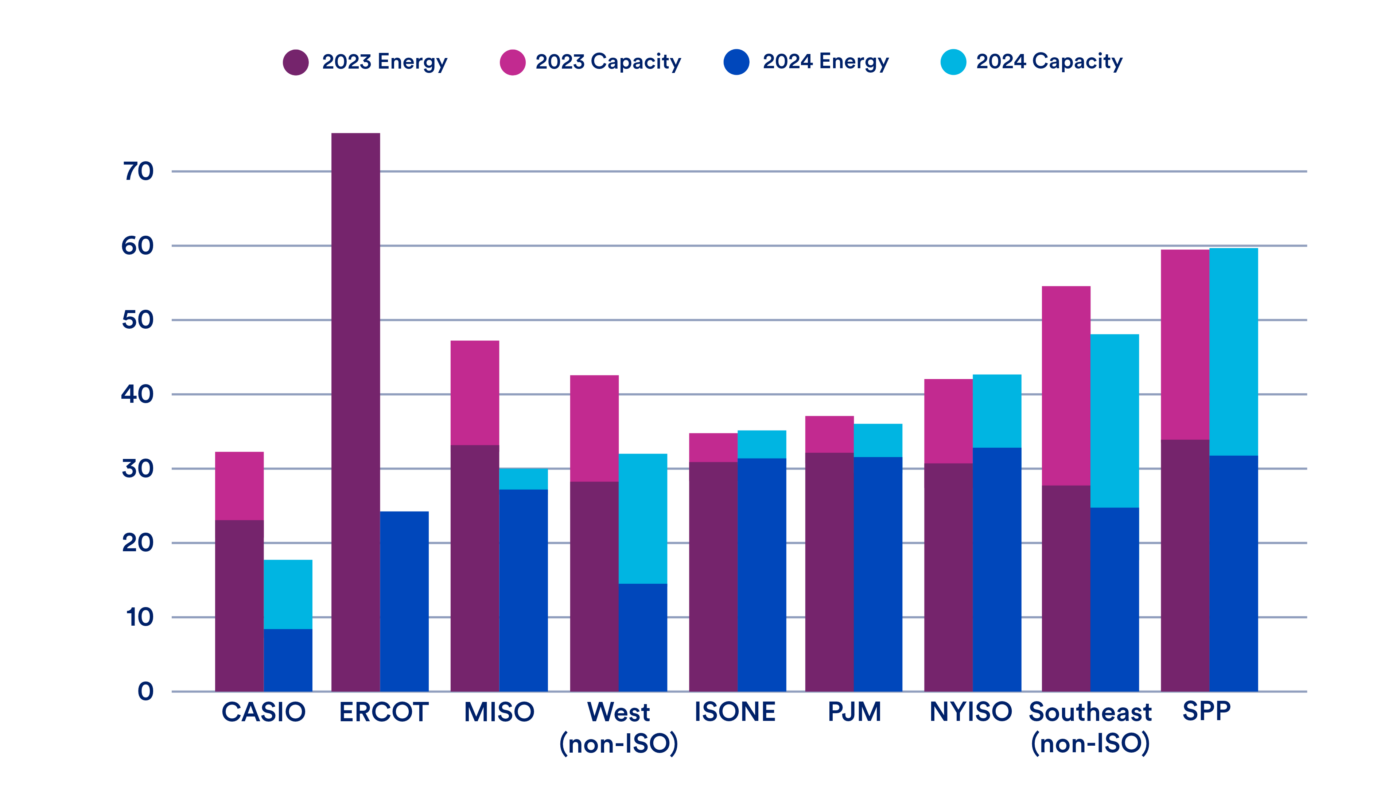
If the significant hurdles to implementation of Connect-and-Manage for resource adequacy programs cannot be overcome, even a fully successful implementation for energy-only generators in the same market regions may have limited practical impact. This is because generators that connect as energy-only resources in these markets (without acquiring separate firm transmission service) would give up any potential capacity revenues, which can be a meaningful portion of generator earnings (see Figure 6).65 The speed and cost certainty of energy-only or Connect-and-Manage interconnection would need to provide sufficient benefits to make the loss of capacity revenues a worthwhile tradeoff. The balance may shift in favor of energy-only connect-and-mange as wind and solar capacity accreditation and associated capacity revenues decline with increasing market penetration, but there is no guarantee that this option would see significant near-term uptake if implemented.
Figure 6: The breakdown of utility-scale solar project value in 2024 between energy and capacity, by market. Source: LBNL U.S. Utility-Scale Solar – 2025 Data Update ($/MWh)
Principle 2: Link transmission and generator interconnection planning processes.
On its own, a Connect-and-Manage framework does not necessarily include proactive transmission planning, but it can and should. For example, in 2005, Texas Senate Bill 20 directed the Public Utility Commission of Texas (PUCT) to “designate competitive renewable energy zones throughout [Texas] in areas in which renewable energy resources and suitable land areas are sufficient to develop generating capacity from renewable energy technologies” and develop plans to construct the transmission necessary to delivery electricity from those zones to customers.66 Competitive Renewable Energy Zones (CREZ) synced proactive transmission planning with interconnection by identifying areas where renewable energy (mostly wind) was best able to connect and building transmission to connect those areas. The PUCT ultimately designated five areas as CREZ, and the results speak for themselves. By 2014, transmission projects connecting CREZ were complete, including over 3,500 miles of open access 345 kV lines and serving approximately 18.5 GW.67 The resulting increase in wind generation helped decrease energy prices in ERCOT.68 The success of CREZ illustrates the importance of including proactive transmission planning into any Connect-and-Manage framework.
Principle 3: Clear the queues and bring power online quickly.
As previously stated, Interconnection queue reforms can use various methods to move projects more quickly through queues, including reforming basic, energy-only study options to allow developers to connect without extensive network upgrades, pre-running studies for certain interconnection locations determined through proactive transmission planning (per Principle 2), setting strict study and decision point timelines, raising the price of queue withdrawal, and implementing strict requirements for project developers to enter the queue to avoid speculative requests, among other options.
A Connect-and-Manage framework would help bring power online faster by offering a truly streamlined study option for generators or load willing to connect without full deliverability. While this might be less attractive for resources that want firm deliverability, for data centers willing to curtail during peak load or for resources like wind and solar that carry lower capacity value (unless paired with storage), a fast-track, energy-only option could be tempting—as it stands, wind projects face some of the longest interconnection study timelines, and timelines for solar and batteries are trending upward.69 Additionally, eliminating ERIS network upgrade requirements would itself speed up connection timelines, both because generators would not have to wait for the construction of upgrades, and because generators would be less likely to withdraw from the queue due to unexpected network upgrade costs and schedule delays. Overall, while Connect-and-Manage would not fully address the issue of clogged queues (as many generators would continue to pursue NRIS to secure capacity accreditation), it would help resources willing to risk curtailment to come online faster.
Principle 4: Allocate interconnection costs early, efficiently, and transparently.
A Connect-and-Manage framework that reforms ERIS interconnection should bring greater cost transparency and certainty, but only for generators connecting with ERIS. Under such a framework, customers opting for a reliability-only study would not be required to fund network upgrades as a condition of commercial operation, meaning their only upfront costs would be the costs of direct interconnection facilities at the point of interconnection, such as generation-tie lines, circuit breakers, metering equipment, and substation modifications.
But implementing Connect-and-Manage by reforming ERIS while maintaining capacity markets may be a half measure, as it would not increase cost certainty and transparency for generators connecting with NRIS (which would likely still be most generators). Without further reform, generators using NRIS would still face uncertain costs from network upgrades required to test for full deliverability that crop up far along in their interconnection application process. And on its own, a Connect-and-Manage proposal would not reform cost allocation for generators that connect using NRIS (that is, it would not answer the question of who foots the bill in the end).
Principle 5: Identify and proactively use surplus grid capacity.
Enabling utilization of surplus grid capacity is one of the primary advantages of a Connect-and-Manage approach. Unlike current interconnection processes, Connect-and-Manage would allow new generation and load to supply or consume power wherever and whenever the grid can handle it, rather than imposing minimum standards for deliverability. This could enable energy-only generation and storage to smoothly interconnect and create value while accepting potentially greater curtailment risk. Similarly, a Connect-and-Manage approach could facilitate non-firm demand by allowing new loads to connect with minimum network upgrades, so long as they commit to being involuntarily curtailed when operational network limits are reached. As discussed above, the ability of Connect-and-Manage to support additional capacity-accredited generator interconnection is more dubious, as current resource adequacy mechanisms only recognize the reliability value of resources that studies identify as fully deliverable under peak demand conditions. These resource adequacy mechanisms would need to be reformed to recognize the reliability value of energy-only resources. While this value may be significant due to a lack of correlation between real-world network stress and loss-of-load events,70 it is not obvious how it could be recognized and compensated under existing systems of capacity accreditation.
Principle 6: Create a level playing field between incumbent generators and new entrants.
Connect-and-Manage for energy-only generators creates an even playing field between new entrants and incumbents by eliminating requirements to study deliverability under ERIS and pay for any congestion-related network upgrades before interconnecting. Instead of being required to contribute to their own network capacity, new entrants would be allowed to access and utilize the existing transmission grid in exactly the same way as incumbents. This may also be true for versions of Connect-and-Manage designed to be compatible with centralized capacity constructs, depending on the implementation.
Principle 7: Prioritize equal treatment across resource types and sizes.
Connect-and-Manage does not inherently advantage certain generator types or sizes over others, and the more rapid interconnection timelines it enables may reduce the motivation for emergency fast-track processes that bias outcomes in favor of large projects. Like the CPP framework assessed earlier, it is possible that Connect-and-Manage could in practice favor generators in some locations over others depending on how the system operator chooses to manage network upgrades. If network upgrades that increase deliverability from certain locations are not pursued, generator types that are more geographically concentrated (e.g. wind resources) may be unfairly disadvantaged. For this reason, interconnection reform that enables a more flexible interconnection paradigm must be coupled with a more proactive transmission process like the Texas CREZ or SPP’s CPP effort.
Moving Forward: Learning from and Improving Current Practices
CPP and Connect-and-Manage each meet some of the seven principles. CPP plainly meets Principles 1, 2, 3, and 4: it can be implemented across diverse markets, successfully links transmission and interconnection through its PILs, clears queues quickly with faster timelines and greater predictability for project developers seeking interconnection, and uses Grid-C rates and a beneficiary-pays model to make costs transparent and fairly allocated. On the flip side, Connect-and-Manage implemented outside of ERCOT meets 3, 5, and 6: it clears the queues by offering a truly streamlined (and relatively cheap) option to connect, utilizes surplus grid capacity by allowing new generation and load to supply or consume power wherever the grid can handle it, and creates a level playing field by lowering barriers to new entrants. Both frameworks could meet Principle 7, although implementation may favor certain resources in practice.
Below, we propose two opportunities to improve interconnection queue reforms consistent with the outlined principles.
Opportunity 1: Leverage the best of CPP and Connect-and-Manage
Under the current status quo where centralized capacity constructs remain core features of most US electricity markets, CPP and Connect-and-Manage could be implemented together in a way that maintains many of the advantages of both while minimizing the need for major market reforms. Under this option, transmission providers would implement a CPP-style process involving long-term, multi-value transmission planning – as required under FERC Order 1920 – that is used to identify PILs and pre-run relevant interconnection studies for these locations. As in CPP, generators would be able to interconnect at PILs at fixed upfront rates on quick, transparent timelines, and applying for NRIS at these PILs would allow generators to qualify as accredited capacity.
At the same time, ERIS could be reformed as a Connect-and-Manage process, eliminating deliverability studies and limiting network upgrades to only those necessary to ensure that the facility can be interconnected safely. This ERIS reform would apply to any point of interconnection – not just PILs – and would allow energy-only resources to rapidly interconnect at the most valuable locations. Generators that choose the Connect-and-Manage option would not be eligible for capacity accreditation without acquiring firm transmission service or a similar status, meaning that interconnection at PILs would remain a valuable option. At the same time, the existence of energy-only Connect-and-Manage alongside CPP-style PILs would mitigate the potential risk of PILs being identified too slowly or in locations that disfavor certain resource types. This hybrid approach would not unlock the full benefits of ERCOT-style Connect-and-Manage due to the continued existence of capacity markets, but it may be the most expedient way to maximize the near-term impact of interconnection reform.
Opportunity 2: Reduce the importance of capacity revenues for generators
Independent of Opportunity 1, or potentially as a longer-term solution building on that opportunity, markets with centralized capacity constructs could be reformed to reduce the importance of capacity revenues for most generators or eliminate them altogether. This would skirt the challenge of making Connect-and-Manage interconnection compatible with NRIS and deliverability-based capacity accreditation.
Under this pathway, ERIS for generators would be replaced or supplemented with a full Connect-and-Manage interconnection option similar to the approach used in ERCOT. But under current ISO market design outside of ERCOT, energy prices are capped at relatively low levels, and a significant portion of generator revenues are instead derived from centralized resource adequacy mechanisms based on accredited capacity that require assessment of deliverability via NRIS (see Figure 6). As discussed above, this market structure would discourage generators from utilizing Connect-and-Manage interconnection because they would earn only the relatively muted revenues available from the energy market while sacrificing any capacity revenue.
One solution to this challenge would be to shift the balance between the two revenue streams. This could be done by raising the cap on energy prices, which would reduce the amount of “missing money” that generators need to recover via capacity payments, leading to lower capacity prices while keeping overall revenues and consumer costs flat. Doing so would unlock more revenue for energy-only generators and reduce the importance of capacity revenues. This approach is already being considered by PJM, primarily as a means of addressing the collapse in trust in its existing capacity market,71 but it would also have significant implications for the viability of Connect-and-Manage. As energy revenues become a greater portion of total expected generator earnings, Connect-and-Manage interconnection would become an increasingly attractive option for generators, potentially enabling a rapid expansion of supply. Even before Connect-and-Manage becomes economically viable as a standalone interconnection pathway, increased energy revenues could make it sufficiently compelling as a temporary status while generators wait for NRIS and associated network upgrades.
Alternatively, or as an evolution of the above approach, markets with centralized resource adequacy mechanisms based on accredited capacity could opt to eliminate these mechanisms altogether, instead relying solely on energy market incentives (i.e., the threat of unhedged scarcity pricing during extreme events) or regulatory hedging requirements to ensure that load-serving entities procure sufficient capacity through energy and derivative contracts to ensure reliability even under extreme circumstances. Under such a system, ISOs would give up the role of centrally determining the capacity value of generating resources and would instead use transmission planning and energy market design as their primary tools for ensuring reliability. Resource adequacy and deliverability studies would still be employed, but they would no longer limit new generator interconnection. Instead, they would solely inform network planning to ensure that demand centers have access to sufficiently reliable supply at minimum cost. Although this pathway would require a radical shift in the structure of energy markets nationwide, it is the only approach that would unlock the full benefits of Connect-and-Manage interconnection.
Footnotes
- A. Weeks et al., “PJM’s Speed to Power Problem and How to Fix It,” RMI (November 4, 2025), https://rmi.org/resources/pjms-speed-to-power-problem-and-how-to-fix-it/.
- See Standardization of Generator Interconnection Agreements & Procs., Order No. 2003 (“Order No. 2003”), 104 FERC ¶ 61,103 at P 755 (2003).
- In some circumstances, ERIS can be paired with forms of firm transmission service to qualify as accredited capacity. See: How to Convert Seasonal Accredited Capacity (SAC) associated with Energy Resource Service (ERIS) into Zonal Resource Credits (ZRC), MISO (April 24, 2026), https://help.misoenergy.org/knowledgebase/article/KA-01402/en-us.
- See Building for the Future Through Electric Regional Transmission Planning and Cost Allocation,Order No. 1920 (“Order No. 1920”),187 FERC ¶ 61,068, at P 110; https://www.energy.gov/documents/national-transmission-needs-study-draft-july-2026 at 36-40, 54-56.
- See generally Transmission Planning and Cost Allocation by Transmission Owning and Operating Public Utilities, Order No. 1000, 139 FERC ¶ 61,051, (2011).
- Compare, e.g., Regional Transmission Expansion Plan (RTEP), PJM, https://www.pjm.com/library/reports-notices/rtep-documents (PJM, annual); MISO Transmission Expansion Plan (MTEP), MISO, https://www.misoenergy.org/planning/transmission-planning/mtep/#t=10&p=0&s=&sd= (MISO, annual) with Regional Planning, WestConnect,https://regplanning.westconnect.com/regional_planning.htm (WestConnect, biennial); Public Policy Transmission Planning Process, NYISO (November 30, 2022), https://www.nyiso.com/documents/20142/34647738/10%2031.4%20OATT%20Att.%20Y%20RL%20v.%20e_tariff.pdf/d304a5c9-9bcb-9653-1e10-68dba052ff31 (NYISO, biennial).
- See Order No. 1920 at PP 85, 101, 109-10, 122-23, 127-28 (2024).
- Order Accepting Tariff Revisions, Subject to Condition, 194 FERC ¶ 61,192, at P 3 (March 13, 2026) (Rosner, concurring).
- See How to Convert Seasonal Accredited Capacity (SAC) associated with Energy Resource Service (ERIS) into Zonal Resource Credits (ZRC), MISO (April 24, 2026), https://www.ferc.gov/news-events/news/order-no-1920-compliance-filings-schedule.
- Order Addressing Arguments Raised on Rehearing, Setting Aside Prior Order, in Part, and Granting Clarification, Order No. 1920A, 189 FERC ¶ 61,126, at P 268 (2024). These factors include laws affecting resource mix, decarbonization, and electrification; state-approved integrated resource plans and expected supply obligations for load-serving entities; trends in fuel costs and in the cost, performance, and availability of generation; resource retirements; and utility and corporate commitments. Id.
- J. Seel et al., Generator Interconnection Costs to the Transmission System in non-ISO Balancing Authorities, Lawrence Berkeley National Laboratory (February 2026), https://energyanalysis.lbl.gov/publications/generator-interconnection-costs-0.
- See Midwest Indep. Transmission Sys. Operator, Inc., 124 FERC ¶ 61,183 (2008) (approving MISO’s use of cluster studies), and Johannes Pfeifenberger, “Generation Interconnection and Transmission Planning,” Brattle & ESIG at 3 (Aug. 9, 2022), https://www.brattle.com/wp-content/uploads/2022/08/Generation-Interconnection-and-Transmission-Planning.pdf.
- U.S. Department of Energy, Transmission Interconnection Roadmap at 49 (April 2024).
- See Rob Gramlich, et al, Unlocking America’s Energy, Grid Strategies & The Brattle Group at 25-26 (August 2024) https://gridstrategiesllc.com/wp-content/uploads/Exec-Sum-and-Report-Unlocking-Americas-Energy-How-to-Efficiently-Connect-New-Generation-to-the-Grid.pdf
- California ISO, 2025-2026 Transmission Plan at 2-3 (May 12, 2026) https://www.caiso.com/documents/revised-draft-2025-2026-transmission-plan-may-2026.pdf.
- Order on Tariff Revisions, 189 FERC ¶ 61,108, at PP 5-6 (November 13, 2024)
- Id.
- Joint Targeted Interconnection Queue (JTIQ) Study, MISO at 7 (June 18, 2024) https://cdn.misoenergy.org/20240618%20PAC-RECBWG%20Item%2002%20JTIQ%20Presentation634859.pdf
- Joint Targeted Interconnection Queue (JTIQ) Study, MISO at 7-8.
- Tsuchida, et al, “Proactive Planning for Generation Interconnection: A Case Study of SPP and MISO, Brattle, at 14 (Sept. 2022), https://www.esig.energy/wp-content/uploads/2022/09/ESIG-Proactive-GI-Planning-Final-Study.pdf.
- Joint Targeted Interconnection Study (JTIQ), MISO & SPP at 2 (March 2022), https://cdn.misoenergy.org/JTIQ%20Report623262.pdf.
- J. Rand et al., Queued Up: 2026 Edition, Lawrence Berkeley National Laboratory (June 2026), 35 https://emp.lbl.gov/sites/default/files/2026-06/Queued%20Up%202026%20Edition.pdf.
- Id. at 54.
- Id. at 24.
- See, e.g., PJM’s capacity market: https://www.congress.gov/crs-product/R48553
- Gramlich, “Unlocking American’s Energy” at 20.
- Order No. 2003 at P 93.
- Rand, Queued Up at 47.
- W. Gorman et al., A Review of United States Energy-only Generator Interconnection Service Policy and Considerations for Reform, Lawrence Berkeley National Laboratory, 3rdRail Inc., & Nicholas Institute for Energy, Environment & Sustainability at Duke University (February 2, 2026), https://papers.ssrn.com/sol3/papers.cfm?abstract_id=6870718.
- Katie Siegner, et al, “A Fast-Path to Affordability: Understanding the Benefits of Energy-Only Resources in PJM,” RMI (May 11, 2026) https://rmi.org/resources/a-fast-path-to-affordability-understanding-the-benefits-of-energy-only-resources-in-pjm/
- T. H. Norris et al., Is Energy-Only Interconnection Working? Empirical Evidence from Two Decades of US Market Data, Nicholas School of the Environment at Duke University & Lawrence Berkeley National Laboratory (June 3, 2026), https://papers.ssrn.com/sol3/papers.cfm?abstract_id=6881698.
- Rand, Queued Up at 35.
- Id. at 34.
- Improvements to Generator Interconnection Procedures and Agreements, Order 2023 (“Order No. 2023”), 184 FERC ¶ 61,054 at P 47 (July 28, 2023) (“the withdrawal of speculative interconnection requests that trigger reassessments and possible restudies by the transmission provider can delay the timing and increase the cost to interconnect for lower-queued interconnection requests.”); see also “Generator Interconnection Interim Progress Report,” Grid Strategies, Brattle (June 2026) at 25 https://gridstrategiesllc.com/wp-content/uploads/GS_Generator-Interconnection-Interim-Progress-Report.pdf (explaining that speculative projects entering the queue have “contributed to the cascading cycle of withdrawals and restudies that created SPP’s backlog”).
- Rand, Queued Up at 38.
- Id. at 41.
- Order No. 2023 at P 49.
- See, e.g., Y. Lavi et al., “Unlocking the Grid,” National Resources Defense Council (April 7, 2026), https://www.nrdc.org/resources/unlocking-grid; Gramlich, “Unlocking American’s Energy” at 20.
- New Service Requests: System Impact Study Executive Summary Report: Transition Cycle 1 Phase III, PJM (September 18, 2025), https://www.pjm.com/pjmfiles/pub/planning/project-queues/Cluster-Reports/TC1/TC1_PH3_Executive_Summary.htm#exec-sum-analysis-load-flow (see “Steady State Thermal & Voltage Reinforcements” table).
- See Order No. 2023 at P 453.
- See, e.g., Tenaska Clear Creek Wind, LLC, 177 FERC ¶ 61,200 (2021) (Tenaska Clear Creek Wind alleged SPP erroneously assigned Tenaska approximately $66 million in network upgrade costs during restudy).
- See Gramlich, “Unlocking American’s Energy” at 19.
- U.S. Department of Energy, Transmission Interconnection Roadmap at 55 (April 2024).
- 16 Tex. Admin. Code § 25.195(f)(1).
- 16 Tex. Admin. Code § 25.195(f)(2)–(3).
- Midcontinent Indep. Sys. Operator, Inc. Sw. Power Pool, Inc., 191 FERC ¶ 61,231 (2025) (quoting Illinois Com. Comm’n v. FERC, 576 F.3d 470, 477 (7th Cir. 2009)).
- National Transmission Needs Study, United States Department of Energy (October 2023), https://www.energy.gov/sites/default/files/2023-12/National%20Transmission%20Needs%20Study%20-%20Final_2023.12.1.pdf.
- R. Prabha & L. Min, “U.S. Transmission System Utilization Study Phase 1: WECC,” Stanford University (December 12, 2025), https://storymaps.arcgis.com/stories/b05bbe4413a04947b76319b0343ba5f5.
- Understanding the linkage between transmission deliverability and resource adequacy, GridLAB & Telos Energy (July 2026), https://gridlab.org/portfolio-item/gridlab-telos-presentation-deliverability-and-resource-adequacy/.
- C. Brancucci et al., Flexible Data Centers: A Faster, More Affordable Path to Power, Camus, encoord, & Princeton ZERO lab (December 2025), https://www.camus.energy/flexible-data-center-report.
- FERC Launches Aggressive Targeted Action to Speed Large Load Integration, FERC (June 18, 2026), https://www.ferc.gov/news-events/news/ferc-launches-aggressive-targeted-action-speed-large-load-integration.
- E. Caplan, ACORE Comments on PJM Surplus Interconnection Service Proposal, American Council on Renewable Energy (January 13, 2025), https://acore.org/resources/acore-comments-on-pjm-surplus-interconnection-service-proposal/.
- Energy Primer: A Handbook for Energy Market Basics, FERC Office of Energy Policy and Innovation, (December 2023), https://www.ferc.gov/news-events/news/ferc-staff-issues-2024-energy-primer-handbook-energy-market-basics.
- PJM Chooses 51 Generation Resource Projects To Address Near-Term Electricity Demand Growth, PJM Inside Lines (May 2, 2025), https://insidelines.pjm.com/pjm-chooses-51-generation-resource-projects-to-address-near-term-electricity-demand-growth/; FERC approves MISO’s Expedited Resource Addition Study, MISO (July 22, 2025), https://www.misoenergy.org/meet-miso/media-center/2025—news-releases/ferc-approves-misos-expedited-resource-addition-study/; SPP board approves expedited generation interconnection process to help meet regional resource adequacy, SPP (May 8, 2025), https://www.spp.org/news-list/spp-board-approves-expedited-generation-interconnection-process-to-help-meet-regional-resource-adequacy/,
- Order Accepting Tariff Revisions, Subject to Condition, 194 FERC ¶ 61,192, at P 1 (March 13, 2026).
- Id. at PP 47-48.
- Texas as a National Model for Bringing Clean Energy to the Grid, Americans for a Clean Grid (October 13, 2017), https://cleanenergygrid.org/texas-national-model-bringing-clean-energy-grid/.
- Order Accepting Tariff Revisions, Subject to Condition, 194 FERC ¶ 61,192, at P 4 (March 13, 2026) (Rosner, concurring).
- SPP Consolidated Planning Process to Reduce Costs and Help Meet Nation’s Growing Energy Needs, SPP (Aug. 5, 2025),https://www.spp.org/news-list/spp-consolidated-planning-process-to-reduce-costs-and-help-meet-nation-s-growing-energy-needs/.
- Order Accepting Tariff Revisions, Subject to Condition, 194 FERC ¶ 61,192, at P 5 (March 13, 2026) (Rosner, concurring).
- Rand et al., Queued Up at 46.
- CPP uses a “highway/byway” method, as well as the GRID-C rates themselves, to allocate costs between load and generators. See Order Accepting Tariff Revisions, Subject to Condition, 194 FERC ¶ 61,192, at P 71 (March 13, 2026).
- Order Accepting Tariff Revisions, Subject to Condition, 194 FERC ¶ 61,192, at P 71 (March 13, 2026).
- T. H. Norris, Beyond FERC Order 2023: Considerations on Deep Interconnection Reform, Nicholas Institute for Energy, Environment & Sustainability at Duke University (August 2023), https://nicholasinstitute.duke.edu/publications/beyond-ferc-order-2023-considerations-deep-interconnection-reform; S. Toth Kotwis et al., “Powering New Loads and Lowering Electricity Costs with Connect-and-Manage Interconnection,” RMI (July 14, 2026), https://rmi.org/resources/powering-new-loads-and-lowering-electricity-costs-with-connect-and-manage-interconnection/; Gramlich, “Unlocking American’s Energy.”
- R. H. Wiser et al., Land-Based Wind Energy Technology Update: 2025 Edition, Lawrence Berkeley National Laboratory (August 2025), https://emp.lbl.gov/publications/land-based-wind-energy-technology; J. Seel et al., U.S. Utility-Scale Solar, 2025 Data Update, Lawrence Berkeley National Laboratory (October 2025), https://emp.lbl.gov/publications/us-utility-scale-solar-2025-data.
- 2005 Tex. Sess. Law Serv. 1st Called Sess. Ch. 1 (S.B. 20).
- Warren Lasher, The Competitive Renewable Energy Zones Process, ERCOT at 8 (Aug. 11, 2014) https://www.energy.gov/sites/prod/files/2014/08/f18/c_lasher_qer_santafe_presentation.pdf
- Report on Existing and Potential Electric System Constraints and Needs, ERCOT at i (Dec. 2018) https://www.ercot.com/files/docs/2018/12/21/2018_Constraints_and_Needs_Report.pdf.
- Rand, Queued Up at 45.
- GridLAB & Telos Energy, “Understanding the linkage between transmission deliverability and resource adequacy,” https://gridlab.org/portfolio-item/gridlab-telos-presentation-deliverability-and-resource-adequacy/
- Powering Reliability Through Market Design: Addressing Rising Demand and Constrained Supply, and
- Stimulating Investment To Support Durable Reliability, PJM (May 6, 2026), https://www.pjm.com/-/media/DotCom/library/reports-notices/special-reports/2026/20260506-powering-reliability-through-market-design.pdf.
Credits
- Wilson Ricks – Program Manager, Electricity Program, CATF
- Veronica Saltzman – Attorney, CATF

