
More than a buyer: Key features for centralised purchasing of international credits in the EU
Executive Summary
The revised European Climate Law sets a 2040 climate target of 90% net reduction in greenhouse gas emissions relative to 1990 levels, with up to 5% to be met through the limited use of high-quality international credits under Article 6 of the Paris Agreement from 2036 to 2040. The European Commission is expected to propose a legal framework for the possible use of international credits by the end of 2026. This analysis explores how the upcoming proposal can establish and design centralised purchasing to operate as a service or, preferably, a requirement for Member States using international credits under national climate targets.
The case for centralised purchasing (e.g. via the European Commission, an existing agency, or new dedicated body) compared to decentralised purchasing by Member States or companies is strong. If properly designed, centralised purchasing can contribute to systemic transformation and high ambition in non-EU partner countries by enabling the EU to leverage and strategically link credit purchases to genuinely transformative agreements and partnerships, rather than using the credits primarily in an attempt to reduce compliance costs. It also enables pooling of technical expertise, lowers implementation costs, enables greater transparency, and increases purchasing efficiency.
The risk of overreliance and underdelivery of the pursued international credits is significant. This stems from factors such as the needed EU quality and strategic criteria, Article 6 rules (e.g. trade conditions and inability to bank credits across periods), rising partner country incentives to retain mitigation benefits within their own territories, and project lead times. The design and governance of centralised purchasing will be critical to help hedge these risks and ensure appropriate volumes of high-quality international credits are available, while maintaining environmental integrity and coherence with the broader EU climate policy framework.
Key recommendations for centralised purchasing of international credits
- International credits should primarily be voluntarily financed by Member States using international credits as a limited flexibility under national climate targets. The credits should not be allowed for direct compliance under the EU Emissions Trading System (EU ETS) to preserve its integrity and predictability, and EU ETS revenues should primarily be focused on the European clean transition.
- The purchasing of international credits should adhere to a structured procurement timeline. Member States should, by 2030 at the latest, submit their intended use of international credits towards national climate targets to signal expected demand and enable agreements with partner countries. A calibration moment will be required well before 2036 to align national climate targets and EU instruments with what has actually been contracted and financed.
- Delivery risk management should be built into the centralised purchasing entity’s design and the overall climate policy (e.g. by strategic over-procurement of international credits beyond Member States’ direct demand to secure supply).
- Centralised purchasing must be paired with high-quality and strategic criteria and high ambitions on sharing of mitigation outcomes (e.g. minimum values for sharing of mitigation benefits and the Adaptation Fund). Decentralised purchasing by Member States should adhere to the EU-regulated criteria and timelines and be coordinated with and scrutinized by the centralised purchasing entity and/or the European Commission.
Context and background
In December 2025, the EU agreed on a 2040 climate target of 90% net greenhouse gas reduction relative to 1990, with up to 5% to be met through high-quality international credits under Article 6 of the Paris Agreement from 2036 to 2040. The European Commission is expected to bring forward a legislative proposal for the possible use of international credits by the end of 2026. Key design choices for this framework remain open, such as quality and strategic criteria for the purchase of the credits; whether procurement operates under Article 6.2, Article 6.4, or both; and how international credits interact with policies implemented at the EU level (e.g. the EU Emissions Trading System (EU ETS) and policies for emissions from sectors covered by national climate targets).
International credits were a central issue in the 2040 climate target negotiations and introduced without an impact assessment of their role. Several voices, including the European Scientific Advisory Board on Climate Change, argued the EU should reach the 90% climate target through domestic climate action. CONCITO and Clean Air Task Force strongly support domestic action as the primary route to the 2040 climate target due to the significant risks of utilising international credits. In light of the role envisioned for these credits as part of the 2040 climate target, this analysis explores how the upcoming proposal can establish and design centralised purchasing of international credits.
Lessons learned and future risks
The EU should draw on the lessons learned from the previous use of international credits under the Clean Development Mechanism (CDM) and Joint Implementation (JI), as well as experiences within the voluntary carbon market and countries’ current engagements with Article 6. The implementation of the CDM and JI raised long-running concerns about the quality of the credits, leading the EU to progressively restrict and then phase out the direct use of international credits in the EU ETS to help restore confidence in the system and support a robust carbon price signal.1
Recent developments under Article 6 suggest that many of the practical challenges associated with international crediting mechanisms remain unresolved. While several countries have expanded bilateral cooperation agreements, the translation of these arrangements into actual credit generation and transfers has been slow, and further delays are emerging in the operationalisation of the Paris Agreement Crediting Mechanism (PACM).2 Experience from countries already active on Article 6 markets – Switzerland and Norway – shows that even well-resourced government buyers have struggled to have contracted volumes delivered on time.3 Table 1 summarises some examples of the possible constraints on future international credit supply, underscoring the potential risk of over-relying on these credits.
Table 1: Examples of possible constraints on future supply of international credits
| Quality constraints | The future availability of high-quality credits is highly uncertain. Credits that meet high quality requirements may represent a limited, higher-cost subset of global supply, while lower-cost options may fail to meet the forthcoming EU quality criteria, creating a structural risk of undersupply at acceptable quality levels.4 |
| Temporal eligibility constraints | Article 6 rules restrict eligible Internationally Transferred Mitigation Outcomes (ITMOs) to those generated within the relevant Nationally Determined Contribution (NDC) period, meaning only credits issued in 2036–2040 can be used in this period.5 This removes the ability to bank credits across periods and reduces compliance flexibility. |
| Long project lead times | Credit supplies depend on project development cycles that span many years from design to issuance.6 Evidence from the voluntary market indicates that delivery timelines are often long, and unlocking new sources of supply will take time. |
| Decreasing willingness to sell international credits: | As partner countries progress toward achieving net greenhouse gas reduction trajectories compatible with the Paris Agreement objective, the opportunity cost of transferring mitigation outcomes internationally is likely to increase.7 Partner countries may therefore increasingly prioritise retaining emissions reductions for domestic NDC compliance. |
Taken together, these constraints mean high-quality international credits are not guaranteed to be available at the scale needed to ensure appropriate volumes in the EU’s climate policy from 2036 to 2040. To lower the risk of overreliance and underdelivery, early coordination, credible demand signals, and structured procurement over time are important. The upcoming legislative framework, planned for the fourth quarter of 2026, should therefore treat future credit availability as an outcome to be actively managed, with planning aligned with a realistic and potentially constrained supply trajectory. This makes the design and procurement timeline of centralised purchasing central governance tools.
The case for centralised purchasing of international credits
Centralised purchasing, either through the European Commission, an existing EU agency, or a new dedicated body, should help to ensure systemic transformation8 and high ambition level in partner countries and maps directly onto the aforementioned risks.
The purchasing of international credits is one lever at the EU’s disposal in incentivising ambition in partner countries and should be used by the EU as quid pro quos in bilateral agreements or mitigation partnerships such as the Clean Trade and Investment Partnerships9, Just Energy Transition Partnerships and other partnerships. In this way, centralised purchasing can contribute to systemic transformation and high ambition in non-EU partner countries by enabling the EU to leverage and strategically link credit purchases to genuinely transformative agreements and partnerships on the clean transition. The more decentralised the purchasing (e.g. by each Member State), the less feasible it will be to link international credits with quid pro quos and use them to secure systemic transformation and high ambition in partner countries and achieve other policy goals. On the contrary, decentralised purchasing could tend to serve the narrower goal of cutting compliance costs, depending on the Member States’ interest. Centralised purchasing also enables pooling of technical expertise, lowers implementation costs,10 enables greater transparency, and increases purchasing efficiency (e.g. due to mutualisation of resources and bargaining power and prevents counterproductive competition). It could also create a better institutional basis for the binding procurement timelines that are essential to securing supply in advance (see next section).
Finance could, in principle, come from several sources, including financial contributions from Member States, revenues from the EU ETS, the Carbon Border Adjustment Mechanism, or from the EU budget. Various finance sources have pros and cons, and such a choice should be consistent with the decision made on how to integrate international credits into the broader EU climate policy framework. CONCITO and Clean Air Task Force call for international credits to be primarily financed by participating Member States using them as a limited flexibility under their national climate targets (e.g. through new economy-wide national targets or extension of the current climate architecture). This ensures accountability and allows each Member State to assess and weigh domestic decarbonisation against the use of international credits.11 International credits should not be allowed for direct compliance and finance under the EU ETS to ensure the integrity and predictability of the system, and EU ETS revenues should be focused on the European clean transition.
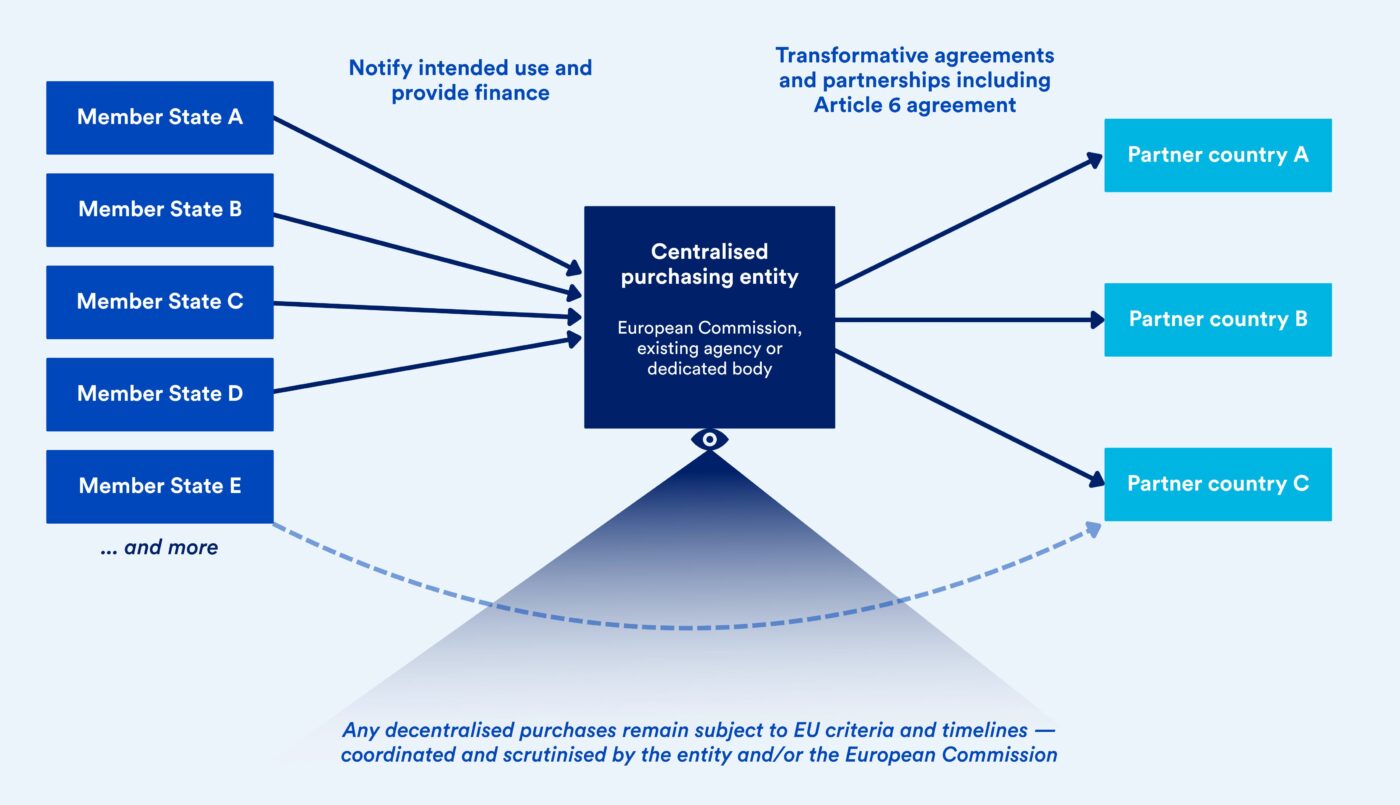
For the purchasing approach, CONCITO and Clean Air Task Force prefer a centralised approach for all EU countries purchasing in light of the clear benefits, but the EU could also decide to adopt a hybrid model combining both centralised and decentralised purchasing to accommodate diverse Member State interests and preferences (e.g. due to existing efforts on Article 6 and/or diplomatic partnerships). If the hybrid model is preferred, centralised purchasing could operate as a service or default option for Member States. Any decentralised purchasing by individual Member States should be in line with the EU-regulated criteria and timelines, and be coordinated with and scrutinised by the centralised purchasing entity and/or the European Commission to ensure compliance, prevent counterproductive competition, and enhance transparency. Figure 1 illustrates the approach.
Figure 1: Illustration of centralised purchasing of international credits on behalf of participating Member States
The limited flexibility of international credits can be designed in many ways under national climate targets. One option is to use them as an upfront flexibility for Member States to reach their target (e.g. similar to the flexibility to access allowances from the EU ETS under the Effort Sharing Regulation). Another option is to make them serve as a safety reserve (e.g. where domestic climate action and other flexibilities are exhausted first, and/or in the case that the EU fails to meet its climate target of reducing emissions by 90 % by 2040 domestically). This requires careful consideration and is out of the scope of this analysis.
Recommendations
- Centralised purchasing should operate as a service or, preferably, a requirement for Member States under national climate targets. Purchasing should ensure systemic transformation and high ambition in partner countries by enabling the EU to leverage and strategically link credit purchases to genuinely transformative agreements and partnerships rather than using them primarily in an attempt to reduce compliance costs.
- A decision for decentralised purchasing must ensure that individual Member States should adhere to the EU-regulated criteria and timelines and be coordinated and scrutinised by the centralised purchasing entity and/or the European Commission.
- International credits should primarily be voluntarily financed by Member States using international credits as a limited flexibility under national climate targets. International credits should not be allowed for direct compliance under the EU Emissions Trading System (EU ETS) to preserve its integrity and predictability, and EU ETS revenues should primarily be focused on the European clean transition.
Procurement timelines
Since the future availability of high-quality international credits is uncertain, the governance and market design of centralised purchasing will be critical to ensure the appropriate volumes and quality of international credits pursued in the 2036-2040 period. A structured procurement timeline aligned with the decisions of Member States to use the limited flexibility within national climate targets is important to ensure realistic credit delivery and reduce the risk of late-stage compliance shortfalls and/or pressure to weaken the EU-regulated quality criteria.
In the following section, important phases and decisions for purchasing international credits are illustrated. International credits can be sourced either through bilateral agreements under Article 6.2 (purchasing agreements with partner countries), bilateral agreements under Article 6.4 (purchasing agreements with project developers), or spot purchases under Art. 6.4. Bilateral agreements under Art. 6.2 and 6.4 could provide greater certainty over credit supply, while relying on spot purchases under Article 6.4 carries a much higher risk that future supply does not materialise in the quantity or quality needed. This section assumes credits are primarily procured through bilateral Article 6.2 and 6.4 agreements, and international credits are used as an upfront flexibility under national climate targets. However, these assumptions warrant future analysis.
Figure 2: Timeline of different phases under the procurement of international credits for 2036-2040 compliance period
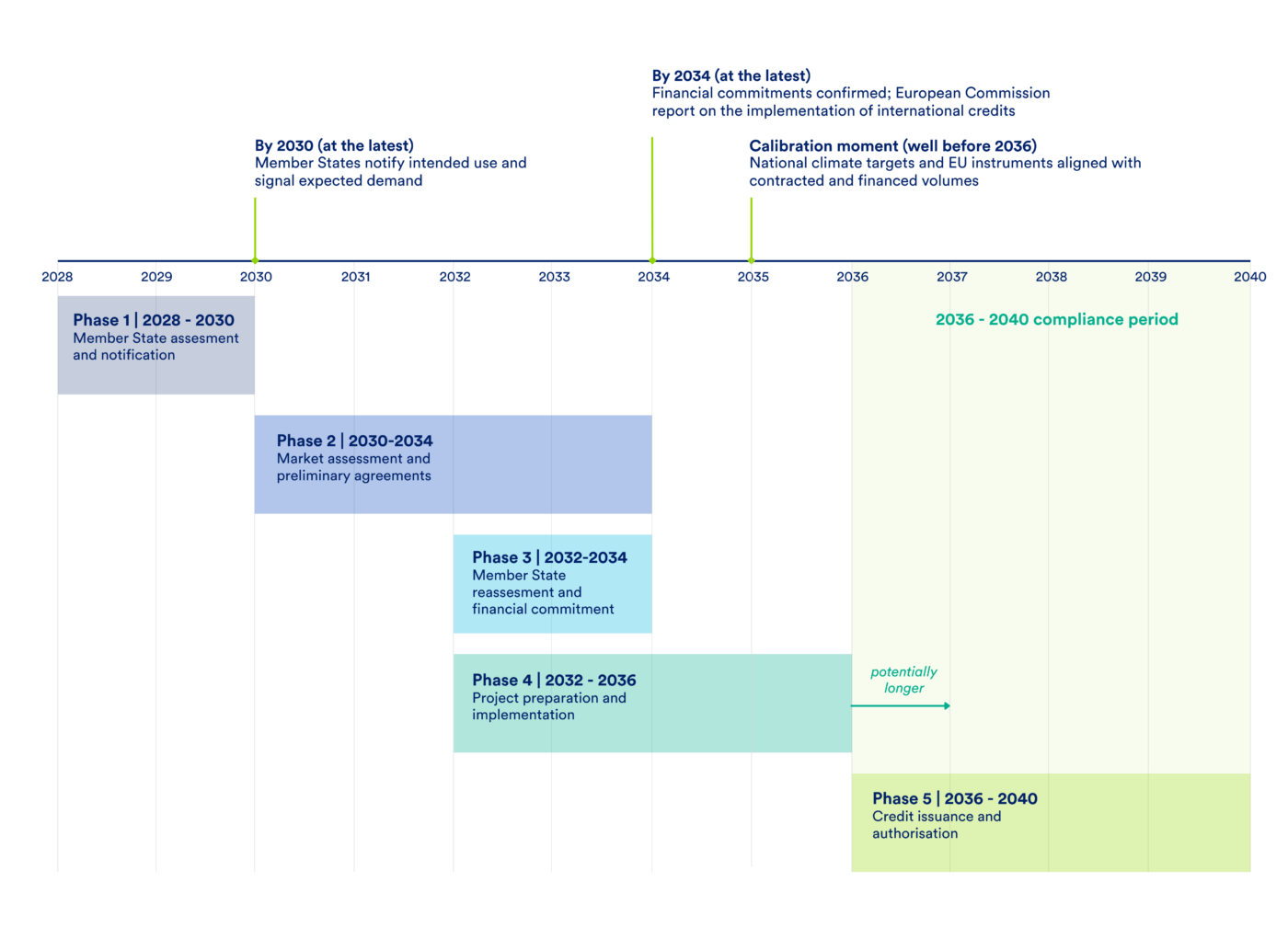
Note: The different phases and years assigned are indicative and should not be seen as direct recommendations.
Phase 1: Member State assessment and notification (2028-2030)
Member States should assess their expected need and use of international credits in light of their national climate targets. If credits are used as an upfront flexibility, Member States should notify the European Commission by 2030 at the latest of:
- Their intended use of international credits as a limited flexibility in the 2036-2040 compliance period
- Whether they intend to utilise the centralised purchasing approach, decentralised trading, and/or a hybrid approach – if that is optional.
To avoid free-riding, e.g. where Member States benefit from the supply-securing effect of aggregated demand without committing to the procurement, Phase 1 notifications should carry either provisional financial commitments and/or clear priority rules under which credits secured against early notified demand are allocated first to those Member States that created the basis for procurement.
Phase 2: Market assessment and preliminary agreements (2030-2034)
As a response to the notification and placing of orders from Member States, the centralised purchasing entity begins identifying potential supply through bilateral Article 6 agreements and establishing preliminary purchasing agreements. Utilising the pilot period from 2031 to 2035 to initiate a high-quality and high-integrity international credit market should be considered in this context. Procurement efforts should not only cover Member States’ direct demand but also sharing of mitigation outcomes (e.g. sharing of mitigation benefits and the Adaptation Fund)12, as well as potential additional volumes needed to manage delivery risk (see considerations below). All procurement efforts should comply with the EU-regulated quality and strategic criteria.
Phase 3: Member State reassessment and financial commitment (2032-2034)
As preliminary agreements are made, they should be presented to participating Member States for evaluation. Member States may have a chance to reassess and revise their intended use of international credits before financially committing to purchasing agreements. This assessment could include whether Member States are willing to pay the negotiated credit prices as opposed to financing domestic mitigation efforts, as well as their confidence in project delivery timelines. Member States must confirm their financial commitment through 2034 at the latest. By 2034, the European Commission should submit a report on the implementation of international credits, taking into account intended uses, contracted volumes, preliminary agreements and any residual gap, as well as potential legislative proposals to align national climate targets and EU instruments with what has actually been contracted and financed of international credits.
Phase 4: Project preparation and implementation (2032-2036 and potentially longer)
Once agreements are preliminarily or formally concluded, projects start entering development. Given the possible lead times involved and the need for credible, long-term purchase commitments to secure project financing, the financial commitments in Phase 3 could be structured to aid project development. For example, preliminary agreements could include conditional bankable elements to help projects move forward (e.g. milestone payments, offtake agreements, etc.). The centralised purchasing entity should actively monitor project development progress during this phase to identify emerging delivery risks before the 2036 compliance window opens.
Phase 5: Credit issuance and authorisation (2036-2040)
Once projects become operational, mitigation outcomes are quantified according to approved methodologies, enabling the issuance of credits.13 However, delivery risks can remain significant. Projects may be delayed or fail to become operational within the relevant compliance period from 2036-2040, reducing credit availability, and ex-post project performance may generate fewer credits than anticipated during ex-ante assessments. On this basis, additional strategies to mitigate such delivery risk should be considered. An example of this could be strategic overprocurement. The precise calibration of over-procurement and reserve size is a technical and political question that should be informed by a further analysis of delivery risks of current and future Article 6 transactions. This will naturally also be influenced by the establishment of quality and strategic criteria, minimum thresholds for sharing of mitigation benefits, the Adaptation Fund and OMGE (overall mitigation in global emissions) requirements.
Recommendations
- Member States should, by 2030 at the latest, submit their intended use of international credits towards national climate targets to signal expected demand and enable agreements with partner countries.
- By 2034, the European Commission should submit a report on the implementation of international credits, taking into account intended use, contracted volumes, preliminary agreements and any residual gap. This should feed into a calibration moment well before 2036 to align national climate targets and EU instruments (e.g. adjust the emissions cap in the EU ETS, etc.) with what has actually been contracted and financed.
- Delivery risk management should be built into the centralised purchasing entity’s design and the overall climate policy (e.g. by strategic over-procurement of international credits beyond Member States’ direct demand to secure supply).
Further design considerations
A centralised purchasing entity is more than a shared procurement office. It is also a strategic instrument for managing the supply, quality and diplomatic dimensions of the EU’s climate efforts. Doing so requires resolving a complex set of interlinked design choices, including the role and scale of international credits relative to domestic action, selection criteria for partner countries, quality criteria (e.g. the ambition level relative to PACM) and strategic criteria, possible restrictions on types of mitigation activities, validation and verification rules, sharing of mitigation outcomes, and public transparency provisions. The European Commission should assess existing frameworks, including ICVCM Core Carbon Principles, voluntary carbon market protocols, and the Article 6.4 Mechanism, for alignment with EU-defined quality criteria. At the same time, additional criteria and safeguards (e.g. qualitative restrictions on types of mitigation activities) are likely needed. Furthermore, the EU must uphold high ambitions on sharing of mitigation outcomes, as already required by the European Climate Law‘s reference to adaptation proceeds14 and sharing of mitigation benefits with partner countries.
Quality and strategic criteria only work in practice if there is a clear institutional answer to who applies them. A centralised purchasing entity mandated to deliver appropriate volumes from 2036 could face pressure to handle trade-offs between ambitious strategic and quality criteria and procurement inappropriately. It could be considered that decisions on methodologies and types of mitigation activities are carried out in a different institutional set-up than procurement. For example, Switzerland’s Article 6 architecture already applies this division of roles. The Federal Office for the Environment sets eligibility criteria and authorises each mitigation activity, while procurement is carried out separately by the KliK Foundation, so delivery pressure on the buyer cannot translate into weaker eligibility decisions. However, these elements need to be further analysed.
Recommendations
- Centralised purchasing must be paired with high-quality and strategic criteria and high ambitions on sharing of mitigation outcomes (e.g. minimum values for sharing of mitigation benefits, the Adaptation Fund, etc.).
- The European Commission should assess if decisions on methodologies and types of mitigation activities will be carried out in a different institutional set-up operating at arm’s length from the procurementprocess to avoid pressure to weaken eligibility decisions.
Footnotes
- The direct use of international credits in the EU ETS contributed, with other factors such as the 2008 economic crisis, to the historical surplus in the system in the first periods.
- As of March 2026, 106 bilateral cooperation arrangements with 53 host countries have been formalised, yet completed ITMO transfers remain limited to a handful of cases. On the PACM, the first methodology was adopted only in October 2025 and the first credits issued in February 2026, while COP30 extended the CDM transition deadline to mid-2026 amid slow host country approvals.
- For example Switzerland’s KliK Foundation planned to procure 2.1 million ITMOs in the 2022–2024 period but will only generate around 400,000 ITMOs. Additionally the Foundation projects a gap of roughly 14 million ITMOs against its 2025–2030 needs which will be met through domestic efforts.
- Some academic literature, such as Probst et al. 2024, Cames et al. 2016, Swinfield et al. 2026, and Gill-Wiehl et al. 2024 , have identified widespread concerns regarding additionality and overcrediting in carbon credit markets. This suggests that a significant share of existing supply may not be aligned with future EU quality criteria and could be associated with significantly higher prices than currently observed in the market.
- According to UNFCCC, ITMOs used must have a vintage within the using Party’s NDC period towards which the ITMO is used.
- According to the World Bank and the OECD, carbon credit projects have significant lead times which could be further extended due to requirements under Article 6.
- This is also noted by New Climate Institue.
- Europe’s external action must focus on accelerating climate-aligned investment in these economies, with system transformation rather than fragmented projects at the center.
- These agreements should be designed as broader strategic partnerships, integrating development cooperation, trade, and/or capacity building, to build the reciprocal relationships that make the partnership mutually beneficial.
- For example by limiting the need for setting up administration to engage in the Article 6 market in each individual Member State and avoid of duplication of efforts.
- Thereby, Member States are not forced to use the flexibility.
- A portion of issued credits could also be cancelled to deliver “overall mitigation in global emissions” (OMGE) meaning those units cannot be used by any party. It is mandatory under article 6.4 and encouraged under article 6.2.
- Further, the partner country must authorize credits for international transfer and use as ITMOs. Without partner country authorization, credits cannot count toward EU and Member State NDC compliance.
- The 5% credit transfer to the Adaptation Fund under PACM should apply as a minimum standard.

