
Integrating Agricultural Development and Methane Mitigation as part of the EU Livestock Strategy


Key Takeaways
- The forthcoming EU Livestock Strategy is central to balancing food security, rural livelihoods, and climate neutrality. It represents a critical opportunity to secure the long-term viability of the EU agricultural sector while addressing its substantial methane footprint. With livestock responsible for around two-thirds of the EU’s agricultural greenhouse gas emissions, methane mitigation must be recognised in the Strategy. Methane mitigation should be embedded within broader agricultural development objectives, prioritising farmers’ livelihoods, productivity gains, animal health, and economic resilience. Farm-centric approaches are essential for accelerating adoption and ensuring durable emission reductions.
- Rapid methane reduction is essential for meeting the EU’s climate objectives and can foster the sector’s resilience. Livestock methane emissions are a major driver for global warming and one of the most effective levers for slowing global warming in this century. Addressing methane mitigation, particularly by reducing methane intensity of livestock products, in the EU Livestock Strategy can deliver near-term climate benefits while strengthening the sector’s resilience to climate impacts such as heat stress and drought.
- Large productivity disparities between member states create an opportunity for action. Despite high average productivity in the EU livestock sector, there is variation both between and within member states. The EU Livestock Strategy can unlock significant climate and economic benefits by targeting productivity gains, thereby creating synergies between methane emissions intensity reduction and rural development.
- A fit-for-purpose EU Livestock Strategy must be tailored, data-driven, and member state-specific. Methane sources, production systems, and economic conditions vary across member states, underscoring the need to adapt mitigation pathways to national and regional contexts. The Strategy should support member-state-specific methane action plans that align CAP incentives with mitigation practices and strengthen farm-level emission and economic data collection to ensure effective and equitable implementation.
- The EU Livestock Strategy can drive cost-effective methane reductions by strategically leveraging existing EU policy instruments and improving incentives and measurement. The Strategy can guide the use of existing frameworks, such as the Industrial Emissions Directive (IED) and the Common Agricultural Policy (CAP), to scale proven mitigation practices. By signalling a shift towards methane-specific CAP support, strengthening regulatory coherence, and improving farm-level measurement and reporting, the Strategy can enhance accountability while rewarding performance. Anchored in member-state-specific methane action plans, these levers can align climate ambition with farm economics and enable future market-based approaches.
Domestic livestock production is both a cornerstone of EU food security and a culturally and socially vital activity that supports over 4 million farms across member states.1 For this reason, the EU Vision for Agriculture and Food2 prioritises launching a strategy on livestock for a robust and sustainable EU livestock sector that balances environmental protection, economic viability, and social justice.
With livestock responsible for around two-thirds of the EU’s agricultural greenhouse gas emissions, the sector’s methane footprint cannot be overlooked. Methane is a potent, short-lived climate pollutant, and reducing livestock methane emissions is one of the most effective levers for slowing near-term global warming. The EU Livestock Strategy represents a critical opportunity to embed methane mitigation within broader agricultural development objectives — supporting farmers’ livelihoods and productivity while delivering meaningful climate benefits.
This can be accomplished by:
- Targeting productivity gains, thereby creating synergies between methane emissions intensity reduction and rural development;
- Supporting member-state-specific methane action plans that align CAP incentives with mitigation practices and strengthen farm-level emission and economic data collection to ensure effective and equitable implementation; and
- Guiding the use of existing frameworks, such as the Industrial Emissions Directive (IED) and the Common Agricultural Policy (CAP), to scale proven mitigation practices.
EU livestock production is a major methane emitter — and emissions are not falling fast enough
In 2024, there were 72 million bovine animals in the EU,3 which produced 6.6 million tons (Mt) of meat3 and 161.8 tons of dairy products for domestic consumption and export.4 As of 2020, livestock production also supported the livelihoods of over 1.5 million farmers in all EU member states, and Norway and Switzerland.5
Livestock production also has a substantial environmental impact: it is the single largest source of human-made methane, a potent short-lived greenhouse gas (GHG) responsible for 0.5 degrees Celsius of the excess warming we’re experiencing today. While methane from livestock is considered biogenic, it drives the same warming effects in the atmosphere as methane from fossil fuels. This methane is released in the atmosphere when ruminant animals, particularly cattle, digest their food (enteric emissions) or when their manure is stored in lagoons (manure emissions). In the EU, livestock production accounts for approximately 66% of agricultural GHG emissions.6 The EU agricultural sector emits around 8.2 Mt of methane annually,7 with manure accounting for 22% and enteric emissions accounting for 76%, the main source of which are roughly 100 million head of cattle. The profile of these emissions varies across member states: in Denmark, 40% of livestock methane emissions come from manure, whereas in France over 80% are enteric.
Figure 1. Enteric and manure methane emissions from EU member states
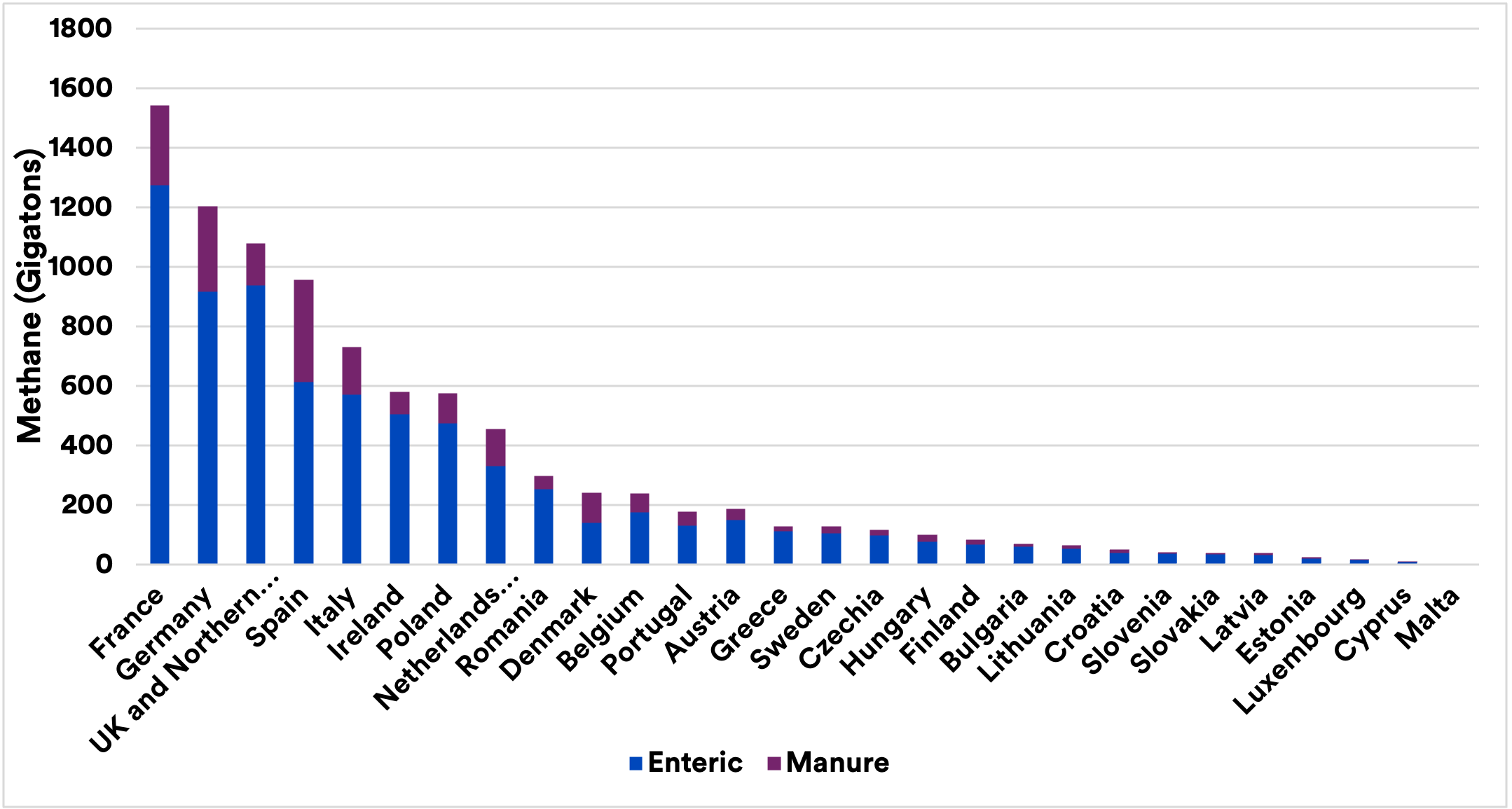
Progress on livestock methane mitigation has been slow, with emissions declining only marginally in the last two decades. Enteric emissions, for example, have tapered off from around 6.8 gigatons in 2005 to about 6.4 gigatons in 2023. These trends vary considerably across member states: France reduced its agricultural methane emissions by approximately 14% between 2005 and 2023, while Ireland’s has increased by 8%. These numbers highlight the need to accelerate action to reduce methane emissions from the livestock sector.
Integrating agricultural development and methane mitigation is the key for reducing emissions
Deep reductions in methane emissions from all sources offer the best strategy to slow climate change within our lifetimes. Livestock are already particularly vulnerable to climate change, and without action, changes in rain patterns as well as prolonged heat waves and droughts can lead to significant economic losses, further straining farmers’ livelihoods in the EU.
Yet countries often hesitate to commit to methane mitigation in the agriculture sector due to the perception that reducing emissions will constrain production or impose burdens on farmers. In reality, methane mitigation and agricultural development must advance together. The key is a farmer-centric approach that makes emissions reduction economically viable: when technologies and practices deliver clear productivity gains and financial returns to farmers, adoption accelerates naturally. This requires scaling methane-reducing technologies while demonstrating their economic value, ensuring that climate action and farm profitability reinforce rather than compete with each other.
Productivity gains can drive emissions reductions
When assessing methane emissions from livestock systems and opportunities to mitigate them, it is essential to distinguish between two complementary but conceptually distinct metrics: absolute emissions and emissions intensity. Both are required for a rigorous evaluation of mitigation outcomes and policy relevance.
- Absolute methane emissions refer to the total quantity of methane emitted by the livestock sector over a given period, typically expressed in tonnes of CH₄ (methane) or CO₂ (carbon dioxide)-equivalent. This metric reflects the sector’s aggregate contribution to atmospheric methane concentrations.
- Emissions intensity refers to the amount of methane emitted per unit of livestock output, such as kilograms of CH₄ per kilogram of meat or liter of milk produced. This metric captures the efficiency of production systems rather than their total scale.
Livestock production patterns vary significantly by region and by product. In the EU, beef consumption is expected to decline, but production of cheese and other dairy products are expected to continue to grow. Globally, total livestock production is expected to continue increasing in many regions due to long-term trends in population and income growth, driving demand for animal-source foods.
In this context, the value of emissions intensity as a metric lies in the fact that is allows for comparisons between emissions associated with producing a given quantity of meat or milk under current or historical productivity trajectories (business-as-usual) versus emissions associated with producing the same quantity under systems with higher productivity per animal or per hectare. The difference between these two scenarios represents emissions avoided through productivity improvements, even if absolute emissions do not decline. Over the long term, increased productivity enables reductions in livestock numbers while maintaining output.
From a climate perspective, absolute emissions are the primary determinant of warming outcomes. Achieving global temperature stabilization or reduction requires declines in total emissions across all sectors, including agriculture. However, given the conditions described, emissions intensity becomes a critical analytical metric for assessing whether production is occurring with higher or lower emissions efficiency, particularly in countries where demand is expected to increase, or exporting countries.
Technical opportunities for reducing livestock methane emissions
There is a widespread misconception reducing livestock emissions, particularly enteric emissions, requires waiting for breakthrough technologies. In reality, current technologies targeting outcomes like better feed, healthier animals, stronger genes, and smart manure management practices can significantly reduce the environmental impact of livestock today, while also benefitting farmers.8 The most appropriate actions will depend on the context in which livestock production occurs, which is highly variable across EU member states.
On average, the productivity of livestock systems in the EU are high, but significant variation exists across member states. Actions focusing on accelerating productivity gains to close gaps where they exist should be prioritised. For instance, average dairy productivity in the EU is approximately 8,120 kg/cow per year, but it varies significantly by member state. For example, Romania, where over 90% of livestock farmers operate on less than 5 hectares of land,has an average productivity per cow of about 3,300–3,600 kg per year. By contrast, a dairy cow in Denmark produces about 10,300 kg/year.
Breakthrough technologies are promising and will have a role to play in reducing enteric emissions, but very few are commercially available and/or suited to the diversity of livestock systems present in the EU. Furthermore, the economics of some of these technologies still need to be pencilled out, meaning that without adequate support, farmers that adopt them will be further financially strained.
Below we summarise key methane-reducing strategies9 that should be incorporated as pillars into the EU Livestock Strategy.
| Area | Action | Impact on methane emissions* |
|---|---|---|
| Better feed management | Leverage feed balancing, local feed ingredients and byproducts to reduce production costs while maintaining production. Evaluate balanced use of sustainably sourced fats to decrease methane emissions. | Variable, usually positive (low) Highly digestible feed can increase production while decreasing methane emissions, reducing emissions intensity. If high tannins ingredients are used (e.g., byproducts of wineries), absolute methane emissions may be reduced. Increased use of certain lipids source can also reduce absolute emissions. |
| Enhanced pasture management | Optimize pasture management to reduce overgrazing, increase forage quality, resilience, and optimize land use, improving animal health and welfare. Incorporate legumes into grazing lands and pastures when suitable as it can improve soil quality, reduce nitrogen use, and reduce methane emissions. | Variable, usually positive (low) Smart grazing improves forage availability and quality, increasing animal production and reducing methane emissions intensity. |
| Methane reducing feed additives | Evaluate the implementation of innovative feed additives that reduce enteric emissions. Evaluate the economic impact of feed additives as new research has demonstrated that certain additives can impact milk composition, which may represent an opportunity for markets valuing fat and protein due to increased demand for cheese. Interaction with local diets and ingredients and long-term animal welfare should be prioritized. | Medium-high** Use highly dependent on cattle management, diet, and consumer’s preferences. It can reduce both emissions intensity and absolute emissions. |
| Healthier animals and new methane reducing “vaccines” | Develop animal health efforts to increase uptake of vaccination, improve milk quality, decrease abortion rates, improve productive life, improve early detection of diseases, and improve reproductive performance. It can increase milk productivity, reducing methane emissions per unit of milk. Evaluate the use of vaccines to reduce methane emissions when they become available (currently in developmental stages). Although not an animal health strategy per se, methane-reducing vaccines have the potential to be used as a mitigation strategy. | Low – medium Healthier animals support continuous productivity, reducing emissions intensity. In some countries, this represents an important lever. |
| Genetics for productivity, feed efficiency, and methane reduction | Strengthen member states genetic programs through data collection and sharing and public-private partnerships. Genetic selection can support the development of generations of animals that are healthier, more productive, and more feed and methane efficient. For reference, in the U.S., 60% of the productive gains of dairy cows is attributable to genetics gains. Most EU member states have a robust genetic program for their cattle. Priority should be given to the development of feed efficiency and methane efficiency traits for dairy and beef cattle, and development of economic strategies to accelerate uptake of these genetics by farmers. | Medium It’s a long-term strategy but permanent and additive. It reduces both absolute emissions and emissions intensity. |
| Smarter manure management | Create robust guardrails for anaerobic digesters. When well-managed, can reduce emissions from livestock manure. However, strong guardrails such as a robust MMRV and LDAR are needed. Accelerate uptake of alternative manure management practices for farmers or regions where anaerobic digestion is not an option. Practices that reduce manure storage time, percentage of volatile solids, and that acidify or aerates it can also reduce methane emissions from manure. | Medium-high Reduces absolute emissions. |
| Refined farm management | Improve the use of reproductive technologies, particularly in beef herds. Artificial insemination and the use of genetically improved bulls can significantly improve weaning weight, average daily gain, and the reproductive performance of beef herds, and accelerate the genetic gain across generations. | Low-medium Greater impacts in the long-term as genetic gains are permanent and additive. It can reduce both absolute emissions and emissions intensity. |
**Only available for confined animals as current effect depends on steady consumption of the product throughout the day
Policy opportunities for reducing livestock methane emissions
Given the plethora of technical opportunities to reduce agricultural emissions, the EU Livestock Strategy should build on existing policy frameworks to incentivise farmers to adopt these solutions, with support and engagement of processors, while simultaneously optimising resources and political capital across other key sustainability concerns, such as animal welfare, land use, production costs and economic feasibility, and consumer preferences.
In this context, the EU Livestock Strategy could take forward specific policies, encouraging uptake of key technical solutions:
- Revision of Industrial Emissions Directive to include cattle manure: The Livestock Strategy should build on the EU Revised Industrial Emissions Directive, the changes of which went into effect in August 2024. This revision included intensive pig and poultry farms in its scope, requiring them to use Best Available Techniques to reduce methane emissions. The revision also stated that by the end of 2026, the European Commission will issue an evaluation on including cattle in the IED, subjecting larger cattle farms with significant emissions from manure to similar rules on environmental permits and Best Available Techniques. The EU Livestock Strategy should recommend including best practices for cattle where safe tools exist, such as manure management in confined cattle systems.
- Optimise the Common Agriculture Policy (CAP) to support livestock development and methane mitigation Eco-schemes: Currently, the CAP has interventions that provide direct support to livestock without any requirement to mitigate emissions, a reality also reflected in the CAP budget allocation that has over €9 billion allocated to coupled income support (CIS) for livestock, and less than €3 billion allocated for interventions that can support emissions reductions.10 The Livestock Strategy should strategically provide guidelines and recommendations on Eco-schemes, incorporating and expanding practices that have a positive impact in reducing methane emissions (absolute or intensity). These schemes pay farmers additional compensation for exceeding mandatory requirements and can help make methane performance a quantifiable competitive advantage.
- Expand Measurement, Monitoring, Reporting, and Verification (MMRV) for livestock farms with frameworks that collect data from key farmers representing regional farm archetypes: current approaches are not accurate enough to demonstrate the impact and improvements of individual farmers investing in efficiency and emissions reduction, and is not credible enough to support a carbon market like the EU Carbon Removal Certification Framework. A network of farmers reporting tier 3 level data can help harmonize agricultural data, improve local baselines by providing activity-level data, and create a pathway for livestock farmers to participate in carbon markets.
- Prioritisation of livestock methane mitigation research under Horizon Europe: The EU Livestock Strategy should recommend using Horizon Europe as the primary framework for advancing research and innovation on livestock methane mitigation. Under Horizon Europe’s Cluster 6 (Food, Bioeconomy, Natural Resources, Agriculture and Environment), the EU has already recognised the role of sustainable livestock systems in achieving climate and environmental objectives. The Strategy should recommend that future Horizon Europe work programmes and their successor framework programme explicitly prioritise cross-European research on enteric methane‑reducing vaccines, genetic selection and breeding tools, and associated measurement methodologies, alongside animal health and productivity outcomes.
These policy shifts will help drive reductions in agricultural emissions at the EU level, by leveraging accountability, financial incentives, and new market-standards. However, given the complexity of livestock production, and the vast divergency between regions, countries, and specific farms, the EU Livestock Strategy should also include critical actions to better understand, inform, and design future policies to mitigate livestock methane emissions:
- Estimate methane intensity variation both among and within individual member states as well as the key technical and non-technical factors leading to observed variations. This can provide key information for policy action. For instance, identifying factors that lead to low productivity and high-cost variation (by region, farm size, and production system) can unlock insights that support effective policy design and ensure broad farmer participation.11
- Evaluate the short and long-term economic impacts at the farm level of proposed policies through robust farm management economic studies. These assessments should be Member State- and region-specific, and differentiated by production system (e.g., beef suckler farmers, stockers, finishing, dairy confined, dairy grazing, etc.).
- Create a robust methane action plan for each Member State. Robust plans will integrate policies, technologies, and measurement at the farm level, and engage with farmers to measure both the impact on emissions but also on farm level economics. Following the upcoming revision of the EU Governance Regulation, the Member States should integrate livestock methane mitigation more systematically into their National Energy and Climate Plans (NECPs), including through quantified targets, supporting measures, and reporting frameworks. Where national agricultural or climate plans are already in place, these should be enhanced by integrating methane mitigation in the livestock sector. Measuring the impact of different interventions on methane emissions in the livestock context is challenging due to the expected variation according to the production system. Strategic policy agendas should incorporate applied research that supports farm-level data collection, sharing, analysis, and governance of the impacts of interventions. A good example of such an initiative is the UK Dairy Carbon Network,12 a public-private multistakeholder network aimed at identifying, supporting, and demonstrating effective ways to cut emissions while maintaining farm productivity.
Enrollment of farmers in incentive schemes and intervention uptake depends on several factors, including financial constraints and risk perception is crucial. Understanding these limitations is crucial to prioritizing supported interventions and designing effective policies at the member state level.
Lastly, policies should be designed with the entire supply chain in mind, fostering integration and collaboration across actors towards farmers’ adoption of practices, which will accelerate methane emissions reductions from livestock.
Footnotes
- European Commission Results Indicators dashboard. Available on https://agridata.ec.europa.eu/extensions/DashboardCapPlan/result_indicators.html
- EU Vision for Agriculture and Food. Available on https://agriculture.ec.europa.eu/overview-vision-agriculture-food/vision-agriculture-and-food_en
- Eurostat (2025). Agricultural production – livestock and meat. Available on https://ec.europa.eu/eurostat/statistics-explained/index.php?title=Agricultural_production_-_livestock_and_meat
- Eurostat (2025). Milk production reached 161.8 million tonnes in 2024. Available on https://ec.europa.eu/eurostat/web/products-eurostat-news/w/ddn-20251120-3
- Eurostat (2026). Data browser for agricultural holdings with livestock, including live bovine animals in 2020. Available here https://ec.europa.eu/eurostat/databrowser/view/tag00124/default/table?lang=en&category=t_agr.t_ef
- European Environmental Agency (2025). Greenhouse gas emissions from agriculture in Europe. Available on https://www.eea.europa.eu/en/analysis/indicators/greenhouse-gas-emissions-from-agriculture
- European Environmental Agency (2025) EEA greenhouse gases – data viewer. Available on https://www.eea.europa.eu/en/analysis/maps-and-charts/greenhouse-gases-viewer-data-viewers
- FAO 2023. Pathways towards lower emissions. A global assessment of the greenhouse gas emissions and mitigation options from livestock agrifood systems. https://openknowledge.fao.org/items/b3f21d6d-bd6d-4e66-b8ca-63ce376560b5
- Perez-Dominguez et al. (2016). An economic assessment of GHG mitigation policy options for EU agriculture. https://publications.jrc.ec.europa.eu/repository/handle/JRC101396
- Scheid A, Hart K, Pasmino J, Riedel A, Tremblay L-l, Durrant L (2025) Leveraging the Common Agricultural Policy to accelerate livestock emission reductions – examples from five Member States, Ecologic Institute and IEEP (2018). https://ieep.eu/wp-content/uploads/2025/09/Leveraging-the-common-agricultural-policy-to-accelerate-livestock-emission-reductions-IEEP-Ecologic-EDF-2025.pdf
- Gloux et al. (2023). Taking the diet of cows into consideration in designing payments to reduce enteric methane emissions on dairy farms. https://linkinghub.elsevier.com/retrieve/pii/S0022030223002825
- The UK dairy Carbon Network. https://ahdb.org.uk/the-uk-dairy-carbon-network

