

Illinois’ return to long-term planning highlights the role of clean firm generation and long-duration energy storage to meet state goals



Illinois is rethinking how it achieves its electricity future. The state finds itself at a crossroads facing several key decision points that will shape how electricity is generated, delivered, and consumed over the next decade and beyond. Largely shaped by the Climate and Equitable Jobs Act (CEJA), its energy policy must balance three interconnected goals: decarbonization, reliability, and affordability, amid growing electricity demand. Enacted in 2021, CEJA established Illinois’ commitment to a clean energy transition, including a pathway toward a carbon-free power sector, expanded renewable energy deployment, electrification, environmental justice, and workforce development programs.
Recent challenges regarding rapid load growth, rising market prices, fossil fuel generation retirements, and looming clean energy target deadlines have left policymakers in deregulated power markets, such as Illinois, debating the policy changes needed to complement existing clean electricity policy, enable load growth, and promote affordability.
A key challenge in Illinois has been the lack of long-term planning, which, as highlighted in our recent state-led planning report, has atrophied in many states since electricity market deregulation. To address this gap, Illinois passed the Clean and Reliable Grid Affordability Act (CRGA) in January 2026, which requires the state to lead a long-term integrated resource plan (IRP) that studies its power system through 2045 and that will directly inform the Illinois Power Agency’s (IPA) procurements, state advocacy positions, and transmission planning. The introduction of state-led long-term planning marks a critical, and welcome, return of long-term planning in Illinois without sacrificing the benefits of the wholesale market it participates in.
The state’s first legislatively-mandated IRP – led by the Illinois Commerce Commission (ICC) staff – is scheduled for release later this November. The IRP aims to provide a comprehensive look at how the state can meet growing electricity demand while maintaining reliability and advancing the state’s clean energy goals. Last month, the ICC and IPA staff released the draft IRP results, highlighting the scale of the challenge ahead. Across five preliminary scenarios presented, Illinois would need to substantially expand its clean electricity supply over the next two decades, including the expansion of long-lead time technologies, like advanced nuclear and long-duration energy storage (LDES), that are unlikely to be motivated solely by power market prices and clean electricity standards.
In the “Reference Case,” the system must double its nameplate capacity to nearly 120 GW by 2045. In meeting the state’s carbon-free power goal, in-state generation reaches 89% clean in 2030 and 99.9% clean by 2045, while remaining a net-exporter in all years. While the supply mix is different for each scenario, one consistent finding is the large and rapid expansion of solar, wind, and storage resources. As fossil units retire under CEJA, the model replaces this firm capacity with renewables, storage, out-of-state natural gas capacity purchases, and new nuclear through uprates and new builds (Figure 1).
Figure 1. By 2045, Illinois’ system could differ by 45 GW depending on load growth, with Reference and High Data Center cases building more nuclear energy.
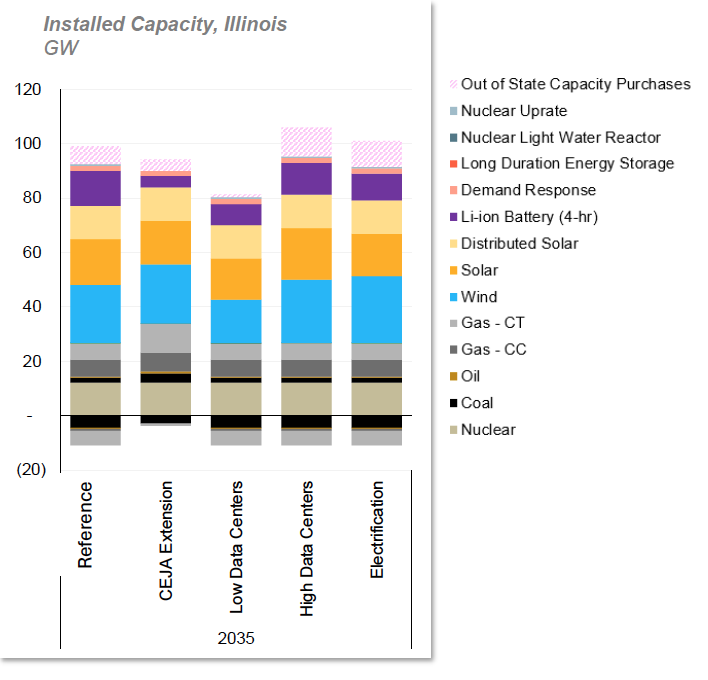
Notably, new nuclear plays a large role in the Reference and High Data Center cases, at roughly *5 to 6 GW of new reactors by 2045. The High Data Center case’s more stable load profile suits nuclear, while Electrification’s more variable load leans on LDES, but still develops about *3 GW of new nuclear reactors. The CEJA Extension and Low Data Center cases see less new nuclear and LDES, giving more priority to existing fossil resources and less need for new supply generally, respectively. Additional cases related to potential clean electricity reforms, which would likely increase the role of new nuclear and LDES in achieving state targets, are due to be published in the final IRP.
These interim results mark an important inflection point for the state. After decades of restrictions on new nuclear, the state’s first long-term planning process since deregulation is showcasing that new nuclear may be essential to achieving the state’s targets at the lowest cost. The recent full repeal of the state’s longstanding nuclear moratorium, in addition to other policy actions, have ensured the technology is being considered in the resource mix. In parallel, modeling shows that LDES may also be needed, especially if rapid load growth persists. But in today’s deregulated markets, nuclear and LDES face hurdles to development due to the lack of long-term market prices and clean electricity standard incentives. As such, Illinois will need to play an active role in enabling these technologies in the state.
According to our report on clean firm generation, nuclear power and other technologies in this category can play an instrumental role in supporting the development of renewables like wind and solar by providing reliable, weather-independent electricity. Although substantial investments in wind and solar will be necessary for Illinois to achieve decarbonization goals, integrating clean firm resources can help reduce overall infrastructure needs and support a more resilient emissions-free power system.To advance implementation, procurement and technology road mapping serve as complements to system assessments of need, as articulated in our state-led planning report. As part of CRGA, Illinois has enabled the state to act on market gaps identified in the IRP with state-led procurement. The state’s role in procurement has begun with its focus on 3GW of short-term storage by 2030. These procurement efforts will need to be expanded following the finalization of the IRP next month.
The recent ICC staff report on the nuclear Notice of Inquiry (NOI) was released to supplement the IRP by laying out stakeholder input on how nuclear projects could be built and procured. Both the NOI report and draft IRP results point to uprates at existing plants as the nearest-term option, while new reactors come later, reflecting their longer development timelines. The report also highlights mechanisms such as long-term offtake agreements, phased procurement that ties spending to risk reduction, and state support for permitting and supply chains to help develop nuclear energy in the state. A similar effort for LDES will likely be needed.
Together, these results suggest that existing and new nuclear and LDES capacity are a central part of Illinois’ clean firm capacity strategy when CEJA retirements proceed on schedule, and that scale depends heavily on load growth and policy choices. However, to enable these technologies to play a role in Illinois, near-term state action is needed.
An ICC proceeding will follow the final state-led IRP submission on November 15, giving stakeholders a platform to weigh in on the evaluation of the plan and propose recommendations before the ICC Commissioners officially approve it. This is an opportunity for Illinois to turn planning into action, so long-lead resources like nuclear and LDES can be built in time to meet its reliability and clean energy goals.
*Estimated from draft IRP results workshop presentation; final figures to be released in the final IRP.

