

The future of superhot rock geothermal will be won by how fast we learn

The promise of superhot rock geothermal is difficult to overstate. If successful at scale, it could unlock one of the world’s largest untapped energy resources and emerge as one of the most important energy opportunities of our generation: abundant, reliable, clean power available across much of the globe. Unlike many energy resources constrained by weather, fuel supply chains, or geopolitics, superhot geothermal offers the potential for countries to produce clean firm power from domestic resources for generations to come. As costs continue to fall, its potential to reshape energy markets grows, supporting new industries, advanced manufacturing, and the rapidly expanding computing infrastructure that increasingly underpins modern economies – all while strengthening energy security.
Yet despite growing excitement around the sector, the discourse remains focused on the outdated question: “Will it work?” But for superhot rock geothermal, that is no longer the central challenge as every year, new technical analyses further strengthen the case that accessing higher-temperature resources is achievable (see the Energy Institute, Earth Sciences New Zealand, and Kyushu University).
The more important question is whether we can create the necessary conditions for the industry to learn quickly enough to advance geothermal in a way that can help governments shape future energy systems capable of addressing rising household energy costs while meeting increasing global energy demand. That means building an ecosystem of sustained investment, demonstration, deployment, knowledge transfer, and growing market confidence in superhot rock geothermal.
History suggests that energy technologies rarely scale because of a single breakthrough. Instead, they scale when technical progress is combined with the collective ability of industry to learn, adapt, and scale together. In fact, many promising energy technologies do not struggle because of unresolved technical questions alone. They struggle because investors, utilities, regulators, insurers, and project developers lack sufficient confidence to deploy capital at scale. Bankability often becomes the bridge between technical success and commercial success. In the long run, the speed at which an industry learns, shares knowledge, and reduces uncertainty may matter more than the speed at which any individual technology advances.
This distinction becomes clear when looking at geothermal’s own history. Recent analysis of geothermal development suggests that the industry has historically progressed toward higher-temperature resources at a surprisingly gradual pace – roughly ten degrees Celsius per decade.
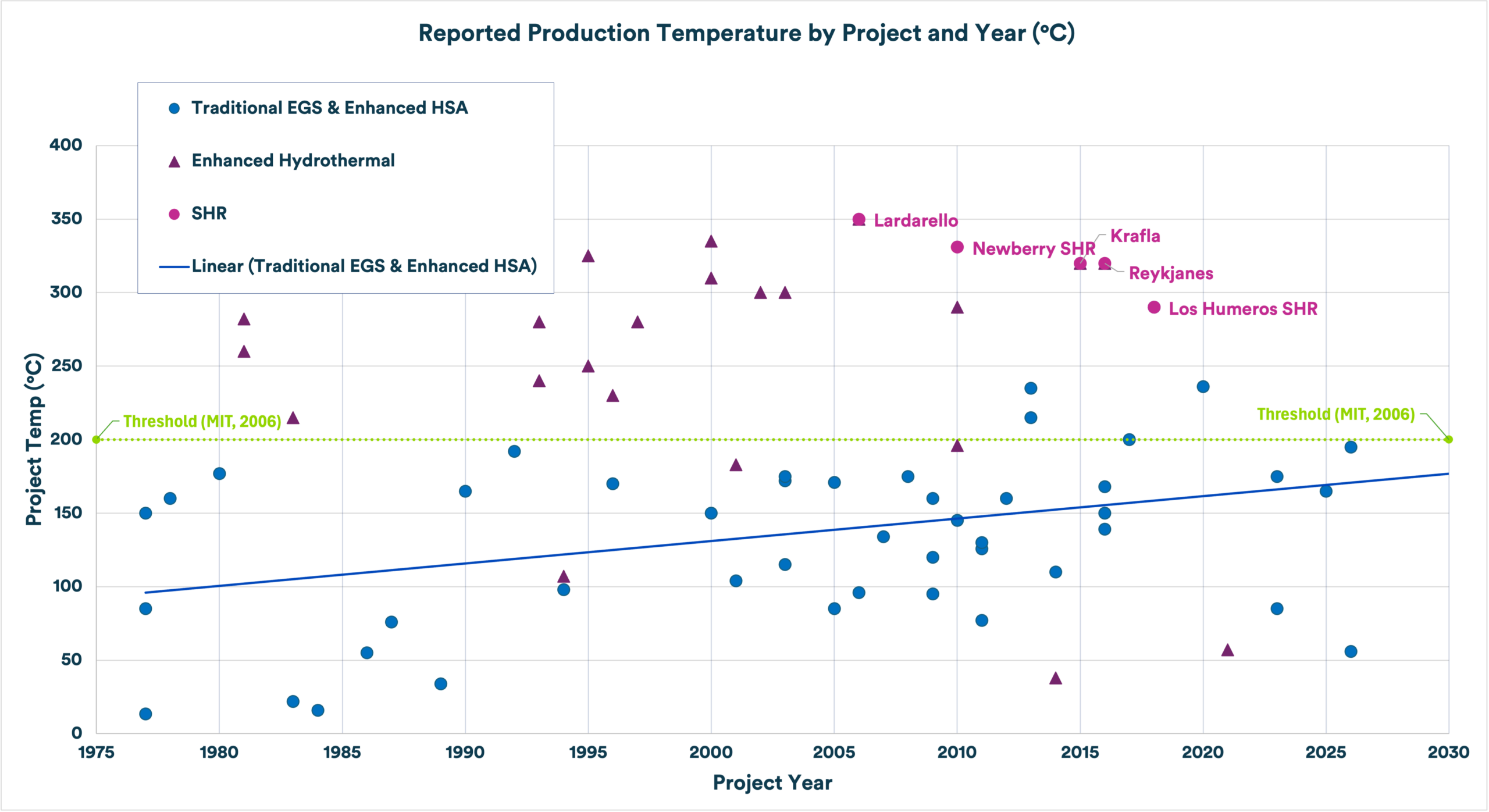
While that trend has begun to accelerate in countries such as Iceland, New Zealand, Japan, and the United States, the reason is noteworthy. These countries possess some of the world’s hottest geothermal expertise and understand better than most the technical difficulty, uncertainty, and cost associated with pursuing increasingly higher-temperature resources. Yet they continue to invest public research dollars and institutional capacity into superhot development because the potential reward is evident and substantial. Higher-enthalpy resources offer the possibility of producing significantly more power from each well, reducing the number of wells required per project, improving power conversion efficiency, and ultimately lowering the cost of electricity. Just as importantly, they unlock access to a vastly larger portion of the geothermal resource base than is available through today’s commercial systems. In short, some of the world’s most experienced geothermal nations are placing a deliberate bet that deeper and hotter resources represent the next major step change in geothermal economics.
Their willingness to make that bet offers an important reminder: transformational industries do not emerge automatically. Left to purely incremental market forces, progress can be measured in generations rather than decades. The acceleration we are beginning to see today is not the result of patience; it’s the result of intentional investment, coordinated research, demonstration projects, and institutions willing to absorb risk in pursuit of a larger outcome. The opportunity before superhot geothermal is simply too significant to assume that organic evolution alone will deliver results at the pace required by growing energy demand, energy security concerns, and broader economic development goals.
The concept of proactive, collaborative, and sustained momentum for technological progress is not unique; in fact, it’s the concept that led to the unconventional oil and gas revolution. Looking back, it is tempting to view shale as a story of a few breakthrough technologies that suddenly unlocked vast new resources. In reality, the revolution was driven by something much larger: an ecosystem that intentionally learned together. This included public research programs that funded early experimentation, test sites that generated shared data, and investors that learned how to evaluate risk.1 All of this underpinned the operator’s ability to refine best practices through hundreds, if not thousands, of wells. The same lesson applies to superhot geothermal today: accelerating progress will likely require shared testbeds that generate open data, coordinated research programs that reduce technical uncertainty and early projects that demonstrate commercial viability.
The result was not simply technical success but an extraordinary reduction in cost and uncertainty that transformed unconventional gas from a niche resource into a dominant component of the North American energy system. As presented by Greg Leveille at the GeoTech Summit hosted by Clean Air Task Force and MIT Energy Initiative, the combination of shared learning platforms, aligned private-sector participation, and increasing standardization helped move unconventional resources from a marginal contributor to a mainstream energy source.
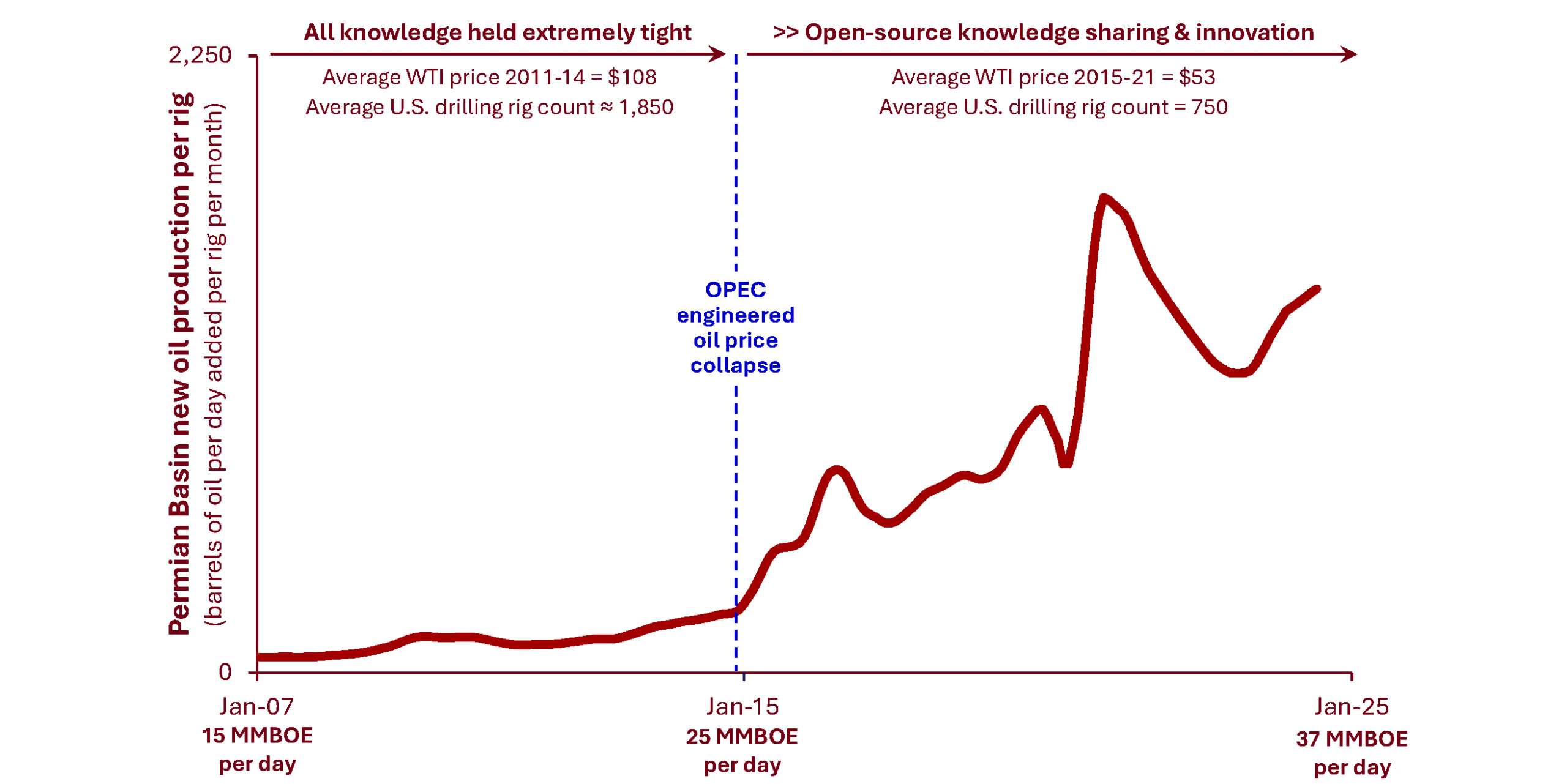
The lesson for superhot geothermal is clear: industries scale when they learn collectively. A lesson learned in Iceland should help avoid a costly mistake at a project in Oregon. A breakthrough in New Zealand should inform work underway in Japan. Competition will remain important, and intellectual property will continue to play a critical role. But when engineering challenges are significant, timelines matter; when the scale of the opportunity is global, progress often belongs to the ecosystems that learn fastest. Fast enough to drive down costs and unlock larger pools of investment. Fast enough to build supply chains, standardize equipment, and improve performance. And fast enough to help meet growing energy demand while the world still needs the solution.
That belief sits at the heart of the second Superhot Rock Geothermal Summit, hosted in Banff, Alberta from June 5–7. The purpose of the gathering is not simply to share presentations or celebrate progress. It is to create the conditions for accelerated learning. Researchers, developers, investors, and technical experts are brought together to tackle common challenges, advance shared frameworks, improve testbed design, and identify opportunities where collaboration can reduce risk and compress timelines. The goal is not consensus for its own sake. The goal is to ensure that valuable lessons travel through the community faster than they otherwise would.
Encouragingly, there is evidence that this approach is already working. The field looks noticeably different than it did eighteen months ago when CATF hosted the first Superhot Rock Geothermal Summit. At the time, number of organizations actively pursuing superhot geothermal projects could almost be counted on one hand. Today, the field includes a growing collection of developers, national laboratories, research institutions, governments, service companies, and investors. The pace of engagement has accelerated dramatically.
More projects are pursuing superhot resources. More investors are engaging with the sector. Governments are beginning to recognize the strategic value of ultra-high-temperature geothermal systems. Perhaps most importantly, the network itself has strengthened. Relationships formed through previous convenings are producing collaborations, technical exchanges, data-sharing efforts, and new project concepts.
The opportunity before us today is not simply to prove that superhot geothermal works. It is to organize the convergence already taking place between technology, talent, and capital. Investor interest is growing as well. The success of Fervo’s recent financing activities and broader market attention toward geothermal demonstrate that the sector is increasingly being viewed as a serious infrastructure opportunity rather than a niche corner of the energy industry. Geothermal is beginning to attract the scale of attention typically reserved for industries expected to deploy at meaningful scale. Looking ahead, forecasts suggest the sector could attract trillions of dollars of investment and hundreds of gigawatts of new capacity over the coming decades.
Those numbers are important not because they are guaranteed, but because they signal something larger: geothermal is no longer being discussed as a bespoke technology. It is increasingly being evaluated as an industry.
The question now is whether we can build the institutions, partnerships, demonstrations, and trusted networks necessary to accelerate commercialization. History suggests that transformative industries emerge when learning becomes systematic rather than accidental. If superhot geothermal follows that path, its future may be determined less by any single breakthrough and more by the collective ability of the industry to learn, adapt, and scale together.
That is ultimately what this summit is designed to accelerate. See more on the 2026 Superhot Rock Geothermal Summit here.
1 HFTS (Hydraulic Fracturing Test Site): A U.S. Department of Energy–supported field research program in the Permian Basin that brought together operators, service companies, national laboratories, and universities to collect high-quality field data on hydraulic fracturing. By generating shared datasets and improving understanding of subsurface behavior, HFTS helped accelerate learning across the unconventional oil and gas industry.

