
What is clean firm electricity, and why does it matter for decarbonizing the grid?


Decarbonizing the electricity system while meeting rising demand, minimizing costs, and managing infrastructure deployment risks is one of the central challenges of the energy transition. Wind, solar, storage, transmission, and demand-side solutions are indispensable, and scaling them significantly and quickly is essential. But evidence from decades of electricity system analysis shows that relying on these resources alone makes the path to a fully clean grid more challenging, expensive, and riskier than it needs to be.
As our new report from CATF report lays out, that is where clean firm generation technologies come in. By delivering clean electricity that is available whenever it is needed, independent of weather, clean firm resources – like geothermal, nuclear energy, and fossil generation with high levels of carbon capture – can reduce the scale of infrastructure required, lower total system costs, and expand the set of viable pathways to deep decarbonization.
Clean firm reduces the infrastructure buildout needed to reach a clean grid
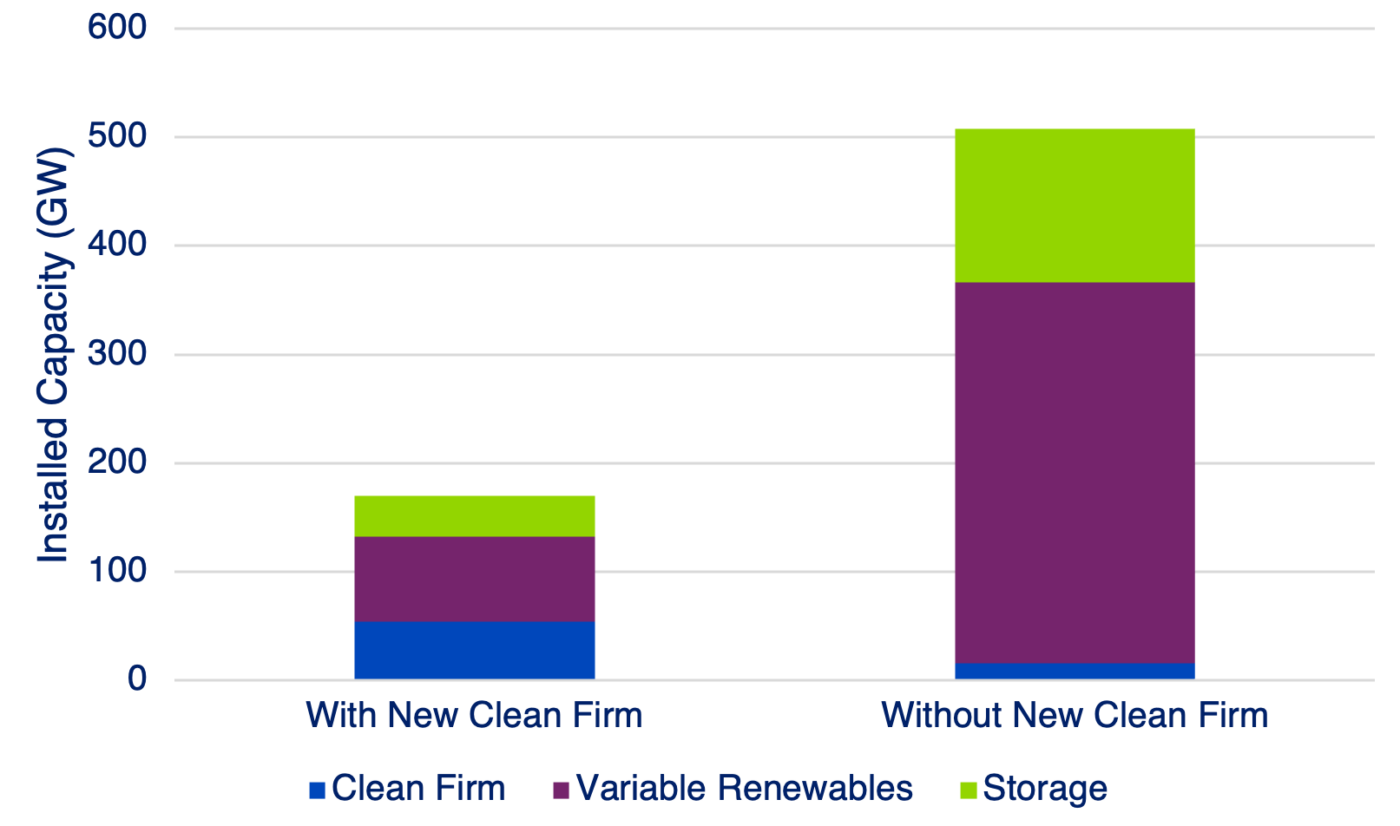
A large body of academic and industry system modeling shows that access to clean firm generation fundamentally alters how much wind, solar, storage, and transmission must be built to meet demand reliably (Figure 1). Because clean firm resources operate at high utilization rates, remain available during prolonged periods of low wind and solar output, and do not have seasonal generation patterns, they dramatically reduce the amount of clean energy resources needed to achieve decarbonization targets.
Across studies, adding clean firm capacity consistently shrinks total system buildout, reducing total generation, storage, and transmission capacity, cutting land use, material requirements, and critical mineral demand to deliver a fully decarbonized power system. In some high-electrification scenarios, each gigawatt of clean firm capacity offsets several gigawatts of variable renewables and storage that would otherwise be required.
Figure 1. Average installed capacity of clean firm power, variable renewables, and storage required to deliver 100% clean electricity in California in 2024 for scenarios with and without new-build clean firm options available, as analyzed by three different electricity system models.
Clean firm can lower the total cost of decarbonization, even when project costs are higher
Clean firm technologies often have higher project-level costs than wind and solar. But system-level analyses show that pathways without clean firm options face steep cost premiums. Fully decarbonized systems based solely on weather-dependent technologies must carry large amounts of generation and storage capacity that sit idle much of the year, significantly driving up total costs.
Reviews of dozens of modeling studies find that diversified power systems that include clean firm generation are significantly less expensive (often by tens of percent) than systems that rely almost exclusively on variable renewables, even under optimistic assumptions about future cost declines for renewables, storage, and transmission (Table 1). Clean firm resources reduce the cost of meeting seasonal and extreme-weather reliability requirements, which dominate costs in deeply decarbonized grids.
Table 1. Summary of calculated cost premiums of highly variable renewable cases compared to a more diversified generation mix in electricity studies.
Cost savings of a diversified generation mix relative to a high variable renewable energy (VRE) strategy: Electricity sector net-zero studies
| Study | Reported Cost Metric | Cases (% Energy from Wind & Solar) | Costs | Cost Savings |
| Sepulveda (2018) | Annual Electricity Cost (Two Regions) | VRE and Storage Only (100%) Low-C Firm Resources (20-40%) | $160 – $215/MWh $100 – $105/MWh | 40% – 50% |
| Clack (2019) | Annual Electricity Cost | Renewables Only (100%) 100% Carbon-Free (65%) | $155/MWh $95/MWh | 40% |
| Baik (2021) | Annual Electricity Cost | VRE and Storage Only (N/A%) All Options (N/A%) | $130 – $150/MWh $70-$95/MWh | 40% – 45% |
| Blanford (2021) | Incremental NPV of Cumulative Energy Services Costs | Renewables Only (95%) All Options (55%) | $0.75 T $0.3 T | 65% |
Clean firm strengthens decarbonization resilience by expanding the set of viable pathways
Electricity sector decarbonization faces persistent uncertainties: siting and permitting barriers, interconnection delays, supply-chain constraints, geopolitical shocks, uncertain technology costs, and unknown future demand growth. Clean firm generation technologies act as a system risk-management tool by lowering the overall scale of infrastructure required and by diversifying the technology mix.
By reducing reliance on any single pathway, clean firm options make decarbonization targets more achievable under real-world conditions, especially if one technology faces unexpected delays or constraints.
To unlock clean firm, we need policies and markets that value its attributes
To unlock the benefits of clean firm generation technologies, however, challenges facing their commercialization or deployment must be addressed. One initial barrier is the exclusion of clean firm generation technologies from clean electricity policy. Some government clean energy targets currently exclude clean firm technologies from eligibility for certain incentives, and some jurisdictions ban the deployment of certain forms of clean firm power altogether.
Beyond exclusion from existing policy frameworks, challenges facing clean firm generation commercialization and deployment include, but are not limited to, early-stage project costs and risks, policy gaps or uncertainty, and electricity system planning shortfalls. For technologies that are proven, such as existing nuclear technologies, next-generation geothermal, and carbon capture, these barriers have stymied deployment. For more nascent emerging technologies, these challenges have so far resulted in a persistent lack of early-commercial stage clean firm financing and, by extension, deployment and technology progress. This creates a negative feedback loop where near-term deployment deficiencies result in stagnant technological progress and continued perceptions of financial risk, further stunting deployment.
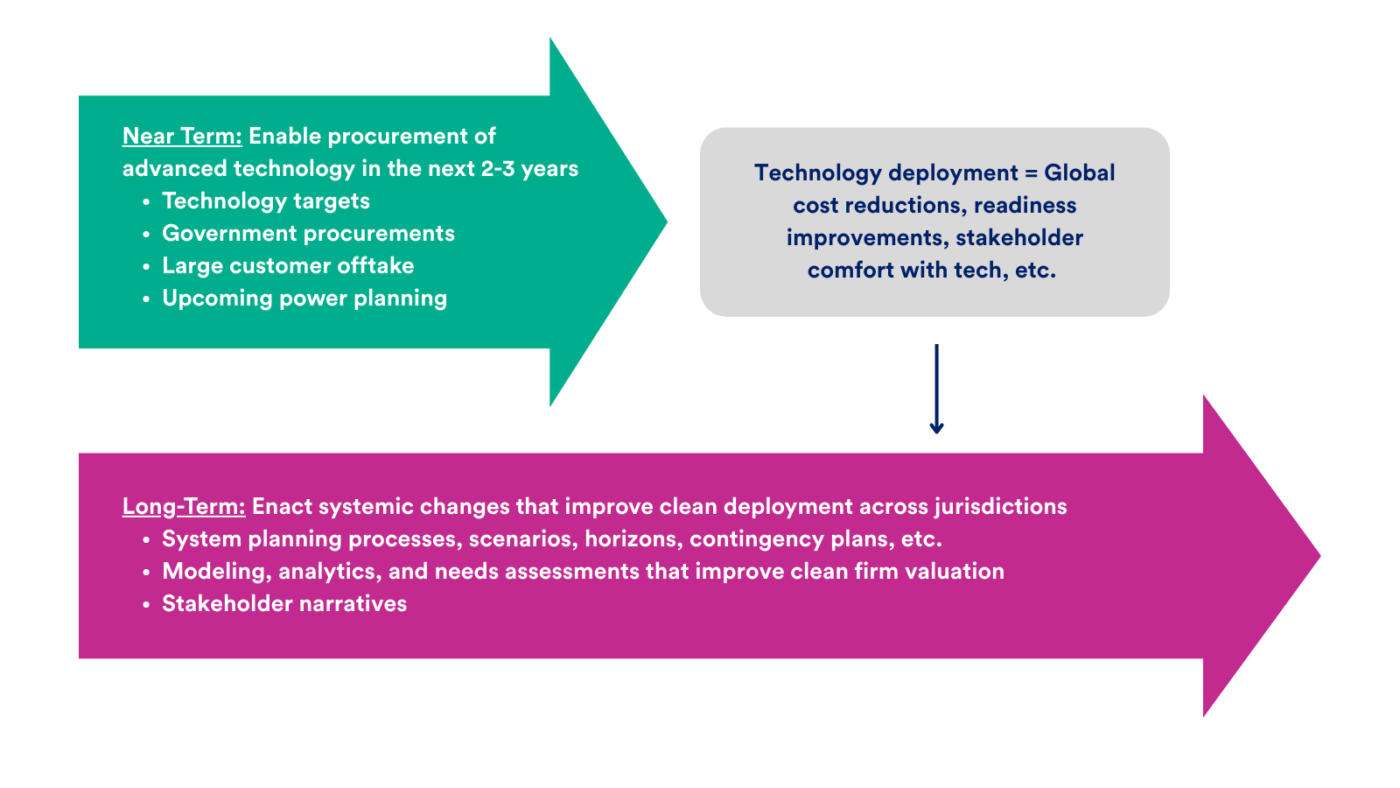
To help overcome near-term barriers and unlock the long-term benefits of clean firm power, policy levers are available across all levels of government. To achieve success, policymakers need to work along two parallel paths: first, enabling near-term deployment of clean firm generation technologies to support technology commercialization and cost reduction, and second, implementing long-term planning and policies that enable optimal integration of clean firm generation technologies into the electricity sector (Figure 2).
Figure 2. Near- and long-term strategies to advance clean firm generation technologies.
The commercialization of clean firm power technologies must serve as a complement – not a substitute – for ambitious reforms that directly address near-term deployment barriers for currently commercialized clean technologies, like solar, wind, and storage. Most clean firm generation technologies will not be widely deployable in the next five years to meet near-term load growth, where other solutions are more suitable. Moreover, even with cost-effective and available clean firm generation technologies, significant buildout of renewables, storage, transmission, and demand response will be needed in the long-term. But if the commercialization of clean firm generation technologies can be accelerated in the near term, their future availability will help the electricity system decarbonize faster, more affordably, and with resilience.
Learn more about our policy recommendations here.

