

Industrial Innovation Policy Playbook in action: From California to Texas


Earlier this year, CATF developed the State Industrial Policy Playbook, a state-focused resource for policymakers seeking to advance industrial innovation. The playbook offers a framework for states by outlining technology pathways and a policy menu that can be tailored to different political, economic, and industrial contexts, designed to be applied in states as different as California and Texas.
The industrial landscape in California and Texas
Heavy industry plays a critical role in both California’s and Texas’ economies. In both states, industrial activity underpins jobs, tax revenue, and supply chains, but also accounts for a substantial share of greenhouse gas emissions and local air pollution. Heavy industry, including the petroleum refining, chemicals, cement, and steel sectors must modernize to ensure economic security, innovate to enable growth, and stay competitive in the global trade environment. The challenge for policymakers in both states is how to enable an innovative industrial sector in a way that aligns with each state’s economic and policy environments.
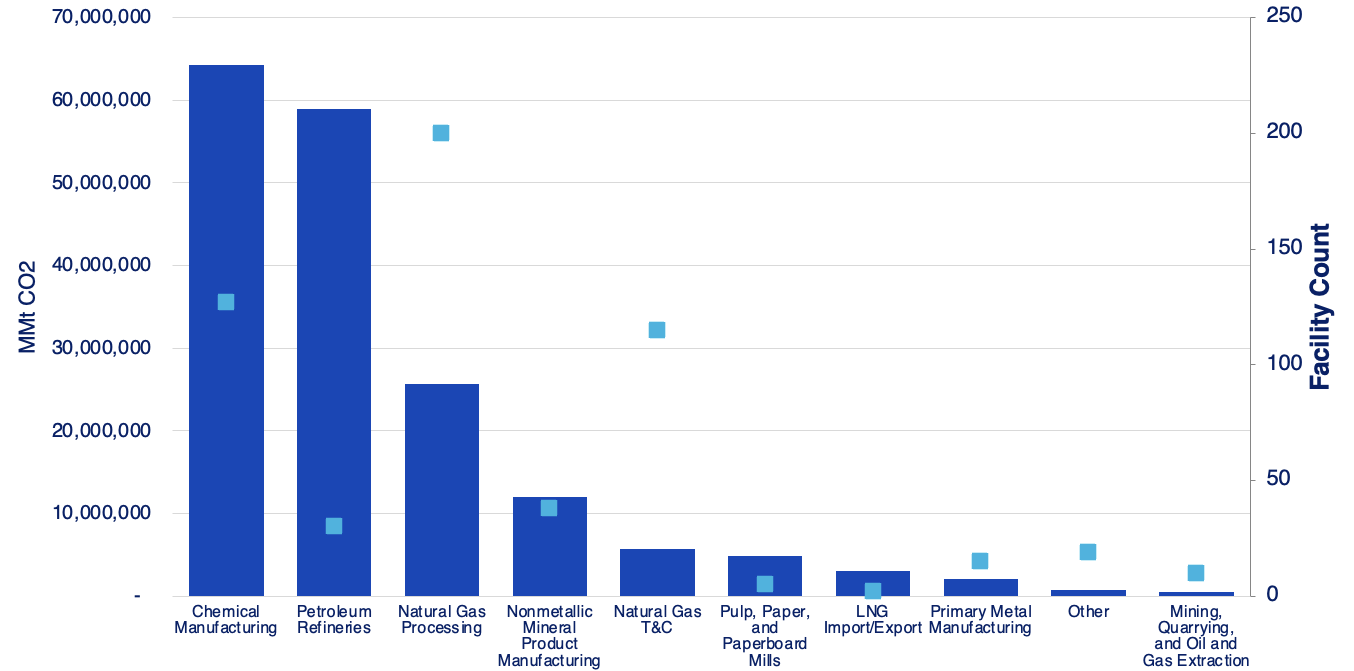
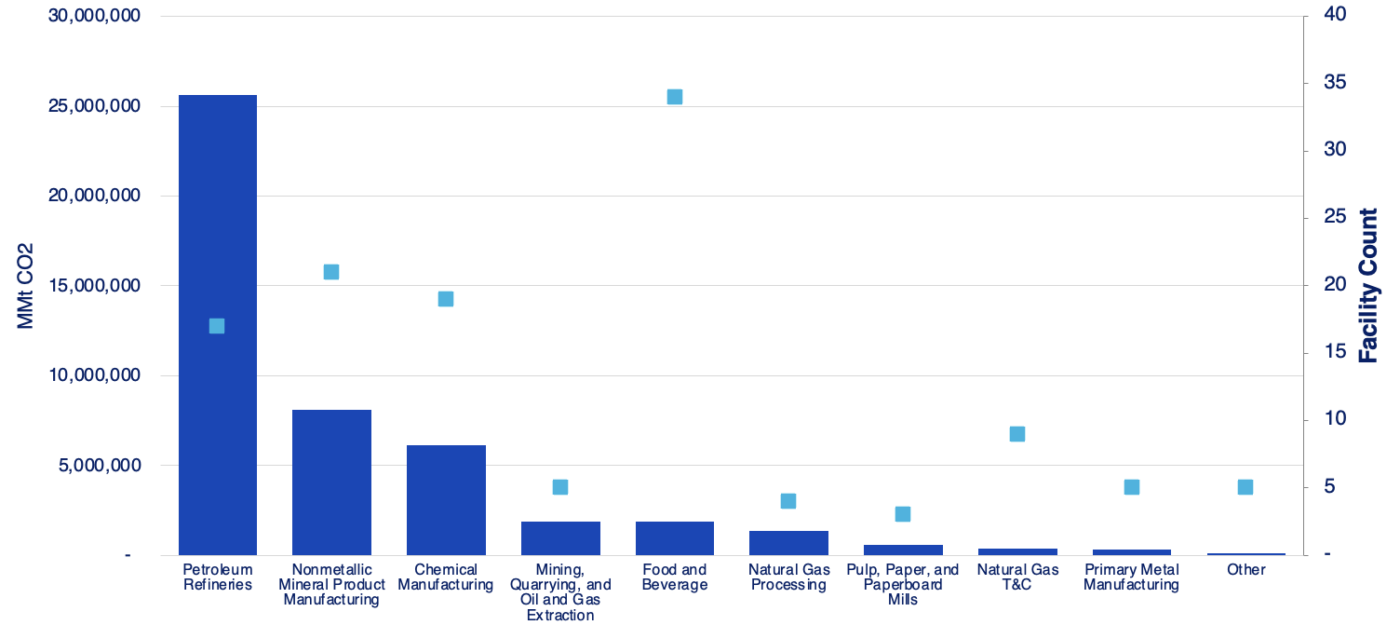
The composition of the industrial base and the forces shaping the future of industry, however, look different in each state. Texas is the nation’s highest-emitting state with roughly 236 million metric tons (MMt) of CO2 per year from heavy industry, more than twice that of any other state. Its industrial profile is dominated by refining, petrochemicals, and cement with a globally competitive chemicals sector. Texas’s emission reductions projects are largely driven by company-led initiatives and global market pressures. California’s industrial carbon footprint is smaller but still significant, emitting roughly 61 million metric tons of CO2 annually, making the state the third highest industrial emitting state in the country. The state remains a major refiner and cement producer but with a comparatively smaller chemical and steel base. Unlike Texas, California’s decarbonization is primarily policy-led, reflecting the state’s dual focus on greenhouse gas reductions and air pollution.
Texas emissions
California emissions
Same technology pathways, different applications
Across the refining, chemicals, cement, and steel sectors, the core technology pathways for industrial emissions reductions are largely the same. The playbook highlights electrification; carbon capture, utilization, and storage (CCUS); alternative production processes; feedstock substitutions; alternative fuels; and energy and material efficiency as primary pathways for reducing industrial emissions. While these pathways are broadly applicable, their commercial readiness, relative costs, and infrastructure requirements shape how they are deployed. As a result, the primary distinction between California and Texas lies in how these tools are applied and prioritized.
In both states, efficiency improvements, low-emission fuels, and CCUS for refining and cement are near-term opportunities. Many of these technologies are already commercially available or close to scale and can deliver meaningful emissions reduction when paired with supportive policy. California’s industrial profile and cleaner power grid make electrification a stronger option in certain applications, alongside CCUS and next-generation low-emission cements. Texas, by contrast, is likely to place greater emphasis on CCUS and low-emission hydrogen, particularly for refining and petrochemical facilities, leveraging its infrastructure, geologic storage potential, and low-cost natural gas.
The playbook emphasizes evaluating technologies based on sector fit and readiness. Some pathways are ready to scale with policy support today, while others require continued research, development, and demonstration before broad deployment. Both states will need a mix of near-term deployment and long-term innovation.
A bipartisan menu of policy pathways
Technology innovation alone will not drive industrial emissions reduction. States must create the conditions for investment and deployment. The playbook organizes state policy tools into four complementary categories that are applicable across political contexts.
First, driving innovation through financial support helps de-risk emerging technologies and catalyze private investment. State tax incentives, targeted technology funding, and technical assistance can close the cost gap and accelerate deployment. In Texas, existing programs such as the Texas Emissions Reduction Plan (TERP) are largely oriented towards combustion-based emission reductions and hydrogen use in transportation, leaving significant industrial opportunities underutilized. Texas could expand eligibility within TERP and other state programs to explicitly support industrial applications, such as carbon capture retrofits, switching to low-emission hydrogen in refineries and chemical plants, and electrification where feasible. Further, Texas can ensure that clean projects are eligible for the same tax exemptions and credits historically available to oil and gas.
In California, early low-emission industry funding already exists through programs such as the California Energy Commission’s Industrial Decarbonization and Improvement of Grid Operations (INDIGO) program and other state-administered climate and innovation funds, but these resources remain limited in scale and scope. Additional state funding is likely needed to support a broader range of industrial applications, including first-of-a-kind deployments and technologies that fall between research and full commercialization. Expanding eligibility, increasing total funding, and exploring low-cost financing tools could help accelerate deployment while leveraging private capital.
Second, stimulating demand for low-emission products reduces investment risk and creates durable markets for cleaner materials. Demand-side policies like environmental product declarations (EPDs) requirements or assistance programs, preferential bidding, long-term procurement commitments, and contracts for difference help create reliable markets and price certainty. California already leads the nation through Buy Clean policies, which require EPDs and set embodied carbon limits for state-funded construction materials. The state can progressively tighten these limits over time as technology improves and can coordinate with in-state manufacturers to ensure procurement rules align with production timelines and technology readiness. California can also leverage advanced market commitments to create stable demand for low-emission cement.
In Texas, stimulating demand is critical to turning industrial scale into a competitive advantage in increasingly low-emission global markets. While Texas has historically relied on low-cost and abundant energy to attract industry, export-oriented sectors are increasingly sensitive to pressure from international buyers seeking lower-emission products. Texas can respond by deploying targeted demand-side tools that reduce investment risk without mandating outcomes. For example, the state could support a voluntary buyers’ coalition with large industrial customers, manufacturers, and ports to aggregate demand for lower-emission materials, helping facilities justify capital investments. Texas could also establish a technical assistance program to support EPD development and verification, lowering barriers for industrial producers entering low-emission markets.
Third, enabling action through streamlined regulation and improved standards removes barriers to deployment and creates certainty for developers and investors. Permitting and siting reforms, coordinated infrastructure corridors, and performance-based material standards can all reduce delays and uncertainty. In Texas, facilities pursuing carbon capture or alternative fuels must navigate multiple permitting processes often with unclear timelines and overlapping requirements. Establishing a clear, coordinated permitting process at the Texas Commission on Environmental Quality for these large-scale projects could significantly reduce delays and investment risk. Additionally, Texas could support infrastructure deployment by pre-clearing rights-of-ways for CO2 and hydrogen pipelines, standardizing siting requirements, and aligning permitting reviews for infrastructure.
In California, regulatory clarity is critical both for industrial facilities pursuing capital-intensive emissions reduction projects and for ensuring strong, enforceable protections for surrounding communities. Clear guidance on how existing air-permitting requirements (e.g., Best Available Control Technology determinations) apply to technologies such as CCUS can reduce uncertainty while maintaining rigorous air-quality safeguards.
The state took a critical step in extending its Cap-and-Invest program to 2045 this past year. Providing clear guidance on how emissions reduction technologies such as CCUS are treated under the program can help align compliance pathways and investment signals with the state’s carbon management targets and carbon neutrality goals.
Finally, data, monitoring, compliance, and stakeholder engagement are cross-cutting foundations that underpin successful policy. California already has one of the most robust industrial data and reporting systems in the country through its Mandatory Reporting Regulation and community air monitoring. California can better integrate and apply existing data into policy design through aligning industrial performance benchmarks across programs, embedding evaluation requirements into incentive and procurement programs, and deepening stakeholder engagement.
By contrast, Texas has a fragmented industrial data landscape spread across federal reporting programs and state permitting processes. Texas could improve transparency and accountability by consolidating emissions and performance data, embedding reporting requirements into state incentive programs, and ensuring public investment delivers measurable benefits. This foundational step would built credibility and stakeholder confidence in state investments.
Conclusion
California and Texas approach innovation in the industrial sector from different political and economic realities, but both states have powerful tools at their disposal they can use to modernize. CATF’s State Industrial Policy Playbook shows how states, including those as different as Texas and California, can pair sector-specific technologies with pragmatic policy pathways to lower emissions in heavy industry. Applied thoughtfully, this framework can help states across the political spectrum reduce emissions while strengthening economic competitiveness, protecting jobs, and positioning their industrial sectors for decades to come.

