

Interconnection reforms and processes across the Atlantic: A primer
This primer was authored by Cameron Dehmlow Dunne.
Interconnection queues across the United States and the United Kingdom have become significantly backlogged, with over 2,500 gigawatts (GW) of generation and storage awaiting connection in the U.S. and over 750 GW in the UK.1 These backlogs have doubled project wait times to five years or more, threatening national energy policies, achievement of climate targets, and efficient capital allocation.2
In response, grid regulators on both sides of the Atlantic are shifting away from the legacy “first come, first served” model, which encouraged developers to get projects “in line” even if those projects were not necessarily build-ready.3 While specific approaches vary, the reforms converge on two core principles:
- A Shift to “First Ready, First Served”: The old serial study process, where projects were analyzed one by one, is being replaced by a cluster or batch study approach.4 This allows grid operators to study groups of projects simultaneously, increasing efficiency and reducing the cascading delays caused by the withdrawal of a single project.
- Financial and Commercial Requirements: To ensure developers are serious about building and not speculatively holding queue spots, reforms impose significant upfront financial commitments. These include large, non-refundable deposits for studies, escalating commercial readiness payments at key milestones, and penalties for projects that withdraw late in the process.
These reforms, proposed and adopted over the past several years, are designed to filter out speculative projects and prioritize those that are commercially mature and ready to build.5 Weeding out stalled projects from the queue and encouraging developers to submit interconnection requests only for projects that have the greatest potential to be built going forward, will help shorten wait times and streamline the queue for projects needed in both countries to decarbonize and improve reliability of grids.
A Transatlantic Difference: Guiding Principles
The U.S. and the UK share an urgency and interest in reforming their interconnection queue processes, and proposed reforms align with the core principles noted above. However, reforms in the two countries do differ in the underlying prioritization of who gets to connect to the grid and why.
United States’ “Just and Reasonable” Open Access: U.S. reforms are grounded in the Federal Power Act’s mandate for “just, reasonable, and not unduly discriminatory” grid access.6 The baseline established by the Federal Energy Regulatory Commission’s (FERC) Order No. 2023 is a “first ready, first served” model where any project that meets the objective readiness criteria has an equal right to be studied.7 However, in acutely constrained regions like California, FERC has approved more scrutinizing triage-based systems that prioritize projects based both on readiness and alignment with state policy goals, signaling a potential divergence in the open access approach.8
United Kingdom’s “Ready and Needed” Grid Priorities: The National Energy System Operator (NESO) has adopted a “first ready and needed, first connected” approach.9 This explicitly allows the system operator to prioritize projects that are not only commercially ready but also align with national policy targets, such as the Clean Power Action Plan.10 This shares the U.S. reforms’ emphasis on project readiness, but allows NESO to shape what types of energy resources are being connected to the grid.11
Comparative Analysis of Interconnection Processes
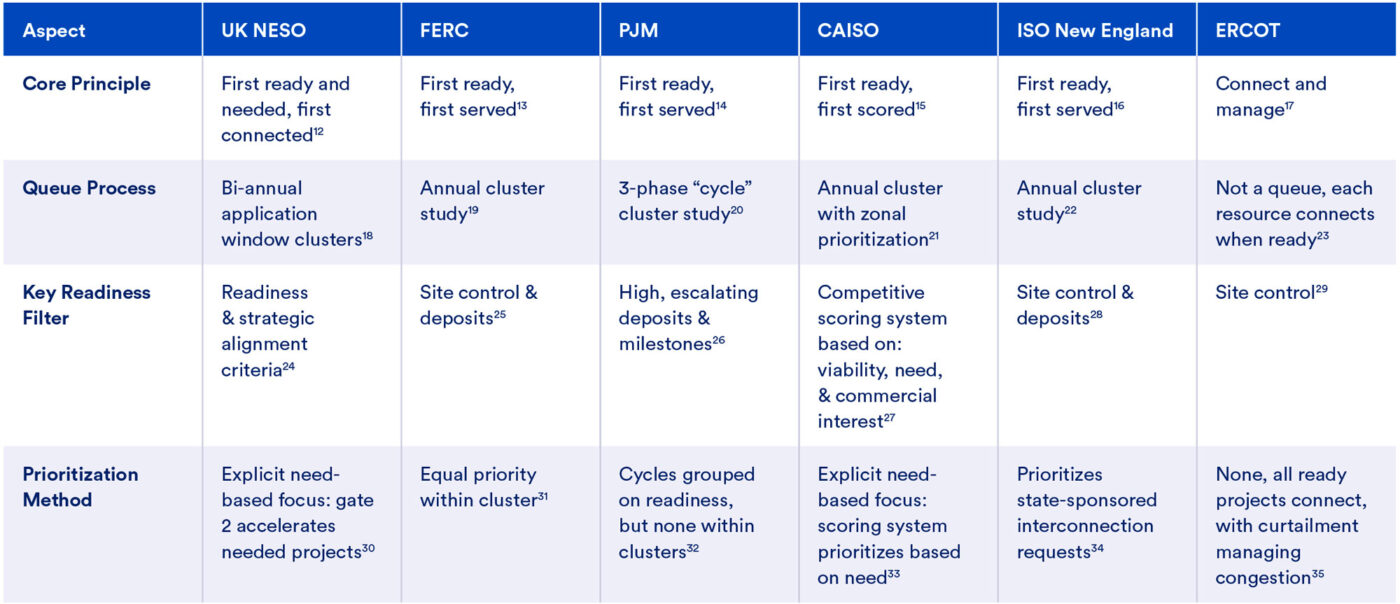
This table compares various aspects of interconnection processes. National level processes – facilitated through FERC in the U.S. and the UK’s NESO – are represented, as are several sub-national grid operators subject to FERC jurisdiction – the PJM Interconnection, New England’s Independent System Operator (ISO-NE), and the California Independent System Operator (CAISO).
Interestingly, in the U.S., not all grid operators are subject to federal jurisdiction and can therefore develop their own interconnection queue processes. This table includes one such non-FERC-jurisdictional grid operator – the Electric Reliability Council of Texas (ERCOT) – to highlight the diversity of interconnection processes in the country.
The definitions below provide more color on the “Aspects” outlined in the table.
Core Principle: The guiding policy behind interconnection reform.
Queue Process: What approach the reform takes to the interconnection queue. “Cluster” means that the grid operator is evaluating a group of projects at the same time.
Key Readiness Filter: How each grid operator determines if a project proceeds in the interconnection process.
Prioritization Method: What, if any, criteria the grid operator uses for getting certain resources interconnected faster.
Link to System-Wide Resource Planning: What, if any, link the interconnection reform has to achieving resource planning goals, such as clean energy targets.
Considerations for National and Regional Grid Operators
Although inherently influenced by local policies and priorities, grid operators considering interconnection queue reforms can look to the following notes to contextualize differences in approaches and implementation in the U.S. and the UK to-date. Going forward, operators should continue to share best practices and challenges in implementation to support infrastructure deployment worldwide.
Defining the Pace of the Energy Transition: The divergence in the U.S. and UK models of “First ready, first served” and “First ready and needed, first connected” illustrate a key difference in policy priorities, with significant implications for connecting clean resources. U.S. grid operators are generally more concerned with getting as much generation connected to the grid as possible, whereas the UK model offers the government more control over what types of generating resources they prioritize. This explicitly accelerates projects aligned with national policy, allowing the government to directly shape the grid’s resource mix.
The Rise of Hybrid Models in Constrained Regions: The standard U.S. model is not uniformly applied. In regions with acute constraints and ambitious policy goals, such as California, operators are adopting hybrid approaches. CAISO’s “first ready, first scored” system prioritizes projects based on their viability and their alignment with state resource plans, moving beyond simple readiness. This suggests that even within the U.S. framework, operators facing a combination of significant queue backlogs and specific state-set mandates may find it necessary to implement more discerning, prioritization-based queue management.
Integrating Interconnection with System Planning: Another key differentiator is the linkage between the interconnection queue and broader resource planning. For many U.S. operators, this link remains minimal or indirect, though FERC Order 1920 requires planners to take the interconnection queue into account when planning. This separation could lead to a disjointed build-out where resources that are ready, but out of step with state priorities, are connected. Conversely, the reforms in the UK, and to some extent in CAISO, demonstrate the power of directly tying interconnection to national or state-level resource plans. This integration allows operators to proactively manage their queues to meet clean energy targets while speeding up queue wait times. Successful integration of interconnection into system planning processes would require enhanced coordination between relevant authorities and government departments, not only to align planning and interconnection policies with policy priorities, but also to assess and prioritize projects.
[1] See NESO, Great Britain’s Connections Reform: Overview Document, 5; Berkeley Lab, Queued Up: Characteristics of Power Plants Seeking Transmission Interconnection
[2] See NESO supra 1 and Berkeley Lab supra 1.
[3] See NESO supra 1; FERC Order No. 2023, 61.
[4] See Table 1.
[5] See NESO supra 1; FERC Order No. 2023, 490.
[6] See Federal Power Act Sections 205(a)-(b) and 206(a), 50-53.
[7] See FERC Order No. 2023, 61.
[8] See FERC Order on Tariff Revisions re California Independent System Operator Corporation under ER24-2671, 49.
[9] See Norton Rose Fulbright, “First Ready, First Connected”: Reform to GB Electricity Grid Connections.
[10] See Id.
[11] See Id.
[12] See NESO, Great Britain’s Connections Reform: Overview Document, 5
[13] See FERC Order No. 2023, 61.
[14] See PJM, Generation Interconnection Fact Sheet, 1. PJM also recently created a short-term reliability initiative to allow certain shovel-ready projects to advance regardless of queue position. See FERC Accepts Two PJM Proposals To Expedite Supply Additions.
[15] See FERC Order on Tariff Revisions re California Independent System Operator Corporation under ER24-2671, 82.
[16] See 191 FERC ¶ 61,018, 3
[17] See Fernandes, ERCOT Interconnection Process: Generation Entity Winter Weather Preparedness Workshop, at 2, (Oct. 2024).
[18] See NESO, Great Britain’s Connections Reform: Overview Document, 19.
[19] See FERC Order No. 2023, 61.
[20] See 190 FERC ¶ 61,084, 2.
[21] See FERC Order on Tariff Revisions re California Independent System Operator Corporation under ER24-2671, 26.
[22] See 191 FERC ¶ 61,018, 5-6.
[23] See Fernandes, supra 17, at 2.
[24] See NESO, Great Britain’s Connections Reform: Overview Document, 6.
[25] See FERC Order No. 2023, 6.
[26] See 190 FERC ¶ 61,084, 103.
[27] See FERC Order on Tariff Revisions re California Independent System Operator Corporation under ER24-2671, 45, 49, 71.
[28] See 191 FERC ¶ 61,018, 54, 62.
[29] See ERCOT, ERCOT Planning Guide, at 5-23 (Mar. 2021).
[30] See NESO, Great Britain’s Connections Reform: Overview Document, 102.
[31] See FERC Order No. 2023, 5.
[32] See Lankford and Grant, FERC Approves PJM Interconnection Process Reforms to Address Backlog.
[33] See FERC Order on Tariff Revisions re California Independent System Operator Corporation under ER24-2671, 49.
[34] See 191 FERC ¶ 61,018, 37.
[35] See Howland, Can ERCOT show the way to faster and cheaper grid interconnection?, Utility Dive, (Nov. 2023).

