Our Work
Advanced nuclear energy in Europe
Europe needs large amounts of reliable, clean energy to meet its climate, economic, and energy security goals.
Nuclear energy can deliver reliable, around-the-clock power – but only if Europe replaces one-off projects with a proven industrial model: standardised reactor fleets built at scale through repetition.

Our approach
We provide the evidence, practical frameworks, and convening platforms needed to enable fleet-scale nuclear energy deployment. Through independent, first-of-a-kind research on deployment economics, licensing pathways, financing structures, and orderbook models, CATF helps decision makers understand why a fleet approach is essential and how to put it into practice.
CATF is uniquely positioned to give decision makers the analytical foundation and practical pathways needed to turn ambition into firm commitments for advanced nuclear energy deployment in Europe.
CATF is part of the Nuclear Scaling Initiative, which aims to build a new nuclear energy ecosystem that can quickly and economically scale to 50+ gigawatts of safe and secure nuclear energy globally per year by the 2030s.

the European Nuclear Energy Landscape
An expensive, uncoordinated approach…
Europe’s current approach to deploying new nuclear energy increases costs and delays projects, preventing capacity from reaching the grid at the pace and scale needed to decarbonise, meet growing demand, and strengthen energy security.
…needs a proven solution
A nuclear reactor fleet delivered through an orderbook model that creates durable demand, enables supply-chain expansion, supports long-term deployment, and reduces costs and project timelines.
We focus on three barriers to nuclear energy deployment
The challenge
Europe’s nuclear energy ambitions suffer from a lack of coordination, resulting in cost overruns and project delays. In addition, the actual cost savings of a fleet of small modular reactors (SMRs) in Europe is unknown – policymakers need modeling and data to inform decisions.
The solution
A fleet approach to nuclear energy, where buyers and utilities coordinate around a series of standardised reactor orders and deployments, creates the durable demand signals needed to build new nuclear energy at scale. Capturing the full economic potential of large reactors and SMRs requires robust data and predictive modelling to quantify how costs fall with repetition, standardisation, and learning accumulated across a fleet.
The challenge
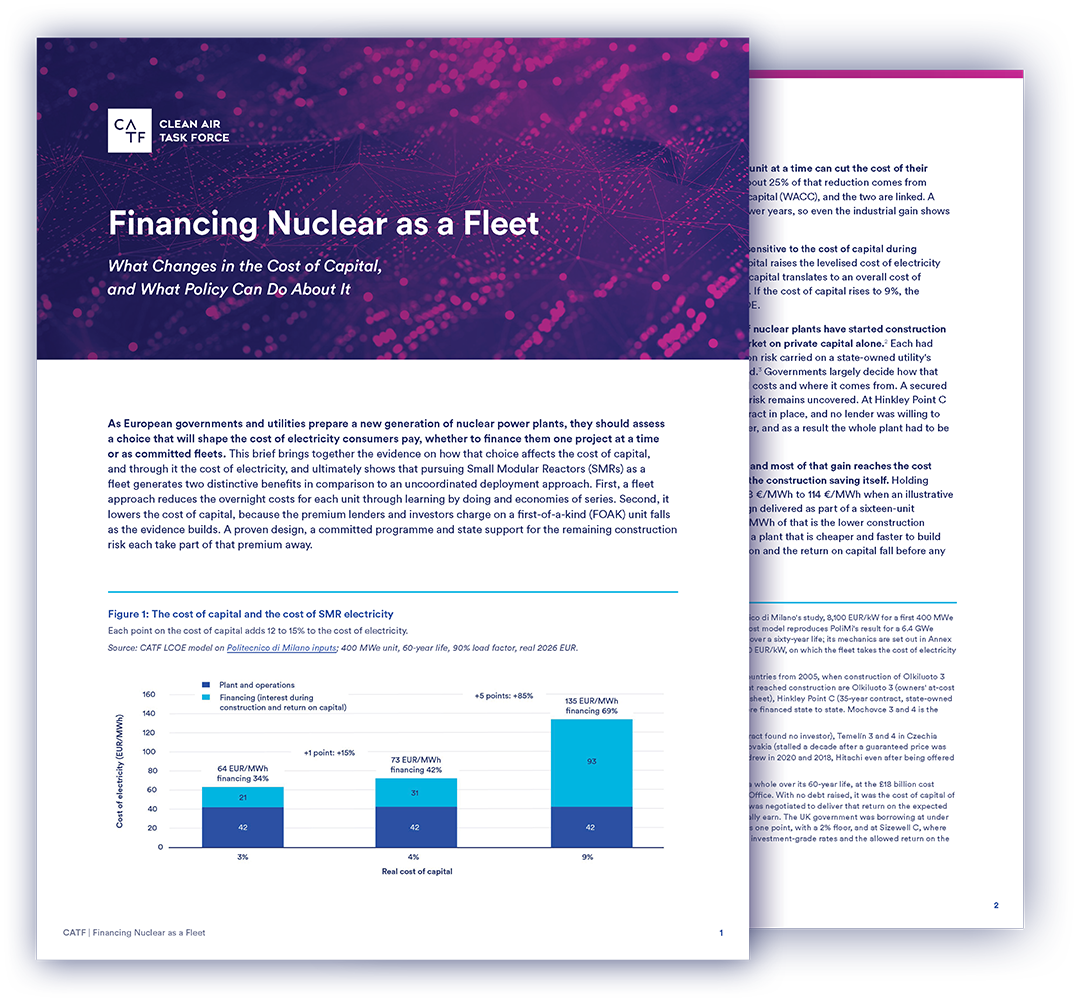
Nuclear projects are capital-intensive with long build times, so their cost is driven largely by the cost of capital, yet construction and market risk keep private finance on the sidelines unless governments absorb much of that risk. In the EU this leaves financing dependent on national balance sheets and case-by-case state aid approval, a slow and uncertain route. Meanwhile, EU funds remain largely limited to research, safety upgrades and decommissioning, and the proposal to make new fission eligible under the 2028–2034 European budget still faces opposition from some member states.
The solution
Finance new nuclear energy as a fleet, not plant by plant. A single programme-scale government commitment and support package would allow lenders to price the full series, lowering capital costs. A fleet financing facility could set common terms for state loans or guarantees, minimise or defer construction interest, leave remote construction risks with the state, and secure one State aid decision using existing national instruments.
The brief estimates that state-backed fleet financing could cut electricity costs by about 40% compared with a stand-alone first-of-a-kind plant, with three quarters of the savings from financing and the rest from serial construction.
The challenge
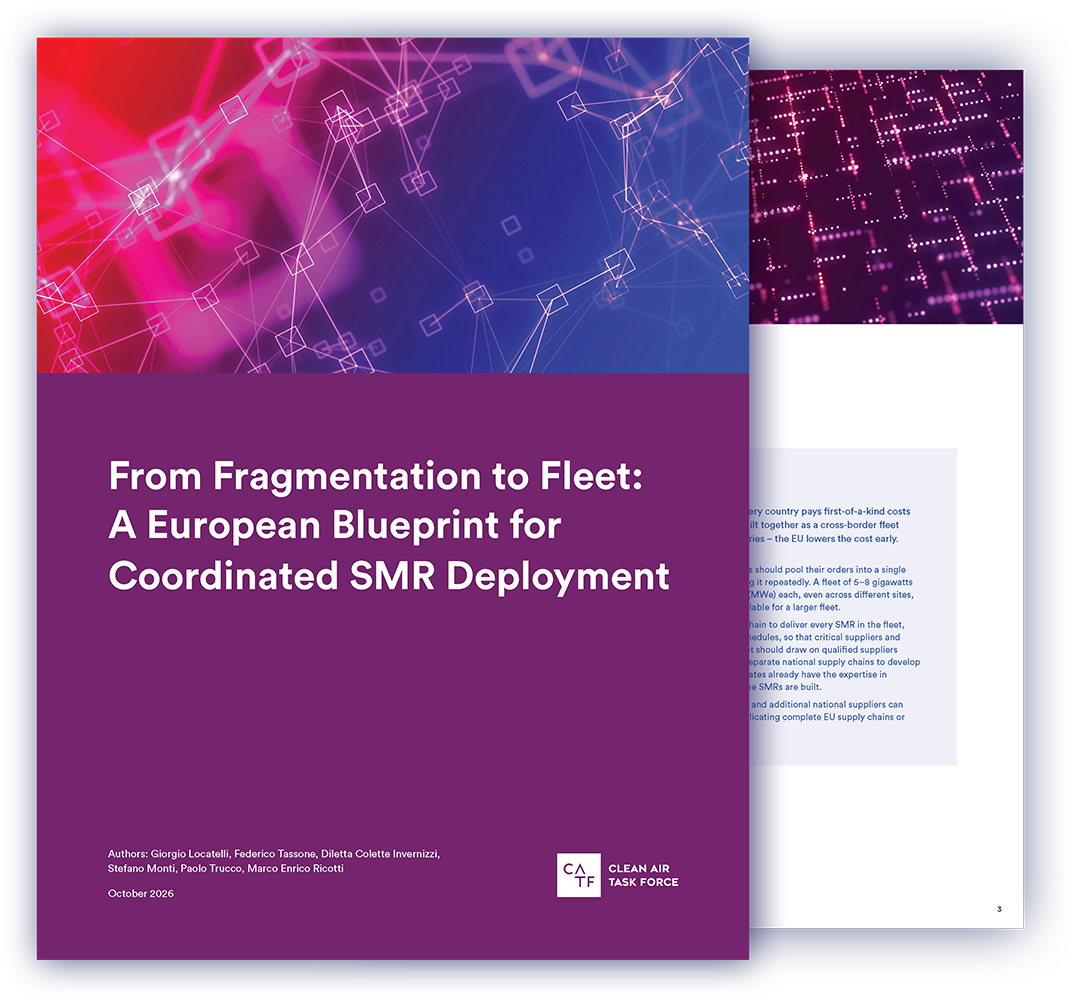
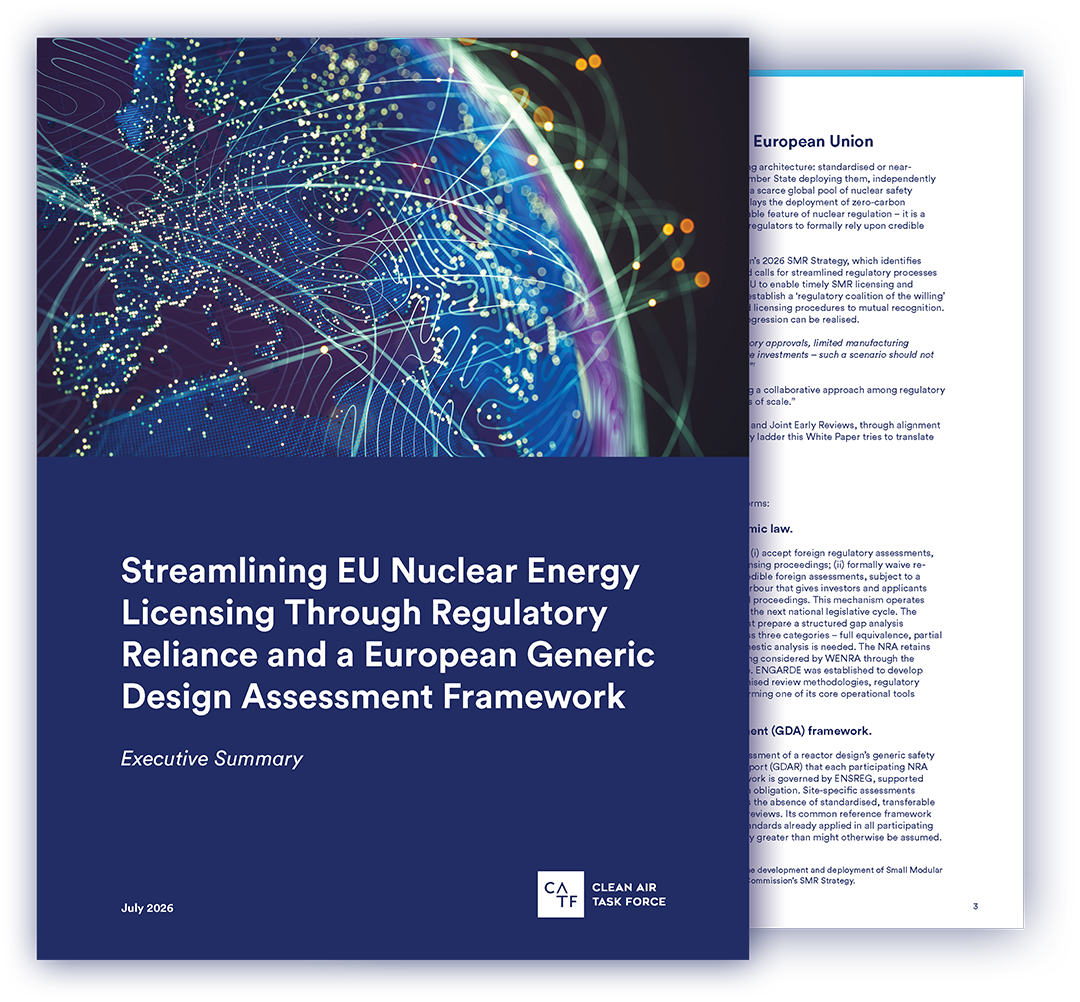
Europe still licenses nuclear plants one country at a time: a standardised reactor design deployed in six Member States is assessed six times, each time from first principles, which ties up scarce regulatory expertise, lengthens timelines, raises investment risk and forces country-specific changes that erode the standardisation SMR fleets depend on. Regulators already cooperate through joint early reviews of SMR designs, but the results have no legal effect, because national law generally gives a regulator no basis to accept another regulator’s assessment as evidence or to waive repeating the work.
The solution
The solution is to give that cooperation legal effect while leaving every licensing decision with the national regulator: a reliance clause in national atomic law would let the regulator accept credible foreign assessments as evidence and waive repeating the analysis where equivalent safety is demonstrated, a change each Member State can make on its own in its next legislative cycle. A voluntary European Generic Design Assessment, coordinated by ENSREG with Commission support, would then have willing regulators assess a design’s generic safety case once and each rely on the joint report at home, so that repeated national reviews become one common exercise with national adaptations and regulators can concentrate on site-specific questions.
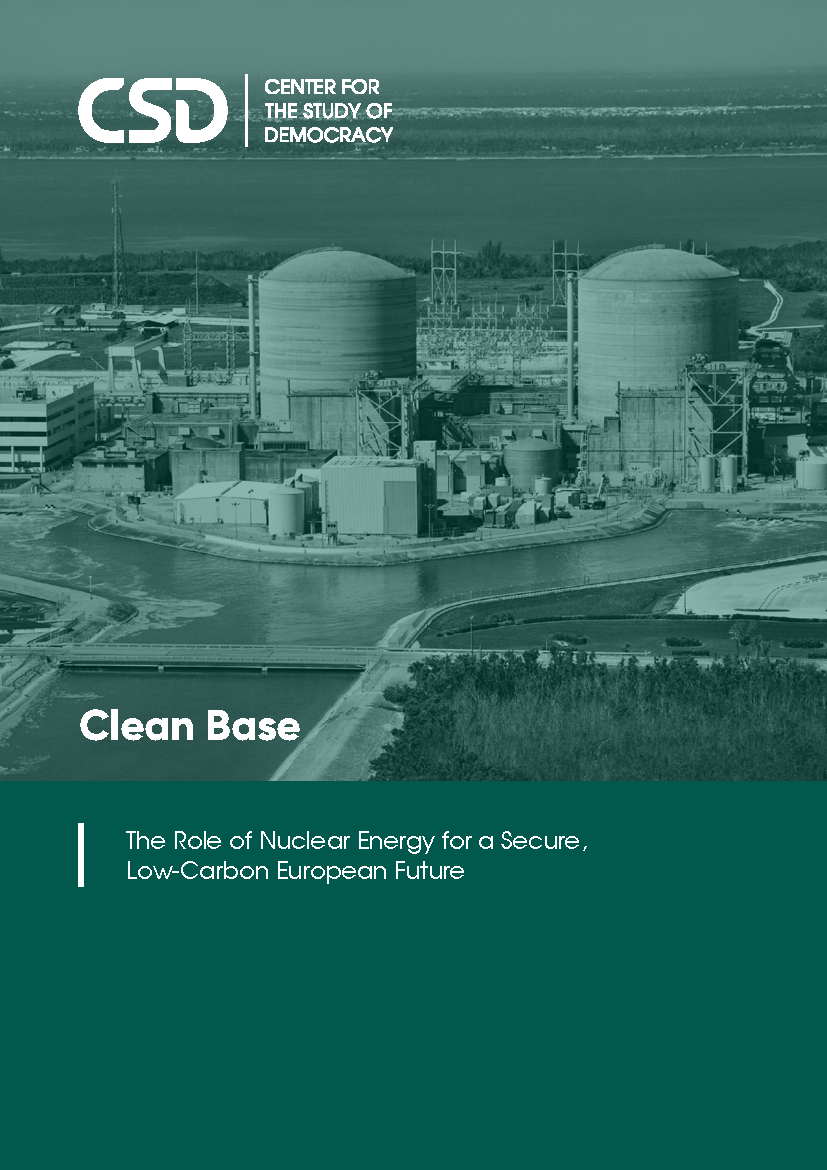
The EU continues to face rising energy security concerns. Advanced nuclear energy is part of the solution.
Read the update to the Center for the Study of Democracy’s acclaimed Energy Security Index – showing quantitatively how a diverse grid that includes nuclear energy directly increases a Member State’s energy security.
Our latest work to accelerate nuclear energy deployment in Europe









Sign up today to receive the latest content from CATF experts.
Related resources
Meet the experts
Meet our staff members working on advanced nuclear energy in Europe.